Blog

Life in the Gutter…

December 30th, 2010 by Lauren_Hunter_Nicoll | Posted in Blog | Comments Off on Life in the Gutter…
Tags: , ,

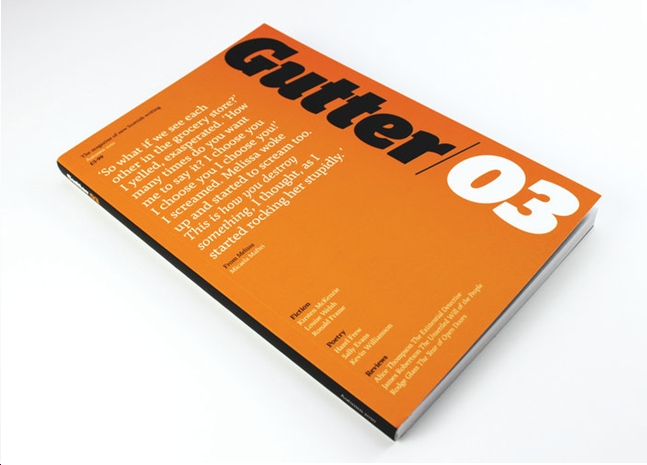
A literary journalist (who shall here rename nameless) overhead at the Wigtown book festival bemoaning the fact there were ‘no good writers under the age of forty-five in Scotland’, and a frustration at a lack of literary magazines exhibiting new Scottish writing, were the key factors which propelled editors Adrian Searle and Colin Begg to establish Scottish literary magazine Gutter.

Both editors recently visited Stirling University’s Publishing Studies centre to share their experiences about establishing the magazine and to provide an insight into the world of publishing.

As graduates from the University of Glasgow’s Masters in Creative Writing course, both Adrian and Colin highlighted the fact that beyond being published in the course’s annual anthology there were few outlets in Scotland for the publication of new writing with the demise of literary magazines such as Cutting Teeth and Cencrastus.

Gutter was established to fill this void. With the proviso to promote new and exciting Scottish writing, the magazine showcases emerging and established writing talent side by side. Published twice yearly, with the first issue launched in August 2008, recently published writers have included Alan Bissett, Patricia Ace and University of Stirling Royal Literary Fund Fellow Linda Cracknell.

Plans for the future include the publishing of a Gutter anthology and the continuation of Gutter events. This year saw a Gutter event ‘McSex’ at the Edinburgh International Book Festival, a night which explored the tradition of eroticism in Scottish Literature – think smutty prose and nipple tassels (the smutty prose from the writers/nipple tassels on the burlesque dancer, although the opposite could have been interesting!), and events at the National Library of Scotland and the Glasgow Aye Write! Book Festival.

With the most recent issue full of stories from Scottish writers such as Louise Welsh, Zoe Strachan and Ewan Morrison I think that particular literary critic’s assertion was perhaps slightly misguided; there are certainly lots of good writers in Scotland under forty-five… Gutter is proof of that.

Lauren Nicoll
Meet our current students…

December 21st, 2010 by cs48@stir.ac.uk | Posted in Blog | Comments Off on Meet our current students…
Tags: , , , ,

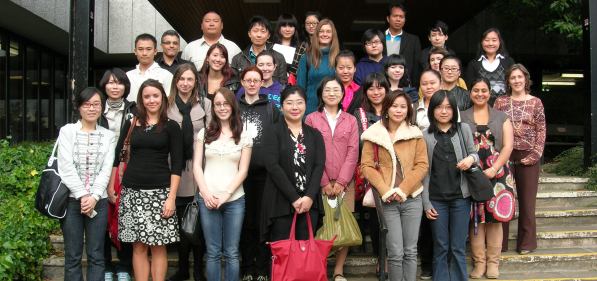
Back in September, we introduced you to our new cohort of students who joined us from around the world to study at the Stirling Centre for International Publishing and Communication.

Well, everyone is now taking a very well deserved rest after a busy semester gathering publishing skills, knowledge and experience, and hearing from an exciting range of visiting speakers. They’ve also been introducing themselves on our website, and you can find a range of student profiles here. As you’ll see, we’ve managed to attract students from around the world as well as tempting our own undergraduates one of whom, after surveying a number of different publishing courses, decided with great pleasure that she favoured Stirling most, and so decided to stay another year.

If you’re interested in coming to study with us for 2011-12, please do look at our study pages, and don’t hesitate to get in touch.

Scotland’s favourite national pastime: NOSTALGIA

December 15th, 2010 by Karen_Margaret_Raith | Posted in Blog | Comments Off on Scotland’s favourite national pastime: NOSTALGIA
Tags: , ,

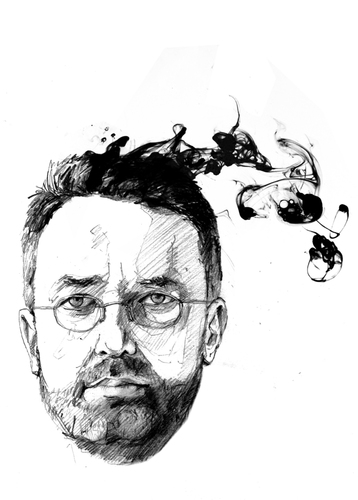
Adrian Searle by David Lemm

Over the past few decades, Scottish literature has become slightly repetitive.  As Liz Lochhead’s quote above affirms, Scots are continuously looking back at the good-old-days.  Kiddies getting milk at school, Ah- Bisto!, the fish man on Tuesdays and working in factories and mines.  Read James Kelman’s The Burn or Gregory Burke’s Gargarin Way, and you will be slapped in the face by a depressing (albeit brilliantly written) anti-Thatcherite society.  Although it has only been twenty years since Mrs Thatcher has been in power, perhaps it’s time to embrace the new literary scene.  Welcome to the spotlight Adrian Searle and Colin Begg, the creators of Gutter magazine.

On the 25th November, these two ambitious young men joined the publishing studies class at Stirling, to promote entrepreneurship and contemporary Scottish fiction.  In reaction to a nameless critic asserting that ‘there were no “young literary Turks” out there,’ Searle and Begg set out to prove that ‘the new writing scene in Scotland is bouncing’ [Hind].  Meeting each other at a Glasgow creative writing course, the double act teamed up to form literary magazine Gutter, which has been compared to industry heavy-hitters MacSweeny.  The magazine concerns quality writing that is well-presented.  Writers have included Louise Welsh, Ewan Morrison and Zoe Strachan.  Searle would love to snag Scottish literary royalty, Kelman, Agnes Owen or Douglas Dunn.  They ardently promote the value of intellectual thought, and aren’t afraid of injecting a bit of Scottish ‘cheek.’  One of their events has been called ‘McSex’ and assessed eroticism in Scottish literature.  Also, the current poem on their webpage concerns the couple of the moment, Prince Will and Kate Middleton.  Excerpts include,

Life may be grim, but bankers and toffs have misery at bay

With this assertion, create a diversion, a Royal wedding day.

[…]

So, welcome back the Tories and their Liberal rejects;

We’ve cuts and riots, it’s strangely quiet, but cardboard city’s next.

Searle with modesty maintains that he is ‘playing with publishing’ or as he quirkily deems it ‘micro-publishing.’  From a marketing and design background, he co-founded the Glasgow-based publishing house, Freight, in 2001.  He decided to self-commission projects, in order to have complete control over the creative process.  Freight has churns out rare titles, including The Hope that Kills Us: An Anthology of Scottish Football Fiction, Snacks after Swimming and The Knuckles End: A meaty Collection of New Scottish Writing.  They base themselves around Scottish writers, and the projects are visually stimulating, and have already received several accolades.  Again, Searle refers to the titles unpretentiously as ‘fairly self-indulgent.’  Freight enjoys a sense of humour in the creative process.  When naming the title Knuckle End it refers to an obnoxious assertion that Scotland is the ‘knuckle end’ of England – the leftovers that you might make soup from or throw to the dogs.  Wittily The Knuckle End is broken into two hardbacks joined in the middle by a knee joint: one section is on fictional short stories, the other a cow’s journey from the field to the abattoir.  Artistically, the text employs squint double columns, and uses vernacular typography, created by ‘non-designers.’  Colin Begg? Well, in his spare time – he’s a doctor.  Doesn’t it make you tired just hearing what they’re up to?

Inspirational and informative the talk had the students swigging their lattes and developing formative strategies for our own publishing houses.  Can’t wait to see what the boys are up to next.

PS: Now you’ve finished reading my blog go over to Gutter to subscribe to their mag, and read the rest of the poem On the Announcement of the Engagement of HRH Prince William & Miss Kate Middleton by Carl MacDougall (Parental Advisory Recommended).

Image copyright David Lemm, www.davidlemm.co.uk.

Karen Raith

Inspiring Paula Morris

December 12th, 2010 by Saskia_Spahn | Posted in Blog | Comments Off on Inspiring Paula Morris
Tags: ,

Personally, I have remained much inspired by the talk of Paula Morris, who was the last guest speaker of our series. Paula is an author and teaches Creative Writing at Stirling. In fact, listening to her felt like ‘Yes, I will write more myself’. Firstly, she addressed the myths people nourish about writers, e.g. the writer isolating themselves, being oblivious to the world, while, in fact, they have another job instead, to make a living. Also, there is the opinion they would compromise for anything that would stimulate sales. However, in the case of popular writers, they might not be prepared to, – an example being Jonathan Franzen, who did not like Oprah’s Book Club (endorsement) sticker on The Corrections. Another ‘myth’ that Paula wanted rid of is that people seem to feel each and every publication be available on Amazon. Not true. Amazon is not hosted in every country, books are out of print, and smaller publishers may not be able to afford distribution through that channel.

Paula then talked about the author–publisher (editor) relationship, and the frustration of many writers, who complain that they aren’t looked after well enough, or that the publisher didn’t do enough for their book to do well. On the other side, there’s the writer, who also needs to become proactive. Not only has he or she to win the publishing team over, so that they will care more about the book, and put more effort towards its realization, but also, if an author won’t show initiative, he or she might sell the book to a publisher to see it disappear before long. Claire asked the curious question, how much it would be also about the team liking you, the author, as a person. Paula’s answer: a lot. No surprise. Nowadays, authors are expected to have Facebook and Twitter accounts, a website, a blog, etc. Their own initiative counts, literally. Paula is a great example herself. On one occasion, when living in the US, she promoted herself, with her husband designing book flyers, to be sent out to bookshops, who, in turn, invited her to do signings. These things make the publisher happy, as the author themselves has provided for a growth in sales. Ideally, the author would subsequently receive more attention from the publisher’s part. However, this may depend on how well the book will do after all. Curiously, if you’re a poet, your book won’t be expected to sell as well as if you were doing fiction. At the bottom line, if the records tell that your book has done great, you are likely to get another deal with your publisher.

According to Paula, everything is about getting your product ‘out there’. She also thinks that you want slightly too many copies of your book on the market, and that it is a good sign if there are returns, as this would confirm that there are a lot of copies out there. Additionally, Paula emphasized the status of London and New York as centers of publishing. Once your book hits London or New York, it would go out in the world – Australia, New Zealand, South Africa, India…

Paula Morris, in my opinion, has been one of the most inspiring guest speakers we had. The effortlessness and candidness she applied speaking about her work, views, and experiences invigorated her talk to evolve into one ever so multi-faceted, relevant, and genuinely stimulating.

From snuff and quill pens to 21st century bookselling…

December 5th, 2010 by Ina Garova | Posted in Blog | Comments Off on From snuff and quill pens to 21st century bookselling…
Tags: , ,

Willie Anderson, the deputy chairman of John Smith & Son, gave a talk at Stirling University’s Centre for International Publishing and Communication recently.

The deputy chairman of John Smith & Son is a charismatic man – well-read, well-informed and well-spoken. For an hour he mixed funny stories from his days in the industry with astute observations about the changing face of bookselling and what the future holds for publishers. 

Mr. Anderson gave a brief account of John Smith’s development as a bookseller starting from 1751. This was when their first store opened in Glasgow, when snuff and quill pens were a part of their stock along with books. Then talked about how John Smith’s decided to concentrate on campus bookselling and exit the general market because they could not compete with the bigger chains.

He also explained why they’ve decided to open a bookshop in Botswana and the deal they’ve made with the university to encourage students to buy from the store. The students are given vouchers from the university, which they can spend on books and other educational resources in the bookshop.

The company has a similar arrangement with the University of East London where students, after finishing their first semester, receive an UEL Progress Bursary Card with £500 they can spend at the John Smith’s store.

Mr. Anderson also mentioned, of course, Amazon – the current threat to chain bookstores.In his words their marketing strategy is ‘brilliant’ because they appear to have everything, but this is not the case. Amazon relies on sheer volume to make a profit. ‘They’ve brainwashed you,’ he smiled, ‘but the sales going through the Amazon web page have been extraordinary for John Smith’s so far.’

 When asked how their website is working out for them, Mr. Anderson replied: ‘You need a website, it’s a good marketing tool, but the sales are not fantastic through it. It is not a very good website,’ he stated, somewhat apologetically.

 The future of bookselling? According to Willie Anderson, it will be interesting to see how the industry will develop in order to overcome the current difficulties in the market. It is a time of great change and publishers need to be increasingly receptive and flexible in regards to these new developments, he concluded.

The International Publishing Industry: Contemporary Perspectives from Oslo

December 4th, 2010 by cs48@stir.ac.uk | Posted in Blog | Comments Off on The International Publishing Industry: Contemporary Perspectives from Oslo
Tags: , , ,

The Director of the Stirling Centre for International Publishing and Communication, Claire Squires, recently returned from Oslo where she was an invited speaker at a seminar on ‘The International Publishing Industry: Contemporary Perspectives’.

The seminar, organised by the Department of Media and Communication at the University of Oslo, brought together a number of scholars who are engaged with examining the contemporary publishing industries around the world from a number of perspectives. The academics from Norway, Sweden, Austria, Slovenia and the UK were joined by a number of publishers, booksellers and writers to discuss overall trends in international publishing, publishing in different international contexts, the future of publishing in the digital world, and cultural policies and authors’ and publishers’ rights.

The Electric Bookshop

November 19th, 2010 by cs48@stir.ac.uk | Posted in Blog | Comments Off on The Electric Bookshop
Tags: , , , , , ,
Padmini, Peggy and Claire at the Electric Bookshop.

Padmini, Peggy and Claire at the Electric Bookshop. Photo credit: Chris Scott

On the evening of Wednesday 27th October I travelled to Edinburgh to attend the first Electric Bookshop event along with three other classmates who had also managed to secure free tickets in advance. We were all looking forward to an online Skype interview with McSweeney’s Managing Director, Eli Horowitz, and a presentation by Sophie Rochester of Fiction Uncovered and The Literary Platform, as well as the opportunity to meet and mingle with publishers and others in the book industry. We weren’t disappointed!

The venue was Inspace, on the ground floor of University of Edinburgh’s Informatics building, a beautiful, sleek and modern glass building on Crichton Street, and, arriving there early, we were immediately welcomed by our Publishing Dynamics lecturer, Padmini Ray Murray and Peggy Hughes (Communications Officer at the Scottish Poetry Library) who, along with Claire Stewart from the Scottish Book Trust, are the minds behind the Electric Bookshop. It was still quite early when we arrived so we were kindly told to make ourselves comfortable and help ourselves to some yummy sparkling wine. In keeping with the ultra modern setting, the place boasted state of the art Mac equipment and fantastically hypnotic visual lights graphics streaming on the walls. As we watched Padmini test the Skype connections from the amphitheatre style seating, the place started to fill up with Edinburgh’s trendy bookish people. There were a couple of little glitches (isn’t there always with Skype!), but before long we were listening to Eli Horowitz all the way from San Francisco!

I have to admit I was a little surprised. From what I knew about McSweeney’s publishing house, I don’t think I had been expecting a corporate suited businessman, but I hadn’t been expecting a rather young bearded man in a hoodie either! Mr Horowitz was insouciant, very affable, and I definitely got the impression that he loved his job. His easy manner and clothes made me think of how I’ve heard google.com employees work, and I wondered if perhaps McSweeney’s have the same innovative yet relaxed attitude towards the workplace. Maybe America’s the place to be!

Padmini asked him some questions she had prepared and then took some questions from the audience. Unsurprisingly many of the questions centred around new technology and aspects of digital publishing, a subject that Sophie Rochester would pick up on during her talk. When asked why McSweeney’s website had stayed so simple and had had no redesigns since its conception, in contrast with all of the fancy flash-driven sites that its competitors boast, Horowitz explained that McSweeney’s had purposefully gone against the grain when designing their site, making it different from the norm in its simplicity, although he hinted that it may be getting a little out of date and that there could be significant developments in the not so distant future.

Next up was The Literary Platform’s Sophie Rochester who gave a fascinating presentation on her career, as well as addressing issues surrounding digital publishing in particular. It was especially interesting to learn about lots of new platforms emerging in this world, developments within ebooks, and conversely the reverting trend for big, beautiful, high quality books – and would this lead to even more beautifully designed and ornate ebooks? Again we had a broad range of questions from the audience, and issues ranging from piracy to the future of the ebook were discussed.

Afterwards we had the chance to mingle, and this was particularly advantageous for Meredith and Ina, who seized the opportunity to quiz a publisher at Canongate on issues that they hoped to discuss in their upcoming presentation on Canongate’s marketing strategies. What was especially interesting about this event was that it was primarily concerned with the issues surrounding new technology and the ramifications of its developments on the publishing world. All in all it was a very thought provoking and entertaining night and I’m very much looking forward to Electric Bookshop’s next event!

Christina O Brien

More pictures from the event can be found on Chris Scott’s photostream here.

Visiting Speakers 2010-11

November 8th, 2010 by cs48@stir.ac.uk | Posted in Blog | Comments Off on Visiting Speakers 2010-11
Tags: , , , , ,

Every year, we welcome to the Stirling Centre for International Publishing and Communication a number of Visiting Speakers. Our speakers all have some sort of connection to the publishing industry, and some of our speakers have previously studied at the Centre.

This semester’s Visiting Speaker programme includes Louise Franklin (Publishing Sector Coordinator, Skillset), the literary agent Lindsey Fraser (Fraser Ross Associates), Willie Anderson (Deputy Chairman, John Smith & Son), Marion Sinclair (Chief Executive, Publishing Scotland and a graduate of our courses), Adrian Searle (Gutter Magazine and Freight) and Paula Morris (author and Lecturer in Creative Writing at Stirling).

Welcome to the Electric Bookshop!

October 25th, 2010 by prm | Posted in Blog | Comments Off on Welcome to the Electric Bookshop!


Are you interested in the future of books? Get plugged into The Electric Bookshop (@electricbkshop) to take part in live interactive debates, hear from special guests speaking live from the future and see innovative and pioneering projects that won’t fit neatly between bookends.

Wednesday 27th October 6.30-8.30pm
Inspace, 1 Crichton Street, Edinburgh EH8 9AB
Free entry – by registration via Eventbrite only. Click here to register.

Our Electric Friend this month is Sophie Rochester of The Literary Platform and our Electric Penpal is Eli Horowitz of McSweeney’s.

The Electric Bookshop will bring together people with a common interest in technology, literature, design and publishing. It’s a discussion and demonstration forum for literary and technology types, as well as being a great social.

The Electric Bookshop is supported by Creative Industries Knowledge Transfer Network, and organised by.

Publishing: an industry set for future prosperity, says Vince Cable

October 9th, 2010 by cs48@stir.ac.uk | Posted in Blog | Comments Off on Publishing: an industry set for future prosperity, says Vince Cable
Tags: , , , ,

The Rt Hon Dr Vince Cable MP, Secretary of State for Business, Innovation and Skills, delivered the Williamson Memorial Lecture lecture at the University of Stirling last night.

In his speech, entitled ‘Scottish Economic Lessons for “the general industry of society”’, Vince Cable addressed the current economic situation and his role within the Government in leading both industry and higher education, and laid out his thoughts for the pathway from recovery to growth that he envisages for the UK.

Among the key sectors he identified that would lead to future prosperity, he identified ‘design, media, publishing and computer games’.

Cable also praised the Scottish interaction between industry and universities in the shift from heavy to lighter, higher technology industries. One of the needs for industrial renewal and economic growth is, he commented, skills and training.  As a provider of publishing education, training and research, and strongly connected to local and international publishing companies, the Stirling Centre for International Publishing and Communication is a very good example of this interaction.

In conclusion, Cable stated, the principles for economic renewal and success, were provided over 250 years ago by books published in Scotland – by Adam Smith. The history of the book may yet provide our future.