Blog

Best Books Are Not Necessarily the Ones That Sell – Lindsey Fraser as guest speaker

October 30th, 2013 by Aija | Posted in Blog | Comments Off on Best Books Are Not Necessarily the Ones That Sell – Lindsey Fraser as guest speaker
Tags: , , , , , , , , ,

One of the most interesting parts of having guest speakers come to the Stirling Publishing class is the varied mix of individuals from all fields of publishing. This time the guest speaker was the key step between an author and publisher; a literary agent, who gave an astute talk from someone who has seen a varied side of the publishing trade.

Lindsey Fraser of Fraser Ross Associates spoke to the MLitt Publishing class of 2013/14 on the long path that led to the start of her own business together with colleague Kathryn Ross. For a time Lindsey was aiming to become a teacher, until the teacher training proved to Lindsey that it was a wonderful career to be admired – but it was not for her. What came out of her studies was the realisation of deep love for books. Therefore, Lindsey went to work at James Thin bookshop, and worked at the children’s books section until becoming part of the family run company of Heffers in Cambridge. Heffers was another children’s bookshop, an experience Lindsey emphasizes invaluable for those wanting to work within the publishing world – learning the tricks of the trade from the other side, from the booksellers’ perspective and creating those ever-vital connections for your future networking. During her time at Heffers, Lindsey learned the value that was placed on who reads, what and how it is accessed. Lindsey warmly reminisced about how Heffers were diversified in this respect compared to all other booksellers before and at the time, and Lindsey got to hone her skills at readership development.

A career move eventually was inevitable, and so Lindsey came to work with the Book Trust Scotland, where she waved her magic wand until founding Fraser and Ross Associates in 2002. Slowly expanding, at the moment Fraser and Ross represent some fifty authors and illustrators, with the benefit of having two – slightly – different personalities with different tastes working together. Whereas Lindsey would be more squeamish and un-impressed on some titles, Kathryn sees the potential and pushes for it – or vice versa, and there comes the beauty of Fraser and Ross Associates diversification.

Knowing the editors within the publishing companies, and knowing the publishing companies’ aims in and out, is the key. A literary agent should not submit the same title to more than a couple of imprints at the same time, as that would be fishing for someone to catch on a title you are not backing one hundred per cent, but not offering it to more than one would also limit the chances of the title being picked. Whereas one publisher might have something similar already in process or is not particularly keen on the content of the novel, another publisher might see it as the gem it is.

Lindsey also remarks on how the publishing industry initially got terrified by the emergence of digital publishing, and how she sees it a near god send for convenience and actually a sensible way forward. And some publishers have even improved the quality of their print books, for noticing that e-sales have increased their print sales as readers who liked the book in e-format more often than not want to buy a hard copy. And ultimately, the eventual experience is the same; you read a book and you either hate it or love it. Only thing Lindsey truly criticises e-publishing for is the low royalties that come toward the author, which should in all senses be higher as e-publishing has not nearly as high costs as printing.

As parting wisdom Lindsey remarks on publishers who hold on to the rights of a title even if the title is not in print; the rights ought to be relinquished so the author can go on to find another channel for their book to keep out there. Generating income for a literary agent or the author is not always a straightforward line; a lot is to do with selling and maximizing rights – having one publisher in the UK and another one in US, but always trying to make sure it is the authors’ rights that are respected, as much meeting profit margin demands. The literary agent is responsible of much of the negotiations between author and potential publisher, as well as being the gatekeeper for first drafts, offering initial feedback. What this boils down to is not the individual likes and dislikes and quirks of personalities, but also being aware of the target audience and the market demand, for what has been a phenomenal success in UK does not mean it will also fare well in other countries. And here it is, the sad truth; best books are not necessarily the ones that sell.

The tweets from Lindsey Fraser’s Visiting Speaker session are Storified here.

Aija Oksman


Conny Lenz, Cengage Learning

October 23rd, 2013 by Xiaolin Ma | Posted in Blog | Comments Off on Conny Lenz, Cengage Learning
Tags: , , , , ,

Conny Lenz‘s visit to Stirling was impressive and meaningful for us. She is a Publishing Studies alumna and digital publishing assistant at Cengage Learning. Conny Lenz introduced her route into publishing and her current job at Cengage Learning.

First of all, she began by expressing her personal feelings about the Stirling publishing course. She thinks this course is very helpful, because it provides a sound overview of the publishing industry, teaches students how to finish marketing and sales tasks, trains students of all kinds of ability through dummy projects, and helps students accomplish their dissertation. Her words inspired us to move forward.

Conny then went on to talk about her route into publishing. She mentioned that internships are very important, and she advised us to contact as many publishing recruiters as possible. She also mentioned that we could use social networks like LinkedIn for our careers. She stressed the importance of competitor awareness in interviews.

Maybe because some of us are not familiar with library reference, Conny introduced the work that library reference does. It needs to source content from libraries and institutions, such as The National Archives, British Library and Royal Archives. It needs to assess, oversee and manage the digitisation of the content. It will determine design and layout of product and images. Providing marketing and sales teams with documentation and information on the product is also a part of its work.

Next, Conny presented how digital archives were created and how to use the search engine of the Daily Mail Historical Archive.

The next topic focused on her current work at Cengage Learning. Her first project was Nineteenth Century Collections Online. The second project was the management of the transfer of seven products from one platform to another. The third project was the State Papers Online, Eighteenth Century Part 1. The fourth project is Punch Historical Archive 1841-1992. She showed her projects by using a lot of images of raw materials and the process of designing these library references, and which fully showed her work at Cengage Learning.

This is an informative session about library reference, and I think the whole class will agree we learned a lot during this speaking. Thanks, Conny!

-Xiaolin Ma

Tweets from Conny’s Visiting Speaker session have been Storified here.


MLitt Publishing Studies students visit BookSource distributors in Glasgow

October 9th, 2013 by Clemence Moulaert | Posted in Blog | Comments Off on MLitt Publishing Studies students visit BookSource distributors in Glasgow
Tags: , , , ,


You walk into a bookshop (if you still do that sort of thing), you pick up a book that looks interesting; with a bounce in your step, you take it to the till, you buy it; you take it home and disappear into it for a few hours. A delightful experience — but do you ever wonder about the journey that book has taken to get to you?

Before it gets to the bookshop it goes through a distributor, a step most readers will not be familiar with. The postgraduate students on the current MLitt Publishing Studies programme recently visited BookSource in Glasgow to learn more about the distribution process, to visit the warehouse and find out how this book distributor is coping in our troubled industry.

BookSource, one of the UK’s foremost book distributors for independent publishers, has existed since 1995 and thrived since then — up until the digital revolution and Amazon, that is.  These last two factors mean that the distribution step is no longer as important as it used to be, and in the future might even be obsolete.

The staff at BookSource are well aware of the dangers facing their business. Managing information is key to their survival: they must be on top of the latest innovations at all times and re-imagine their business strategy in order to remain a fierce competitor on the market. Tapping into the digital book distribution market is a big part of their new business plan. Nevertheless, they are aware of the limitations: ‘I think it will be a sad, sad day when we start making children’s e-books,’ says Davinder Bedi, director, managing director at BookSource.


Davinder believes that Scottish Independence is another threat looming on the horizon. With borders possibly closing off a huge market for BookSource, their business may not survive at all. Publishers like being physically close their books—if Scotland becomes a country on its own, who is to say that British publishers will want to do business outside of their country? Davinder is pessimistic: he doesn’t think the Scottish market is big enough to survive on its own.

Where will BookSource stand in five years’ time — will it even stand at all? Will the warehouse close down or will it be unrecognisable, totally adapted to a wholly changed industry? One thing is for sure: BookSource is determined to try and re-invent themselves before throwing in the towel. The publishing industry must take example from BookSource: we must be perceptive, inventive, and most of all ruthless visionaries to thrive in the digital age.

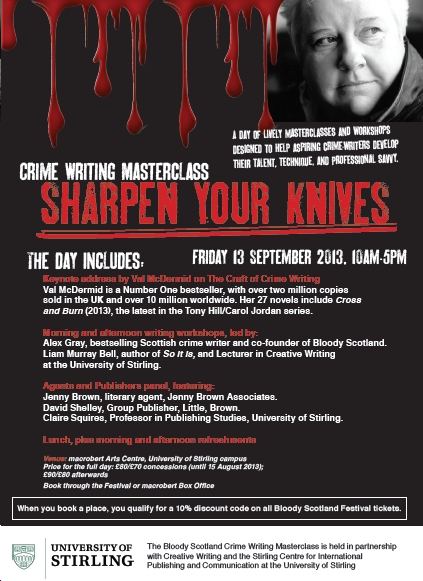
Bloody Scotland Masterclass – Agents’ and Publishers’ Panel

October 7th, 2013 by Aija | Posted in Blog | Comments Off on Bloody Scotland Masterclass – Agents’ and Publishers’ Panel
Tags: , , , , , , , , , , , ,

One of the perks of this year’s Bloody Scotland International Crime Writing Festival in Stirling was the opportunity to hear the best of the field offer advice to hopeful writers on the process of writing, publishing and whatever comes in between.

The Agents’ and Publishers’ panel was lead by Claire Squires, director of Stirling Centre for International Publishing and Communication on September 13th. The panel discussed what happens after the next hopeful front list bestseller has been written and when the author seeks to have the manuscript accepted either by an agent or a publisher.

Taking part in the panel were Jenny Brown, of Jenny Brown Associates, and David Shelley, of Little Brown. Jenny is equally inspiring and intimidating for an aspiring literary agent such as myself, having opened her agency in 2002 after years of formidable experience, not forgetting being the founder of the Edinburgh International Book Festival. If that’s not enough, she and her associates have become the biggest literary agent in Scotland and one of the leading agencies in UK, with international reputation.

David on the other hand represents the other hurdle in the writer’s way towards bestselling stardom – the publisher. David, who has worn many a different hat under the general title publisher has not settled for one particular job title – he also guests as an editor for a few selected authors within Little Brown, including Val McDermid and Mitch Albom (and yes, JK Rowling too, but let’s focus on other exciting aspects of David’s career, shall we?).

Jenny launched right into the session by emphasising how crime writing is still the fastest growing genre in the UK (and one of the leading internationally), with approximately 30% of the book market. David agreed – crime writing is definitely the most commercially growing genre that is remarkably consistent despite other market or trend fluctuations – fluctuations we know all too well that publishing is harshly dependent on. As the trend moves on, so will the publisher.

Both Jenny and David agreed that trends are nearly impossible to keep up with; what is “hot” right now could very well be over by the time you have the manuscript of a bestseller that nicely fits into that pigeonhole all finished and ready to be pitched. Trends move on faster than anyone can write, and rather than focusing on fitting into that niche, both Jenny and David emphasised, an aspiring writer would do well to focus on being passionate and finding your own voice, your niche, rather than doing lavish imitations of others’ work. Jenny also – to my great pleasure – emphasised how translated crime writing is breaking the barriers and entering the UK market. David remarked upon the cold realism of marketing; it is nearly impossible to bring out a title that is based on the same basic idea as one published before. There is no space in the market for two great Fife based detectives, but there might be space for one great detective from Fife, and the other from – why not – Stirling. How you present your setting is what makes you, as a writer, unique.

Classic crime is being brought back as well as being retranslated. Foreign authors are intriguing, whereas deceased writers are proving to be some of the toughest competition to the wave of new writers. One particularly interesting piece of advice that David provided for budding writers was to imagine further than one novel. He has found himself attracted to authors who can envision at least a couple volumes of a series, can explain character traits and subplots beyond that one particular event in the novel they are currently pitching. A good series of novels with an ever-evolving character can very well be the key to cracking your way into the crime-writing scene.

Claire led the discussion to the actual publishing process; what channels are there for new writers? How can one get their manuscript read, represented and subsequently published? As expected, both David and Jenny agreed on this point strongly; get an agent. It is nearly impossible to break into publishing without being professionally represented. Most publishing houses do not accept unsolicited manuscripts so agents act as a quality control filter for publishers. Jenny emphasised having manuscripts edited by a professional freelancer – never submit anything you are not absolutely sure is the best it can be. And this is doubly important for self-publishing authors.

Be confident, know your trade, know your next few steps and especially – know whom you are talking to when making a pitch. Let your story do the talking. It is even more advisable to target your agent and publisher. Do your homework – know whom you are pitching to and make sure they know why you have chosen them. Or perhaps if you’re desperate and unsure of your manuscript, a box of chocolates never hurts – doesn’t necessarily help either, but definitely never hurts.

Claire opened a topic that is much debated in publishing circles – self-publishing. Jenny explained how self-publishing allows more control and can lead to enticing a wide readership, which in turn encourages word-of-mouth and reviews before landing under the ears or eyes of an publisher. Self-publishing allows the writer to test the waters and to cater for the readership before attempting to break into the market. Although, writers would do well to note, that if you have already published something on the internet, the good bet is that a hopeful publisher would prefer to publish something completely new from you – or perhaps offer you a series deal. David did mention how even editors browse through self-publishing platforms – such as Authonomy – as you never know what you might find.

The panel concluded with questions from the master class participants; one particularly memorable was one lady from the master class, who has a number of novels (18 to be exact) published online but no one had yet approached her nor returned her numerous attempts to contact agents and publishers. Jenny’s initial reaction was to enquire what does she believe an agent could do for her that she cannot do herself? What indeed. To leave on a hopeful note, Claire asked both David and Jenny to give the master class some final words of inspiration. David encouraged the budding writers never to give up, as the first book published is rarely the first book written, and to especially venture into other avenues than traditional forms of publishing – digital, self-publishing and the like can prove to be a writer’s saviour, enabling an initial point of contact, enticing on its own merit. Jenny emphasised the necessity of wide reading, because all that we read will feed into what we write, how we write and how we present ourselves. There is hope for everyone.

Visiting Speakers Seminars for Semester 1, 2013-2014

September 19th, 2013 by Frances_Sessford | Posted in Blog | Comments Off on Visiting Speakers Seminars for Semester 1, 2013-2014

Stirling Centre for International Publishing and Communication is pleased to announce the programme of visiting speakers for this forthcoming semester. Our visitors are, as always, drawn from across the publishing and creative industries but this year some are also chosen to reflect one of the themes of this year’s studies. In 2014, Scotland’s voters will be asked to decide Scotland’s future as an independent nation. This year, at the Centre, our students will look at examples of small nation publishing and will explore how the Scottish publishing scene might change – or not change – after the vote.

Our first speaker on September 19 is Miha Kovač, author of Never Mind The Web; Here Comes The Book and a research colleague of the Centre, who will talk about his work as an academic and publisher in Slovenia. There is no session on September 26 but on October 3 we are delighted to have a visit from Conny Lenz, Publishing Studies alumna (2010-11) and Digital Publishing Assistant at Cengage Learning. Conny will be talking about her route into publishing and her current job at Cengage. The next speaker on October 10 is Edinburgh-based literary agent, Lindsey Fraser, followed on October 17 by Aly Barr, Creative Director at Creative Scotland, who will give his views on the development of the cultural industries in Scotland.

After the mid-semester break the second part of the programme begins on October 31 with a talk from Vivian Marr, Head of Language Acquisition at Oxford University Press, a globally recognised brand in educational and academic publishing. We contrast this on November 7 with a visit from Sara Hunt, Publisher at Glasgow-based Saraband Books who will recount her experience as an independent publisher and discuss the challenges of producing content in both print and digital formats. The next speaker on November 14 is another course alumna (1984-85) and CEO of Publishing Scotland, Marion Sinclair, whose talk will be directly relevant to this year’s course theme of small nation publishing. Please note that Marion’s session begins at 12 noon and finishes at 1pm. Next, we are pleased to welcome Will Atkinson, Publisher at Faber & Faber and member of the Centre’s Industry Advisory Board, to be our penultimate speaker on November 21. Will is an extremely experienced publisher and will focus specifically on the workings of Faber Factory, Faber’s digital production service, which is used by many small publishers in Scotland. Our final speaker, Andrea Joyce, is Rights Director at Canongate Books in Edinburgh, another highly successful and internationally recognised Scottish publisher.

All sessions are held in Pathfoot B2 on Thursdays at 2pm unless stated otherwise above. Please note that there is no visiting speaker on September 26. If you would like to attend any session, please email frances.sessford@stir.ac.uk to register (places are free but limited).


Publishing Research Word Cloud

September 15th, 2013 by cs48@stir.ac.uk | Posted in Blog | Comments Off on Publishing Research Word Cloud
Tags: ,

Last year’s students have just received the marks back for their dissertations – congratulations to one and all!


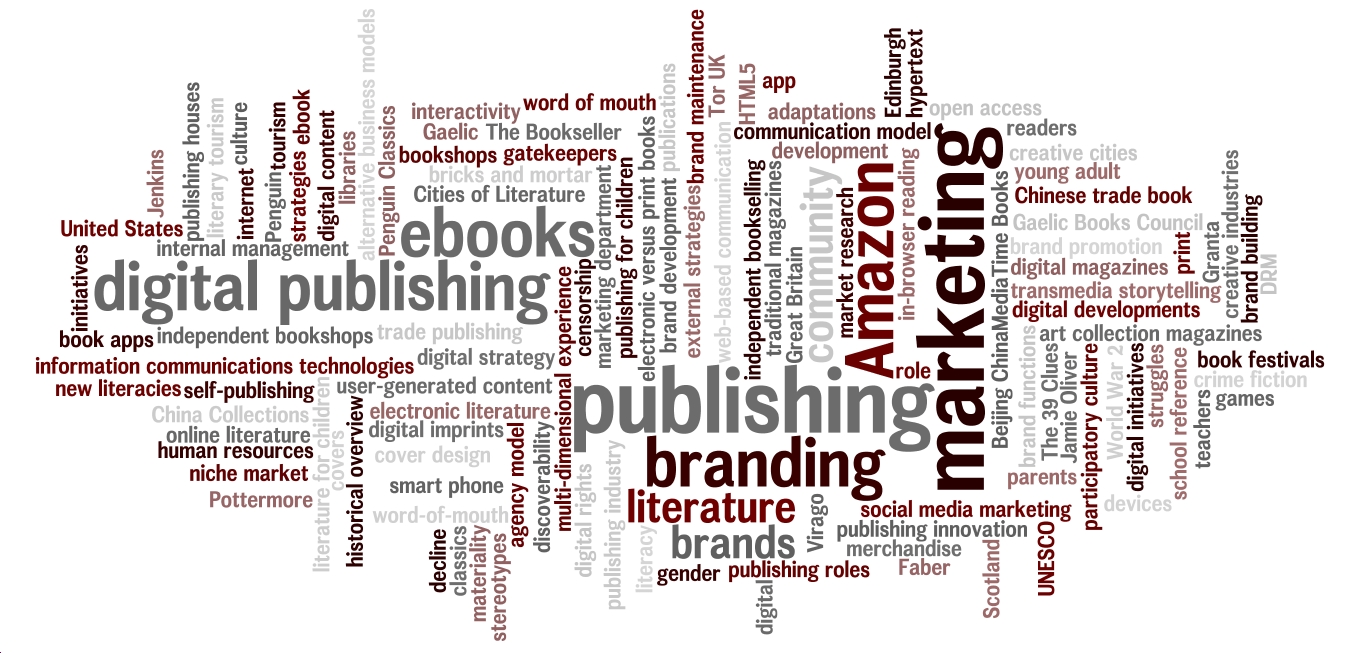
This year, we’ve taken the key words from each student’s dissertation and created a word cloud from them. It demonstrates some fascinating trends in contemporary publishing research. There’s a strong interest, of course, in the digital publishing environment, with HTML5, apps, user-generated content, and transmedia storytelling all featuring. Marketing and branding also feature heavily. Additionally, there is emphasis on particular sectors: children’s and crime, for example, as well as a focus on topics relating to our Scottish location (the UNESCO Cities of Literature; Gaelic publishing) and our international outreach (publishing in China and the United States).


The results are intriguing! We’ll do it again next year.

Off The Page – Stirling’s Book Festival

August 28th, 2013 by Frances_Sessford | Posted in Blog | Comments Off on Off The Page – Stirling’s Book Festival

Stirling’s own book festival, Off The Page, runs this year from 6–14 September. Now in its eighth year, Off The Page has consistently showcased the writing and creative talents of authors and poets from the Stirling area and beyond. The week-long festival is run in partnership with Creative Scotland, the country’s arts investment engine and provides an eclectic mix of speakers, readings and workshops for children and adults.

Highlights this year include Richard Holloway at The Tolbooth on Monday September 9, and Kaye Adams in conversation with Janice Galloway, also at The Tolbooth on Tuesday September 10. The festival always devotes a session to the subject of ‘how to get published’ and this year Stirling Centre for International Publishing and Communication hosts a debate in The Tolbooth Attic on Saturday September 7 which will explore the value of social media in helping authors raise their profiles and sell content. The panel consists of publisher Adrian Searle (Freight Books and Gutter magazine); agent Mark Stanton (Jenny Brown Associates); and author and newly appointed University of Stirling creative writing lecturer, Meaghan Delahunt. Apart from these events there are numerous smaller workshops and talks in local libraries and the Tolbooth Attic, including readings from local writers, Fiona Gibson and Jane Harris.

For full listings, see http://offthepage.stirling.gov.uk/about-us


Saltire Society Publisher of the Year

August 24th, 2013 by cs48@stir.ac.uk | Posted in Blog | Comments Off on Saltire Society Publisher of the Year
Tags: , , , , ,

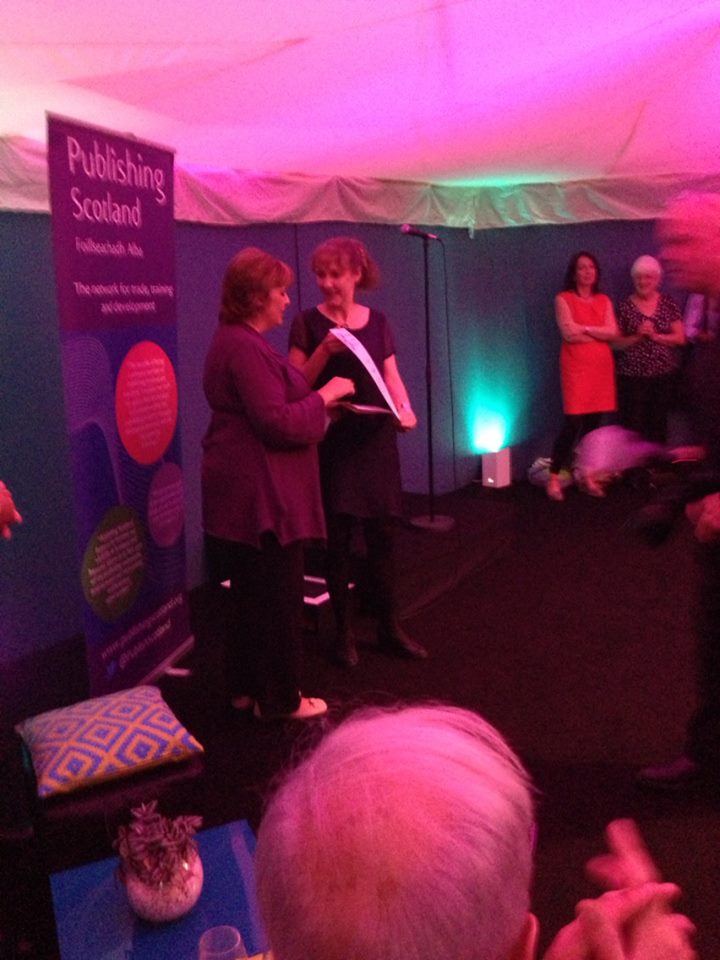
Yesterday at the Publishing Scotland reception at the Edinburgh International Book Festival, the winner of the inaugural Saltire Society Publisher of the Year award was made to Saraband Books by Fiona Hyslop, Cabinet Secretary for Culture and External Affairs. Our Director, Professor Claire Squires, was one of the judges for the award.

The judges said Saraband, a small Glasgow-based publisher run by Sara Hunt, ‘is a company that has shown shrewd and strategic business thinking in a shifting context. They are collaborative, innovative and are distinguished by fresh thinking in their use of digital technology. Their move to new approaches still has the interest of authors at its heart.’

Floris Books of Edinburgh was also commended for its work in publishing children’s books. The full shortlist also included BackPage Press, Barrington Stoke, Edinburgh University Press, and Freight Books. The award is administered by the Saltire Society, with support from Creative Scotland and Publishing Scotland. Further details of the award were reported by The Bookseller.

Over the past year we have had students interning at both Saraband and Floris Books, as well as some of the other shortlisted publishers. We are also very pleased that Sara Hunt will be coming in to speak to our students in the forthcoming semester.


Saltire Society Publisher of the Year Award Shortlist

August 13th, 2013 by cs48@stir.ac.uk | Posted in Blog | Comments Off on Saltire Society Publisher of the Year Award Shortlist
Tags: , , ,

The Saltire Society Publisher of the Year Award has announced its inaugural shortlist, which features BackPage Press, Barrington Stoke, Edinburgh University Press, Floris Books, Freight Books, and Saraband Books.

The Saltire Society comments that the shortlist ‘exemplifies the dynamic and ground breaking work being done by Scottish publishers to engage new readers and take on new challenges, making sure Scottish publishing stand out both nationally and internationally. The mixture of SMEs and larger more established enterprises show how Scottish publishers are making bold and imaginative work in a changing world of publishing, irrespective of their size, age or the pressure to continue on with established working methods.’

Professor Claire Squires, Director of the Stirling Centre for International Publishing and Communication has been one of the judges for the inaugural award. The winner will be announced later this month at the Edinburgh International Book Festival.

The full press release is available from the Saltire Society website.

Recipient of first Gaelic publishing scholarship announced

July 10th, 2013 by cs48@stir.ac.uk | Posted in Blog | Comments Off on Recipient of first Gaelic publishing scholarship announced
Tags: , , , ,

The recipient of the first Gaelic publishing scholarship established by the Gaelic Books Council and the Stirling Centre for International Publishing and Communication at the University of Stirling has been announced.

Liam Crouse, a recent graduate of the University of Edinburgh, is the first recipient of the fully-funded scholarship for the MLitt in Publishing Studies for session 2013-14.

Rosemary Ward, Director of the Gaelic Books Council said: “The Gaelic Books Council is very pleased with the level of interest that has been shown in the Gaelic publishing scholarship and we are delighted to be offering the first scholarship to Liam Crouse. Liam has illustrated that he is an exemplary student having gained a First Class Master of Arts with Honours degree from the School of Scottish Studies at the University of Edinburgh. The Gaelic Books Council is satisfied that he will apply the same commitment, creativity and diligence to his MLitt studies and we anticipate that he will make a valuable contribution to Gaelic publishing in the future.”

She added: “This scholarship was established in the first instance to attract new talent into the sector and to begin the process of increasing capacity. Liam is certainly a talented young man with a strong commitment to the Gaelic language and a secure knowledge of Gaelic literature and publishing and we wish him every success with his studies.”

When the scholarship was offered to him, Liam said: “I am absolutely delighted to be offered this important Gaelic scholarship. It is a wonderful opportunity. In the last ten years, Gaelic literature and publishing has made remarkable progress through various initiatives to support new Gaelic writers. The focus must now be on strengthening the Gaelic publishing infrastructure. The revitalisation of the Gaelic language and the development of Gaelic publishing presents many challenges, and I am delighted to have been given the opportunity to become involved in this important work.”

Professor Claire Squires, Director of the Stirling Centre for International Publishing and Communication said: “We’re very pleased to be working with the Gaelic Books Council to provide this opportunity for a Gaelic-language student on the MLitt in Publishing Studies at Stirling. We are delighted to welcome an outstanding student who brings a passion for the Gaelic language and an international perspective both to the Publishing Studies course and to the Gaelic-speaking community.”

Liam will study at the University’s Stirling campus in session 2013-14 and the Gaelic Books Council will secure appropriate placements for him with Gaelic publisher(s).

More information about the Scholarship is available here.