Blog

Visiting speaker: Lucie Johnston

October 20th, 2012 by Elise Guay | Posted in Blog | Comments Off on Visiting speaker: Lucie Johnston
Tags:

On Thursday, September 27, we had our first guest speaker. Lucie Johnston is a member of the staff in the Career Development office. She specializes in getting jobs in the arts and humanities, and gave us insight into what we might do to prepare for getting jobs. She presented a powerpoint called “Introduction to Jobs, Networking, and Interns,” which included all kinds of information from what kinds of jobs are out there, to how much job experience we need to pique a publisher’s interest. She was very enthusiastic and answered any questions we had to the best of her abilities.
Lucie jumped right into her presentation by telling us which jobs are out there. She gave us a list ranging from editing to marketing to design, emphasizing that publishing is a diverse and cut-throat business, but that there are a lot of options out there. She suggested to start thinking about jobs, but not to jump to any conclusions just yet as we are only in the first weeks of the publishing course. This resonated with me because as soon as we started the design aspect, I leaned heavily towards that, but I also have skills in editing, so having a few options is a good idea. In regards to which job we would ultimately like to do, she told us not to be disheartened if we have to start off as a temp or a secretary because whatever skills we have will shine through and promotions are fairly easy.
The next section of Lucy’s presentation was in regards to which jobs would actually suit us. She gave us an anecdote about somebody who came to her and said they really wanted to be a teacher. They did some teaching experience and came back shortly after deciding they didn’t like children. She said to make sure that you emphasize your strong points and your skills. For example, someone who has experience in editing maybe should go for an editing job. One thing she did say is that you have to love your job, or it is going to be a very long struggle to get up every day. One of my biggest fears is that I will end up in a job that I absolutely despise. I think there are a lot of people my age who feel the same way. There are so many people, me included, with thousands in debt, and to have to take a job because we need to pay off the debt rather than because we love it is going to be a difficult thing to do.
Lucy handed out a piece of paper with circles on it and said it was a fairly elementary exercise that was used to place your strengths and skills in categories and figure out where you got them from. However, she did give us a useful formula to follow which is the STAR formula. STAR stands for scene, task, action, and result. Basically, this is the formula you use when you go to interviews. Each part plays an important role in the interview process, but for example, the results part would mean having facts and figures about the company with which you are interviewing. With regards to interviews, she said to bring examples of your work with you to show at the end. For instance, depending on what type of job you are going for, you would be best to wait until the end and present your work to the potential employer then. This will be really impressive to them especially if they had not asked for it beforehand. This was a good activity to try and discover what your skills are.
As the presentation went on, she talked a bit about work experience. She said if we want publishers to even look at our CV’s, we need at least two weeks of work experience. She also said that we should be prepared to travel for our internships. This is due to the fact that some places close by may not be offering intern positions or that your interests may take you elsewhere. For example, you may like a more unique publishing house, so you may want to go to Two Ravens Press which is on the Isle of Lewis.
As far as getting a job, Lucy stressed the fact that we need to network. She asked us, rather comically, if we had friends. Everyone laughed at this, but she was trying to get the point across that if we have friends, we have already networked. She also mentioned things like LinkedIn and Twitter are important because they make you stand out and keep you in the know. However, be careful with things like Facebook. The internet has an unlimited memory.
This whole presentation was very helpful. At the end she let us ask questions, and as an American, my first question was whether or not I would be able to get a job in the UK. This is where the heartbreak and disappointment comes in. She told us that if we were up against someone from the UK with the same credentials that they would get the job simply because they are British and there is less paperwork to have them as part of the company. Even big companies do not want to deal with all the red tape surrounding someone who is non-EU citizen. Lucie did suggest maybe going home and finding a big company that is willing to have us travel, or a company who wants to spread to the UK. Despite this disappointing news, we enjoyed her talk, and she gave us a wealth of information.

Elise Guay

Fixed Prices for Books?

October 18th, 2012 by Eva Graf | Posted in Blog | Comments Off on Fixed Prices for Books?
Tags: , ,

In Germany, a fixed book price is a legal constraint which forces publishing houses to set a certain price, which is then legally binding for all retailers . As long as the original set price is not reversed, which can happen 18 months after the publication, or it is resold book retailers cannot change the price in any form or way. The main goals of this system are:
→ protecting books as a cultural asset
→ securing a great variety of titles
→ aid nationwide supply with books
A fixed price system was first introduced in 1888 and, despite its long tradition, there are certain new developments that need to be taken into consideration. The most evident modern example being ebooks and how they should be priced. According to the Börsenverein des Deutschen Buchhandels (the German equivalent to the Publishers Assocation) they should have fixed prices because they mirror printed books in their attributes.
What made me think about the whole system was going into a bookshop in the UK and comparing the prices in store to those on Amazon. The newest Ken Follet title Winter of the World costs £10 in hardback, with the Kindle Version selling for only £5.99. Compare this to the German Hardcover, priced at 29.90€, and the Kindle Version, selling at 22.99€. this seems to be a very low price. I cannot decide which system is preferable. On the one hand I can buy books here for a great price, but I feel that the German system has its benefits too. Publishing houses give less discounts and therefore may generate a higher revenue, resulting in being able to plan their budget more accurately. From a professional point of view I can see the advantages of this system; however as a consumer I prefer the lower UK prices.
The topic of fixed prices versus free price setting is very interesting and has lots of room for discussions. There will undoubtedly be some friction in the German industry in the future, mainly due to ebook prices. Big players like Amazon and Apple will drive a hard bargain to establish low prices. This may lead to a more competitive market, similar to the UK market. Or the status quo will continue. Only time will tell.

Eva Graf

Bloody Scotland Masterclasses

October 12th, 2012 by cs48@stir.ac.uk | Posted in Blog | Comments Off on Bloody Scotland Masterclasses
Tags: , , ,

Heather Malcolm, delegate at the recent Bloody Scotland masterclasses, reports on her day at the University:

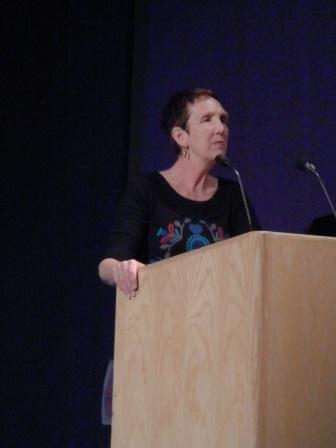
Ann Cleeves at the Bloody Scotland masterclasses

In June this year, I heard that a new crime writing festival called Bloody Scotland was offering a day of master classes. I was a bit hesitant to sign up an untried event, but since the University of Stirling were organising it and they had chosen Ann Cleeves as the keynote speaker, I decided to chance it and parted with £75.00 for my all-day ticket.

September came quickly and the master class day started well. Registration was easy, after which Ann Cleeves opened the event. She was a funny and passionate speaker, and she took us through the process of writing her award-winning novel Raven Black, all the way from its inspiration, through the enjoyment of writing, to the tedium of editing. Among her tips for aspiring writers were; read widely across the genre, get to the end of the book, be lucky, write what you love, and good editors are “worth their weight in diamonds.” She was especially emphatic in calling for us to support our local libraries.

After refreshments, it was time for the classroom sessions. The first was on character and setting, led by Laura Marney. She is a lecturer, short story writer, dramatist and author of four novels including Nobody Loves a Ginger Baby. Laura was funny and authoritative and her session was practical, challenging and very hard work. Her exercise on character was particularly useful – I discovered that one of my minor characters is a Goth.

After a lovely buffet lunch, the second session, on plotting, began. It was led by Allan Guthrie, whose Two Way Split was Theakston’s Crime Novel of the year. He is also an agent and co-founder of a digital publishing house, Blasted Heath. Alan covered the essential characteristics of protagonists and antagonists and discussed the various ways in which a crime novel can be structured. Alan’s experience and forensic understanding of good crime writing meant his class was, like Laura’s, practical and encouraging. I’m already applying his analysis of structure to my own writing.

After another refreshment break, the final event began. Chaired by Professor Claire Squires, Allan Guthrie (in agent mode) along with publishers Maxine Hitchcock from Simon and Schuster, and Rachel Rayner from Transworld discussed trends in publishing. It was fascinating and sobering to hear that good writing is only one factor in deciding whether to take a manuscript on. We also heard how we can help ourselves, e.g. by approaching agents as if we were applying for a job, by doing a creative writing course and having our manuscripts edited.

This was a great chance to get the latest information, the best advice and the most authentic inspiration from some of the most accomplished people in their fields. The atmosphere was relaxed and friendly, thanks to the great organisation, so it was easy to network and gab on endlessly about writing.

The day was inspiring, practical and hard work, and definitely worth the wait. I’m glad that I took that risk back in June and I’ll be back next year.

For more on Bloody Scotland, see Stefani Sloma’s report on volunteering at the festival.

Visiting Speakers for Semester 1, 2012-2013

October 3rd, 2012 by Frances_Sessford | Posted in Blog | Comments Off on Visiting Speakers for Semester 1, 2012-2013

Publishers, communications experts, authors, agents and booksellers will be sharing their industry knowledge and expertise with Stirling Centre for International Publishing and Communication students this semester.

The programme begins on October 4 with Adrian Searle, publisher at Freight Press and editor of Scotland’s leading literary magazine, Gutter. Next (October 11), Peggy Hughes will describe her work at Edinburgh UNESCO City of Literature Trust, and the following week (October 18), Ann Steiner from Lund University, Sweden will give an academic’s perspective on recent developments in international publishing.

After the mid-semester break, two highly successful authors feature in the programme. Keith Gray is a well-established author of fiction for children and reluctant readers (November 1) and is followed by our own Dr Paula Morris of the University’s Creative Writing taught masters course (November 8). Both will give their perspectives on the publishing industry and on how authors can manage their profiles in the digital age.

Our guest on November 15 is Marion Sinclair, course alumni and Chief Executive of Publishing Scotland, the representative body of Scottish publishers. Following Marion on November 22 will be Lindsey Fraser, literary agent and consultant. The programme closes on November 29 with Scott Conan of Better World Books on socially responsible bookselling.

Attendance at all visiting speaker sessions is free but there is limited space. Please email frances.sessford@stir.ac.uk to book a place.

Class of 2012-13

September 28th, 2012 by cs48@stir.ac.uk | Posted in Blog | Comments Off on Class of 2012-13
Tags: ,

It’s that time of the year again when we welcome new students to Stirling, and to our MLitt in Publishing Studies and the MSc in International Publishing Management.

As is usual at the Stirling Centre for International Publishing and Communication, our students come from numerous countries around the world, and from very close by – several of our students choose to continue from their undergraduate studies at the university. This year we have students from: the China, Finland, Germany, Italy, Latvia, the Netherlands, Sweden, the UK, and the USA.

Welcome all!

My Bloody Brilliant Weekend at Bloody Scotland. :)

September 20th, 2012 by Stefani Sloma | Posted in Blog | Comments Off on My Bloody Brilliant Weekend at Bloody Scotland. :)
Tags: , , , , ,

The first full weekend I was in Stirling saw me volunteering at Bloody Scotland, “Scotland’s First International Crime Writing Festival.” I’d heard about the event before arriving in Scotland and offered to volunteer during the weekend. I am SO glad that I did. I had the time of my life!

Due to my previous experience volunteering at the Eudora Welty Writers’ Symposium at Mississippi University for Women, the Front of House Manager for Bloody Scotland, Dom Hastings, asked if I’d be willing to volunteer more than one four-hour shift. I wanted to say “Are you kidding me??!! DUH!” but I politely said, “I can be here whenever you need me.” I ended up being on the schedule all three days (Friday through Sunday) for pretty much the entire day; this was exactly what I wanted.

Friday was the first evening of Bloody Scotland, and I worked the Author Hospitality room, where I checked authors in to the festival and gave them their name badges and goodie bags. I also worked at and helped set up the reception for the authors, which was the kickoff for the festival. After the reception, it was back to Albert Halls for the opening session called, “Why Bloody Scotland?” featuring Alex Gray, Lin Anderson, and Ian Rankin. This session was followed by an author signing, which is where I started getting authors to sign my program (more on this later). I loved these duties because it meant that I was able to meet EVERY author who came into the Stirling Highland Hotel to check in. Friday Night Highlight: Ian Rankin remembered me! I’ve met him previously, as I interviewed him last year for my honors research project (“The City as Character: Edinburgh in the Works of Ian Rankin”), and I was hoping that he’d remember me when I saw him again. HE DID! It made my entire weekend. We had a short conversation about the future of publishing and editors at the reception before I left him alone so he could socialize with other authors.

Saturday began at 9 a.m. with the Author Hospitality room. I spent all of that day at the Stirling Highland Hotel. I worked FOUR signings that morning, meeting authors like Allan Guthrie, Sara Sheridan, Yrsa Sigurdardottir, Caro Ramsay, and more. After that I worked inside front-of-house for two events, which meant I operated the roving microphone and made sure the authors got to their signings after. My shift on Saturday was supposed to end around 3:30 p.m., but I was still needed so I didn’t leave until 7:45 p.m. I worked about 8 hours that day alone! Saturday Highlight: “Meet My Alter Ego” session with Gillian Galbraith, Aline Templeton, Tony Black, and chair Lin Anderson. At the session, the authors spoke as if they were their characters. This was fantastic, because at one point Gillian Galbraith spoke as her character about her author, so it ended up sounding something like, “Sometimes Gillian writes about things that even I don’t know!” or “She explains what happens to me even better than I could!” It was great.

Sunday was the last day, and I can’t even explain how sad I was about this. It was spent at Albert Halls, where I worked inside front-of-house and signing for “The Next Big Thing” with Jade Chandler, Yrsa Sigurdardottir, Val McDermid, and Barry Forshaw. While they didn’t stay on topic much, it was a laugh and very interesting. I also worked inside FOH and the signing for “A Formidable Duo” with Quintin Jardine, Anne Perry, and chair Peter Guttridge. Sunday Highlight: I was able to attend the dramatized performance of “The Red-Headed League.” Stuart MacBride as Holmes was amazing.

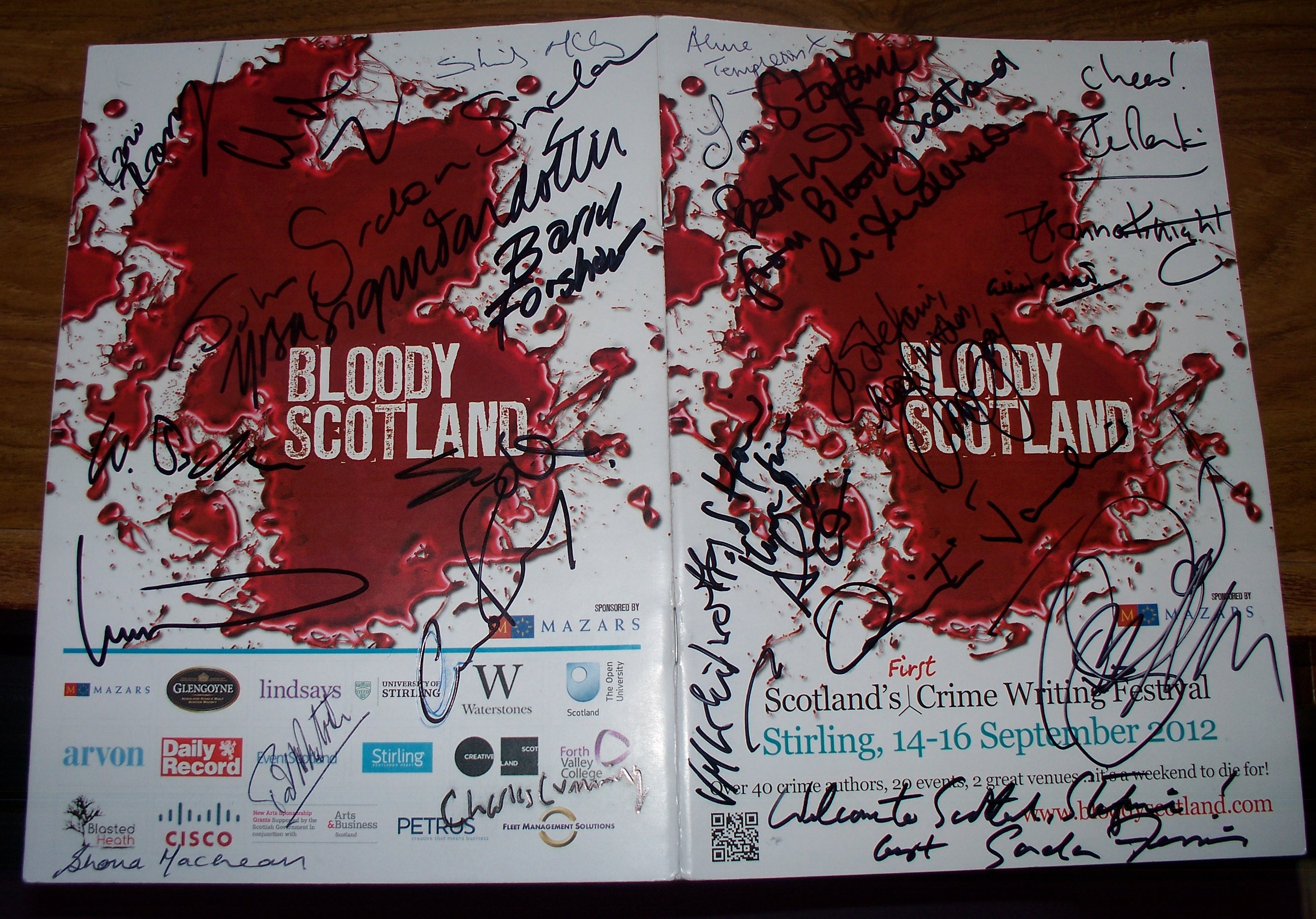
Every author I met this weekend was fantastic. Alex Gray remembered my name ALL weekend and called me “wonderful” and “a star.” I thought this was amazing. Also, Gordon Brown (not the ex-prime minister, but the red-headed crime fiction author, as everyone joked at Bloody Scotland) was one of the nicest guys I’ve ever met. I got him, Craig Robertson, Gillian Philip, and Gordon Ferris to sign books I’d bought by them. I also had TWENTY-FOUR authors to sign my program, which is something I will always treasure; I plan to have it framed! I am so glad that I decided to do this; I couldn’t afford to buy one book by every author I wanted to read and have signed, so I used my program. I think it was a great idea!

I learned a lot about publishing, and I came to realize that I’d one day like to work festivals. It has also fueled my love for crime fiction, and I think I would like to work with it in the future. I think Bloody Scotland is one of the most amazing things I’ve ever been involved in.

I’ve since had a few of the authors follow me on twitter, which is an honor. I hope to keep in contact with them and see them again next year!

-Stefani Sloma

Publishing Scotland’s Marion Sinclair – A Talk of Success

September 20th, 2012 by Sara_Gardiner | Posted in Blog | Comments Off on Publishing Scotland’s Marion Sinclair – A Talk of Success
Tags: ,

Marion graduated the Publishing Studies course at the University of Stirling in the 1980’s. Marion believes that a degree in publishing is useful to have and puts us in good stead for a career in the industry.

Marion Sinclair works for Publishing Scotland whose job it is to promote and support Scottish publishers; these companies may be small, but ‘great books can come out of a one-person company.’ Marion has taken on the task of making Publishing Scotland relevant to their members by supplying outlines of what the publishing industry needs to succeed. There are over 100 active publishing companies in Scotland and most are currently small and medium enterprises; anyone can set themselves up to be a publisher.

Scottish writing has seen a renaissance in the past ten years with writer who have an international following. Alexander McCall Smith, is one example of a flag bearer for Scottish publishing. Scotland in particular has a publishing industry which is more than 500 years old, but in need of new thinking. Over the next two years Publishing Scotland wants to be able to aid companies in development of e-books and web design; they are putting the spotlight on what the independent publishers need.

As such, it is an organization of which Stirling University is a part. Their aim is to cultivate contacts and develop parts of the infrastructure of the media industry. Publishing Scotland’s core activities are:

  • Fulfilling training gaps
  • Information and support
  • Taking publishers to book fairs in London and Frankfurt

Graduates need to have creative and commercial abilities, business sense and be numerate; they need to think beyond being an employee. It has never been easier to set up your own publishing company, so why not think about setting up your own business?

Publishing Scotland holds an annual conference, which members may attend in order to meet new people who already work in the industry. Students may offer to do placement work for a company to begin to get your face known within the industry. Publishing Scotland will help students to find work or a work placement; the best way to get a job is to annoy people at events!

When applying for a job in the publishing industry, potential employers may receive up to 75 CV’s from potential candidates. Of these, the candidates with a publishing degree will be more likely to be picked for interview.

A big thank you to Marion for the talk today with all of the useful hints and tips!

– Sara Gardiner

The Book Unbound at the Electric Bookshop

August 7th, 2012 by prm | Posted in Blog | Comments Off on The Book Unbound at the Electric Bookshop
Tags: , , ,

As regular readers of this blog might be aware, some of the staff and students at the Stirling Centre for International Publishing and Communication have been busy this summer, working on an AHRC-funded research project entitled ‘The Book Unbound: Disruption and disintermediation in the digital age.’ The iPad app which forms part of this project is going to be showcased at the Electric Bookshop, a quarterly event that brings together people from the worlds of publishing, technology and design and is hosted at Inspace in Edinburgh. We’re looking forward to discussing the editorial, creative and production processes that went into the making of the app, and demonstrating how we’ve worked with new technologies to create our own publication. If you would like to attend this free event, please do book a place here.

It’s a tough job…

July 29th, 2012 by Helen Lewis McPhee | Posted in Blog | Comments Off on It’s a tough job…
Tags: , ,

This week finds me editing submissions in the shade of the wisteria that runs wild across the terrasse of my grandparents’ house in the Ardeche region of France. Behind me, Ben, the black Labrador, is my sleepy supervisor, snuffling along the hedgeline and reminding me to keep at it. Despite his insistence, I occasionally allow myself respite from the eradication of comma splices and erroneous apostrophes with a refreshing dip in the 26 degree pool, or a literary dip into 18th century Paris.

There are worse jobs in the world. To fund my undergraduate degree I spent my summers, amongst other things, cleaning at a chicken farm. Such is the true price of higher education. That delicate scent of chicken poop and disinfectant may be the one presiding memory that has stuck with me since my student days.

In the few short years between undergraduate and postgraduate study, I turned my hand to wedding planning, fine wines, facilitation and fostering. Through every one of these roles, I found myself drawn back to working with writers and writing, and finally summoned up the courage (and the several thousand pounds), to take the publishing plunge: initially interning at a literary agency, and then completing my Masters.

The journey over the last two years from wannabe publisher to fully-fledged editor has been a bumpy one, and I still struggle to believe that I’m finally here. To have the privilege of working with such talented writers and esteemed academics is the realisation of a long-standing dream. To play such a part in the exploration and expansion of publishing boundaries through the new digital medium is beyond my wildest.

Today, I am copy-editing short stories and poetry from the comfort of a French villa. The cigales are singing in the background as I immerse myself in rural Luxemburg, remote Shetland, and central Glasgow. And Nana has just brought me a kir. Santé!

Creating an app: the initial stages

July 12th, 2012 by Paula_Morris | Posted in Blog | Comments Off on Creating an app: the initial stages
Tags: , , , , , ,

The months have whizzed by since our first meetings in February with Claire Squires and Padmini Ray Murray to discuss the parameters of the AHRC Book Unbound  project.

Neither Scott Russell nor I live in Stirling, so our first production meeting was a phone call one chilly Monday in late February, where we discussed everything from mission statements to page counts, Twitter feeds to job descriptions. As Scott mentioned in his blog post, we presented these job descriptions, along with a call for content, to the Publishing and Creative Writing students, and waited for their response.

In March, the full steering committee – the Gang of Four – met to discuss the applicants for the project assistant roles. We had a lot of CVs and ideas to sift through, but we soon agreed on the three most suitable candidates: Helen Lewis-McPhee as Associate Editor, and two Production Assistants, Louisa Preston and Aileen Taylor. Our aim was to create a balanced team, with a range of experience (and, hopefully, some good ideas).

Our fleshed-out production team met in April, in a typically dispiriting university conference room. We gathered around the white board and discussed practical issues – like information-sharing via Podio and Dropbox – as well as creative ones. What kind of content could we expect for the app we were developing? What kind of attributes did we want the finished product to have? How would everything work together? What could we call this thing?

At this stage, Scott said, no idea was out of bounds. (‘Out of Bounds’: one of our title ideas!) Everything went up on the white board. We agreed that none of the title ideas were quite the thing, but that was OK. Maybe something would emerge from the content, or from the process of reading and working with the content. Two-and-a-half months later, we still don’t have a title. It’s still OK. I’m confident that something will strike one – or all – of us, as the app continues to take shape and come to life.