Blog

Pick up a Penguin! for Book Week Scotland

November 20th, 2012 by cs48@stir.ac.uk | Posted in Blog | Comments Off on Pick up a Penguin! for Book Week Scotland
Tags: , , ,

Thursday 29 November 2012, 11am-1pm

During Book Week Scotland, we bring you a rare opportunity to pick up a Penguin from the University of Stirling’s impressive collection of the famous publishing house’s books.

Professor Claire Squires, Director of the Stirling Centre for International Publishing and Communication and an expert on 20th and 21st century publishing history, will lead the hands-on session. From the very first set of 10 books from 1935, to some of the earliest Puffins, Penguin Classics, Penguin Specials and Pevsner’s Architectural Guides, and books on yoga, car maintenance and vegetarian cookery, the collection demonstrates just how diverse a publisher Penguin has been – and why its recent merger with Random House is causing such consternation to the publishing industry.

The collection was donated by Dr Angus Mitchell, formerly Chair of the University Court and an avid Penguin collector.

Places are free, but must be booked in advance via the macrobert box office. The event is organised in collaboration with macrobert, who are also hosting a number of other events during Book Week Scotland.

Death of Tim Rix, Honorary Graduate and Publisher

November 19th, 2012 by cs48@stir.ac.uk | Posted in Blog | Comments Off on Death of Tim Rix, Honorary Graduate and Publisher

The Stirling Centre for International Publishing and Communication extends its condolences to the family of Tim Rix, CBE, who died last week. Tim had an illustrious publishing career, notably as CEO of Longman where he was central to development of the UK’s educational publishing sector. He was also an Honorary Graduate of the University, and a former Chair of our Industry Advisory Board, providing support to the postgraduate students in the Centre, and invaluable input into the development of our teaching.

The Electric Bookshop, the October edition

November 18th, 2012 by Verena Bauer | Posted in Blog | Comments Off on The Electric Bookshop, the October edition
Tags: , , ,

After hearing in class about the Electric Bookshop, the 10th of October saw me heading to Edinburgh, excited about the new digital developments I was going to be introduced to.

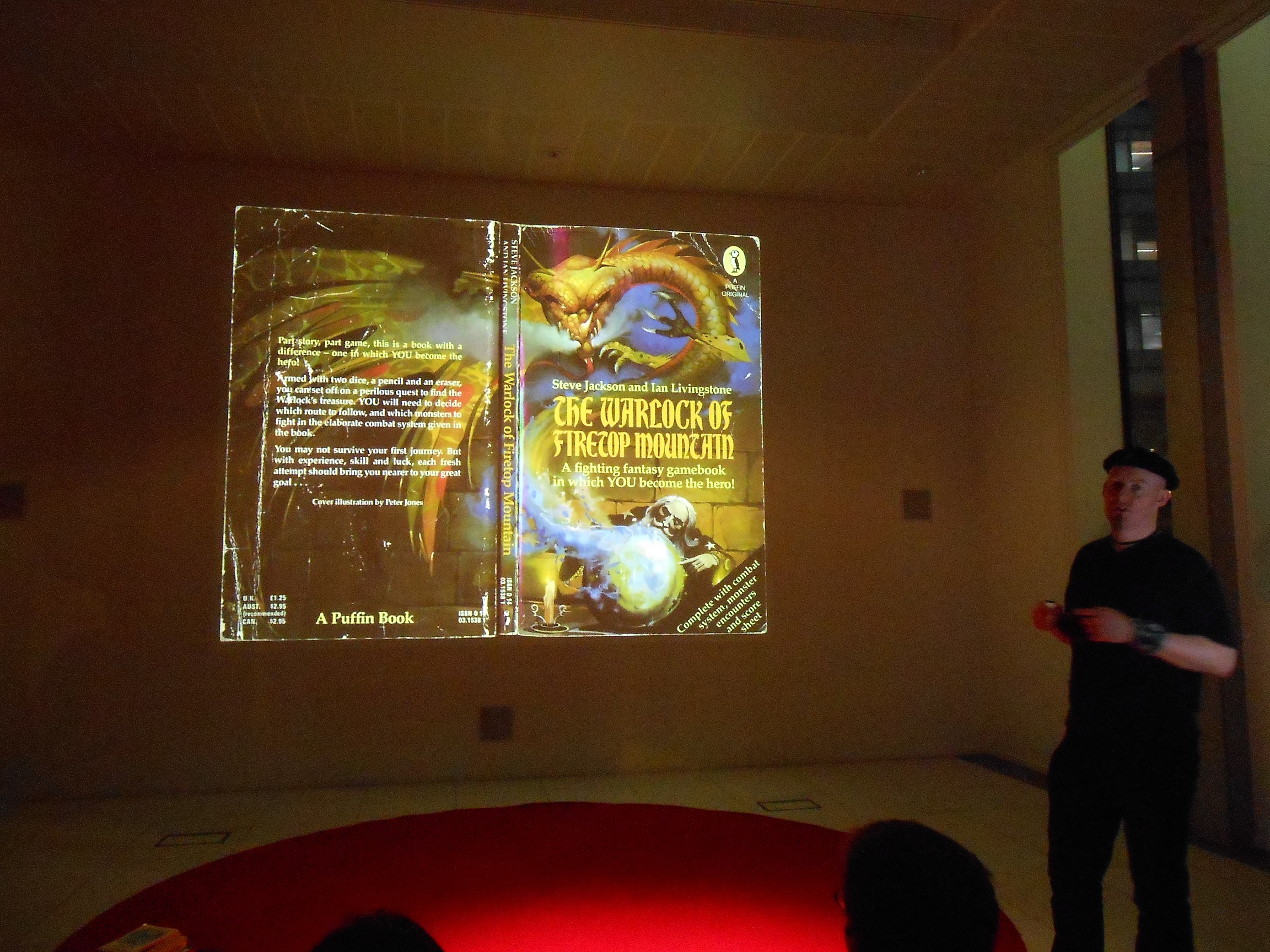
The first guest of the night was writer Gavin Inglis, who is known for his work with Writers’ Bloc and who now presented to us his new interactive game which is called Eerie Estate Agent. We were first introduced to his childhood memories that had inspired him for his latest work – adventure books like Sugarcane Island and The Black Dragon that gave the reader the possibility to make their own choices, leading to different endings instead of a linear story. This idea was later followed by role-playing games such as “Dungeons & Dragons”. Adventure books and games were usually branded as being made exclusively for children, while there were only parodies available for adults – a situation that displeased Inglis. In the 1980s, video games like The Hitchhiker’s Guide to the Galaxy appeared as the forerunner of today’s games and apps – Mary Shelley’s Frankenstein has recently been published as an interactive app that includes the original text but also introduces reader’s choices. This led Inglis to write his own interactive fiction, focusing on the reader’s decisions that “have to be meaningful” and have to matter as an integral part of his Eerie Estate Agent game. The app is very trendy as several adventure series have recently been reissued. Customers can play a trial chapter before buying the app on www.choiceofgames.com.

The next guests of the night were Henry Volans, Head of Digital Publishing at Faber and Faber, and Max Whitby from Touch Press (via Skype). They introduced T. S. Eliot’s The Waste Land, which they published as an app, allowing the reader not only to access the text but also the original manuscript, often with notes by Ezra Pound, as well as notes on references and historical allusions. The highlight, however, is the option to watch a video performance of the poem or listen to six different audio readings. The speakers’ next collaboration (together with Illuminations and The Arden Shakespeare) was on Shakespeare’s Sonnets, which is for them a new and “better way to present literature than the e-book market.” It is thus not just an enhanced e-book, but an app that contains all the 154 sonnets, in the modern edition as well as in a facsimile of the 1609 Quarto edition; a commentary by Don Paterson; and the Arden notes on language, historical facts, and vocabulary, synchronized with the lines you are reading. In addition to that, you can take your own notes or watch the sonnets being performed by one of 42 people, such as Sir Patrick Stewart, David Tennant, or Fiona Shaw. It even has a sharing function for social media such as Facebook or Twitter.

As several of the guests remarked, the app is quite expensive at the price of £9.99; a further drawback is that it can only be used on iPads. However, as a graduate of English Literature, I would love to get the app (if only I was one of the proud owners of an iPad) and I am sure it is very useful to students and academics.

The 8th Electric Bookshop introduced me to exciting new developments and interesting people, so I can only recommend to everyone to go to their next session in January 2013 – I definitely will!

Visiting speaker: Peggy Hughes, City of Literature

November 17th, 2012 by Aija | Posted in Blog | Comments Off on Visiting speaker: Peggy Hughes, City of Literature
Tags: , , , , , , ,

The delightful Peggy Hughes amused the Publishing studies 2012/2013 class  with her lively presentation on the UNESCO badge of City of Literature  – a designation, which was bestowed upon Edinburgh back in 2004. The City of Literature Trust  is head by Peggy herself and her boss Alison Bowden.

Why Edinburgh should be designated as a City of Literature by UNESCO, you might ask. Well, when a group of prominent figures in the literary scene having a post-prandial discussion they came to the surprising conclusion that as Edinburgh was “brilliant at books,” something should be done to make sure this would become general knowledge. Simply because Edinburgh has a huge literary heritage, and has a vibrant contemporary scene – already hosting some of the world’s most well-known and largest poetry and literature festivals and events.

Organisations from grassroots up to government level Edinburgh worked together to create The Bid, an audit of all Scottish literary accomplishments in two volumes – talking about putting things in a nutshell – We Cultivate Literature on a Little Oatmeal. It took a bundle of Scottish treats (whiskey, haggis, bagpiper among others) to convince the UNESCO headquarters in Paris.

Among her lively and very fast paced presentation, the class was entertained with best bits of past events that had aimed to hold Edinburgh to its badge of honour as well as a selected few spoilers over the upcoming events. Working together with other Edinburgh literary events and organisations, the City of Literature has proven to be worth every bit of the designation, more than holding its own among the others with its goals of establishing partnerships, promoting participation, learning as well as advocating awareness towards Edinburgh and keeping the focus on creativity, bringing people together in literature.

Thank you to Peggy for the grand insight into the Scottish literature scene and its uniqueness, and I’m sure the class cannot wait to see the ‘Stache-mob or join the Literary Salon.


Beck Hansen’s Song Reader

November 14th, 2012 by Blake Brooks | Posted in Blog | Comments Off on Beck Hansen’s Song Reader
Tags: , , , , , ,

Beck Hansen is a music artist with many strings to his bow. In a career which has spanned almost twenty years, Hansen has experimented with various genres such as folk, rock, country, and rap, and the artistic forms he has assumed are also numerous; from refusing to sign exclusive label deals in order to record two contrasting albums at once, releasing singles mixed with video game soundtracks, to remaining a highly sought-after producer. Needless to say, avant-garde doesn’t cover it. However, his latest project further pushes the boundaries of modern concepts of music. In December Hansen will release a twenty track ‘album’ entitled Beck Hansen’s Song Reader which will be published only as sheet music. Sold unrecorded, this is an album in its most primal form; musical scores to be deciphered and created by each individual. Musicians may see a challenge while others may consider the album a prized collectible, but those who just want to hear Beck’s latest album may find it frustrating to learn they may need to pick up a ukulele in order to do so.

In America McSweeney’s will publish The Song Reader, while UK publisher Faber will be profiting from this experimental project. The album will retail in the UK at £18.99, more than your average album or book, and it is uncertain how well it will sell. Undoubtedly the experimental form will alienate much of Beck’s audience; a fanbase he has built since becoming the pin-up boy of the underdog, stoner generation in the 1990s. While some may appreciate Hansen’s experimentalism they may not be willing to pay for something they ultimately may not use and it is unlikely anyone unfamiliar with his work will be converted by it.

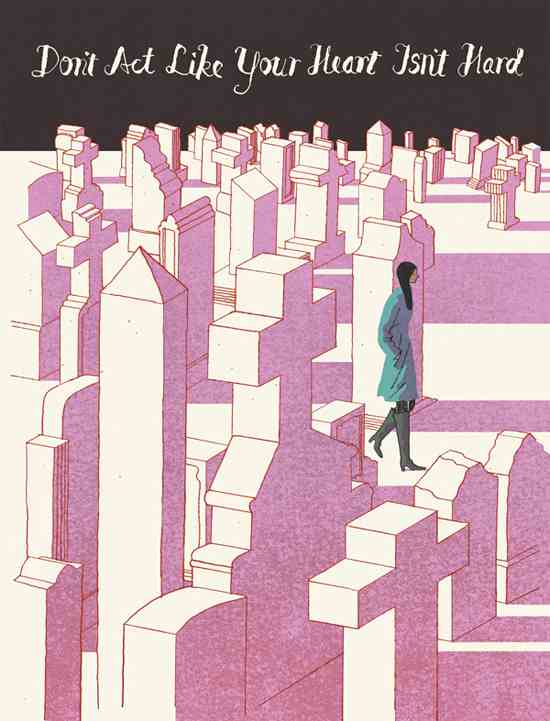
However, the album does pose some interesting questions about what music is and the possible role of the publisher in music production. In order to make the idea desirable and more than mere concept, the publisher has worked hard to ensure the album is aesthetically pleasing.  Marcel Dzama, who has previously collaborated with Hansen on his album Guero, has illustrated some of the album alongside others, creating a book where each song is illustrated in a beautifully individual style. The fonts used vary from page to page to compliment the illustrations, and thus every song has its own persona. This means anyone who buys The Song Reader is not merely purchasing an album but twenty skilfully crafted pieces bound in hardcover, with an elaborate Edwardian cover design that is homage to classical musical manuscripts. Preview images have been released on McSweeney’s website, and what is clear is Beck’s commitment to his vision of a modern tribute to an old style.

The release of a half page score of the song Do We? We Do prompted a flurry of videos and audio clips online of fans playing the song, interpreting it as everything from punk to a ballad. More recently McSweeneys released a page long sample of the song Why?, building on the interest in the Do We? Wo Do sample. These previews are a good marketing move on behalf of McSweeney’s, allowing musicians to integrate with the album even before its release. The sharing of these on sites such as Tumblr and Youtube raises the albums online profile  and is essentially free publicity. Expanding on this, McSweeney’s has announced that tracks and samples can be submitted and shared via an official page which has just launched in anticipation of the albums release. This further raises the album’s profile and simultaneously that of the musicians contributing to the project. However, it also crucially provides a platform for those who wish to hear the songs but cannot play them themselves.

Beck’s high profile sells itself, so The Song Reader may not be such a high risk for McSweeneys and Faber. As Hansen has not released a full album of his own work since 2008, anticipation for a new project has been growing steadily. Although early online reactions to The Song Reader were largely negative, there has been a more positive response since the early release of the Do We? We Do and Why? samples, and pre-release orders of signed copies at $50 sold out in a couple of days. It cannot be denied that McSweeney’s have taken on a complicated and innovative project, with a convoluted audience that may be hard to target. However, the early release of song samples, pre-release sales and previews of the artwork has created a buzz that may mean the project is more popular than early reactions would have anticipated. The clever song-sharing marketing scheme on The Song Reader website allows give-it-a-go musicians a way to be involved, while fans of music as an art form may enjoy the aesthetic of a project that has been beautifully and brilliantly designed. Although The Song Reader is unlikely to be as popular as a recorded album, for a concept it may prove surprisingly successful.

Meeting Adrian Searle

November 8th, 2012 by Luca Baffa | Posted in Blog | Comments Off on Meeting Adrian Searle
Tags: , ,

The Visiting Speaker on 4th October was Adrian Searle, editor of the leading Scottish literary magazine Gutter and publisher at Freight Books. He gave a brief account of his previous career in the publishing field and a description of the projects he is currently working on.

The first publication Adrian described is a collection of short stories: The Hope That Kills Us, An Anthology of Scottish Football Fiction (2002). He came up with this idea in 2001, when he decided to undertake a commissioning project to raise a profile as a publisher. So, with the collaboration of a number of Scottish writers and a photographer, he worked as the editor of this publication. The market of this book was wide enough, from sportsmen to their relatives, and the book sold a thousand copies in paperback all across Scotland.

As the second example of publication, Adrian presented a fascinating book: The Knuckle End (2004). One of the peculiarities of this work is the design: the book appears as two pocket hardback books connected by the cover. The first book is an anthology of stories written by postgraduate students (2003-2004) of the noted Creative Writing course of the University of Glasgow. The text is organized in two columns on each page, and they are reproduced slightly skewed. The typography is completely left to the Victorian master class standard (elaborated types based on traditional letterforms). The second book is a love story shaped as a collection of photos, of self indulgent nature and wrapped in a vernacular typography.

Afterwards, Adrian talked about Gutter. There are few places where authors can publish short stories in Scotland. The aim of Gutter is to fill this lack of outlets and to provide the readers with high quality stories written by Scottish authors (or writers who have a connection to Scotland). The magazine has a taste of old-fashioned literary magazines, there is great care in the use of the typography, and there are no images (except for some cartoons). The magazine is meant to be a beautiful physical object, so there is not an electronic version of the magazine.

Adrian started Freight Books to extend his publishing work from Gutter to a wider selection of writers and audiences. The main characteristic of Freight Books is the size: being small and independent, it is much quicker than bigger publishing houses at undertaking new projects. Also, the titles selection is more balanced on the quality of the products rather than big profits. The second characteristic is the book choice, mostly contemporary fiction, and the high standards of the texts.

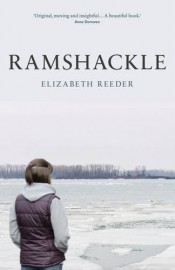
The publishing house aims to release from 10 to 15 books every year. The authors of these publications are debuts, writers who were formerly published in Gutter, and some other writers with a British-Scottish background. He went through a long list of titles that Freight Books has published in the last few years: Killing the Messenger (2011) by C.  Wallace, Furnace (2012) by W. Price, Ramshackle (2012) by E. Reeder, Tip Tap Flat: A View of Glasgow (2012) by L. Welsh, My Gun Was As Tall As Me (2012) by T. Davidson, All the Little Animals (2012) by W. Hamilton and S. Howell, Healing of Luther Grove (2012) by B. Gornell. Then, he told us about a few other titles which are going to be published in the next few months including 101 Uses of a Dead Kindle by A. Searle himself and J. Hastie (8 Oct 2012), and Fabulous Beast by P. Ace (Spring 2013).

I really admire the work of this publisher which is driven by a genuine interest in books and their authors. Adrian described in great detail every feature of the books he edited, with special attention to their look and feel. The authors, also, had been referred to with the greatest esteem during his speech, in an interesting combination of respect and friendship.

From the Other Side

November 4th, 2012 by Emily Ferro | Posted in Blog | Comments Off on From the Other Side

As is typical for students studying English, I had to write a senior thesis for a degree in English Literature last year. The topic I chose was concerning England’s King Richard III, who is remembered as a very controversial king. This is due to the mystery surrounding the disappearance of his nephews when the throne was up for grabs. Because of indecision about his character, Richard happens to have a present-day society set out to defend his name. The Richard III Society has a publication, The Ricardian, which publishes articles concerning Richard’s life. Over the summer, I made it my goal to submit my thesis for publication in The Ricardian. After spending the summer revising it, I finally submitted my essay. It was the first time I had put my work on the line, and I was hopeful because it was such a specialized journal.

Despite my high hopes, my submission was rejected. I was told that my essay did not fit in the journal because it was not a new historical discovery. Although this is a valid reason for a piece to be rejected, there is no getting around the fact that rejection still stings. This rejection in particular was an interesting experience for me because I am not only an author, but also an aspiring editor. I understand that sometimes a manuscript or piece of writing must be rejected because it does not fit the criteria of the publisher. I also know, as an author, that a work can be rejected more than once before getting an acceptance.

After rereading my thesis with the eye of an editor, I can understand that it is too long for the length of the journal, and that perhaps it is a bit too academic. Despite disappointment, this experience has taught me a very important lesson. The rejection is not necessarily a bad thing. Receiving one rejection letter has inspired me to submit other pieces of my work to other journals to potentially be published. I have spent years writing short stories, too intimidated to ever submit my work, and having had the courage to submit my thesis has given me the push I needed to explore other means of publication.

This is an important lesson to learn as an author because there are increasing numbers of ways to get your work out there these days, be it through traditional publishing, self publishing, or even by creating a personal website or blog to display your work. These facts are important for me to make a mental note of as I work towards a career in the publishing industry. I need to tie in my experiences as a writer and as a future publisher to be able to advance my career. As an author, never give up, and as an editor I need to have the same passion for the works I endorse as the author who wrote it.

Emily Ferro

Rolling it Alone – The Challenges of Independent Comic Publishing

November 2nd, 2012 by Joanne Marjoribanks | Posted in Blog | Comments Off on Rolling it Alone – The Challenges of Independent Comic Publishing
Tags: , ,

I wouldn’t say I’m necessarily a fan of comics. I don’t have anything against them; I’ve just never felt drawn to them. That being said, as a student of publishing studies with an avid interest in all aspects of the industry, I happily went along to a discussion hosted by the Society of Young Publishers in Glasgow recently, where the question of ‘Do comics need publishers?’ was debated.

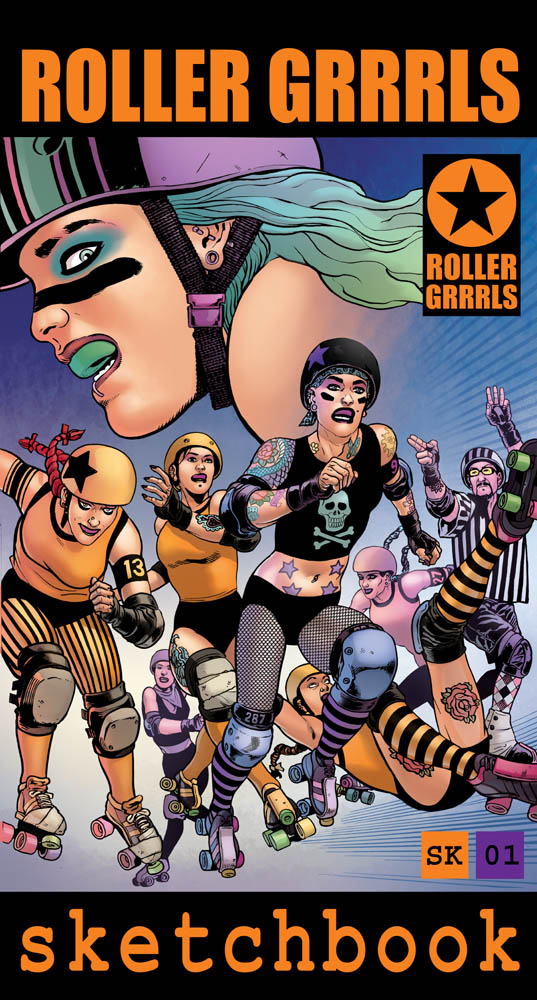
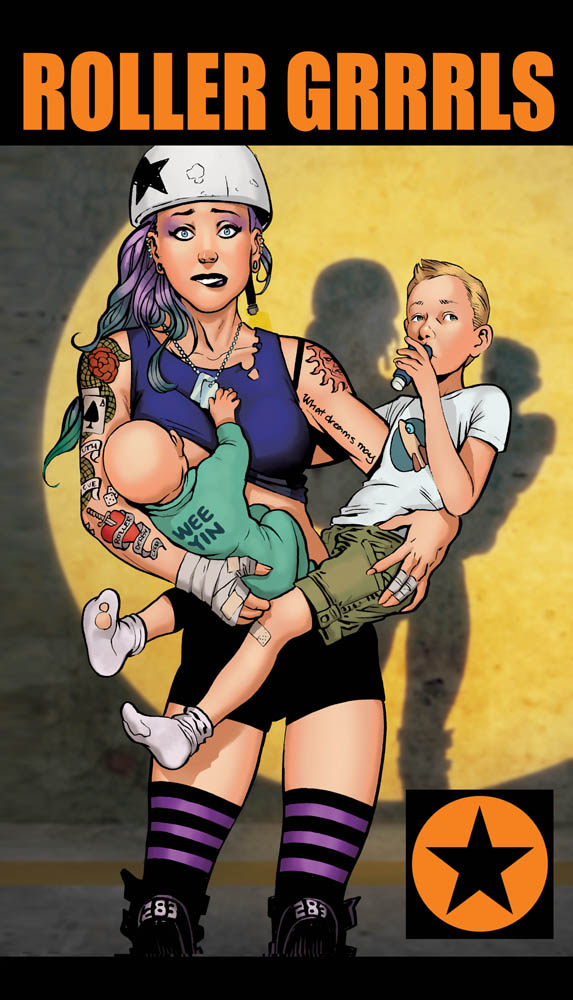
Although I found the debate itself to be very interesting and enlightening, what had the greatest impact on me that evening were the discussions I had with Gary Erskine, one of the panellists, and his wife Anna Malady. As well as taking part in the actual debate, they were also showcasing a sketchbook of sample artwork and character sketches to raise money for their forthcoming comic – Roller Grrrls. The characters come from all walks of life: a nurse; a teacher; a librarian; a scientist; even a pregnant young woman. Yet they are all united in their love of roller derby.

My publishing course places a great emphasis on thinking about the target audience for a publishing product. Well, comics are only for comic lovers, right? Not necessarily, according to Gary and Anna. Rather than aiming their product towards general comic enthusiasts who might frequent the Marvel and DC Comics dominated aisles of the high street shops, Roller Grrrls is primarily targeting fans of roller derby itself, and, by extension, a wider audience of sports enthusiasts.  Of course, if they are able to sell their comic to mainstream retailers, then that would be fantastic, but they were very clear that this is not their primary aim.

Of course, coming up with a great concept is only the first stage in producing a finished product, and there are often challenges to be overcome and lessons to be learned along the way. This has certainly been the case for Gary and Anna, who were more than happy to chat with me about their experiences so far.

A major problem has been the actual distribution of the sketchbook. As with any publishing product, once the fun part of actually designing and producing it is over, attention necessarily turns to more mundane concerns – like postage costs. The Roller Grrrls sketchbook has been printed on high quality – and therefore heavy – paper, and as a result the postage costs are very steep, especially for international locations such as Australia.  Customers might be willing to pay a higher price for the product itself; however, many will baulk at being asked to pay for postage that might exceed even that amount. In light of this Gary told me that, when the actual comic series is produced, it will be printed on significantly lighter paper in order to reduce postage costs.

Issues like this are the unfortunate reality for the smaller, independent publishers like Gary and Anna, whose only real desire is to produce a beautiful piece of artwork to be enjoyed by people with a passion for comics – and roller derby. I may not be a comics fan, but I did buy a copy of the sketchbook. So, I guess this proves Gary and Anna’s point – you don’t have to be a comic geek to pick one up every now and then.

Joanne Marjoribanks

Below are the links to the Roller Grrrls website and social media pages. I highly recommend that you check them out.

Website: http://www.rollergrrrls.com/

Facebook: http://www.facebook.com/pages/Roller-Grrrls/132062103543401

Twitter: https://twitter.com/rollergrrrls

Tumblr: http://rollergrrrls.tumblr.com/

*Images used with permission. Credit: http://www.rollergrrrls.com/
Bloody Scotland: Agents and Publishers Panel (14/09/2012)

October 23rd, 2012 by Blake Brooks | Posted in Blog | Comments Off on Bloody Scotland: Agents and Publishers Panel (14/09/2012)


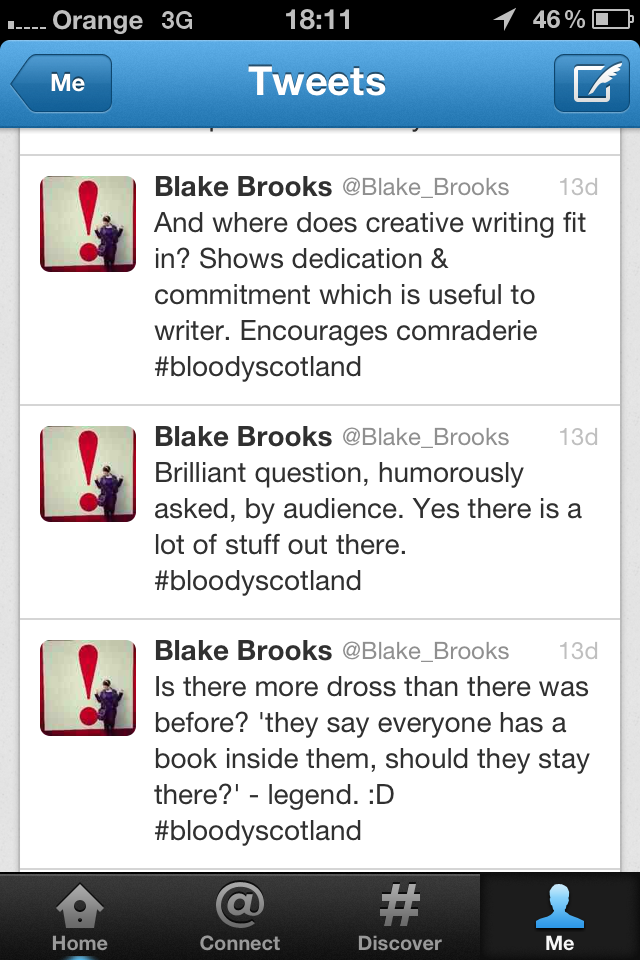
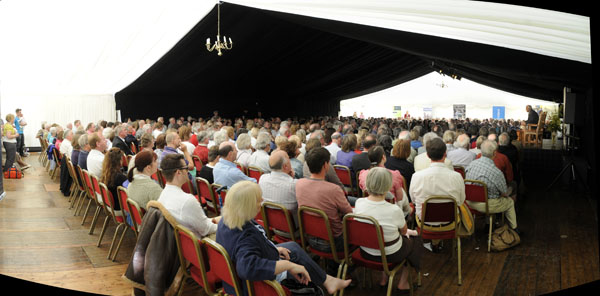
As part of the Bloody Scotland event I live-tweeted an event held in the Macroberts Art Centre featuring various people from the publishing industry discussing various elements to becoming part of the process of publishing – from conception of ideas to the end product. The panel consisted of

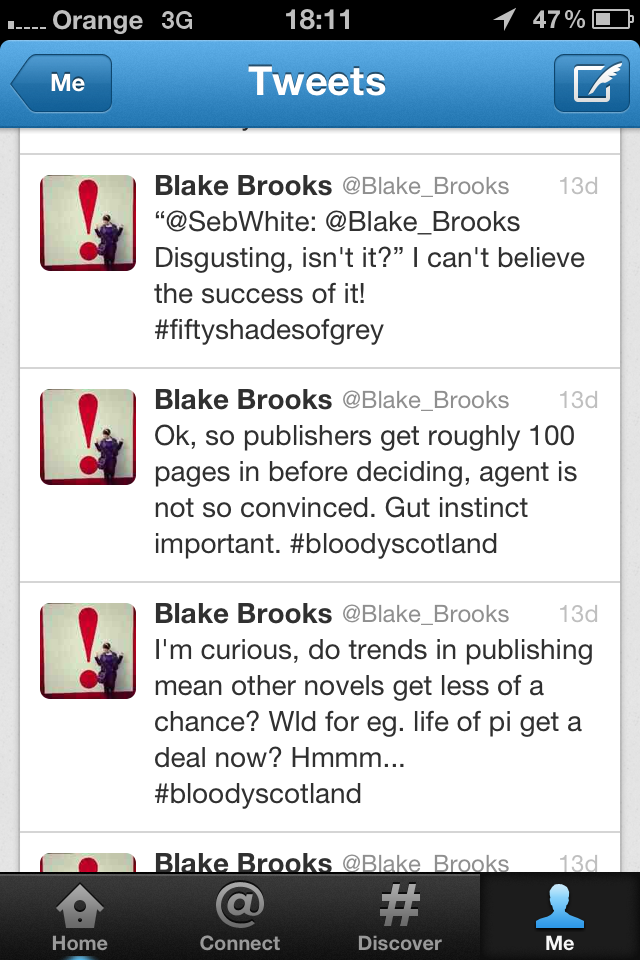
During the discussion topics varied between the role of eBooks in the modern publishing world, how to get published, what content is popular and self publishing. Throughout this I tweeted periodically, attempting to succinctly explain what was being discussed. I used the hashtag #bloodyscotland so the tweets would appear alongside other tweets from the festival. This increases publicity for the events and raises awareness both for those already interested and involved in the events, as well as for others. I regret not tweeting directly to the Bloody Scotland twitter account, as this would also have increased publicity for the event and got more people involved.

I was quite pleased with the response I received. I got tweet responses regarding the amount of money E.L. James makes from her self-publishing of Fifty Shades of Grey which I retweeted. As well as this, following the session I received a tweet from Rachel Raynor, who was on the panel, saying she enjoyed my tweets (which, considering I’d tweeted her name incorrectly due to mishearing, was very kind). Finally I gained 20 followers the week after my live tweets, many publishing companies or publishing related twitter feeds. I feel therefore that the live tweets were a success.


What’s the Point of Literary Festivals?

October 21st, 2012 by cs48@stir.ac.uk | Posted in Blog | Comments Off on What’s the Point of Literary Festivals?
Tags: , ,

One of the Stirling Centre for International Publishing and Communication’s research projects, the RSE-funded Book Cultures, Book Events, has its final event at 10am on Thursday 25 October, at Literary Dundee.

Our Director Claire Squires will be chairing an event titled ‘What’s the Point of Literary Prizes?’, and the speakers on the panel will include Anna Day (organiser of Literary Dundee), Kirsty Gunn (author and Professor of Creative Writing at the University of Dundee) and Adrian Searle (publisher at Freight Books).

If you’ve ever wondered what goes on behind the scenes at a literary festival, the session will give you a privileged peek into the green room, the box office, and the organisers’ diaries.

Tickets are free and can be reserved via the Literary Dundee website.