MLitt Publishing Studies

Publishing Showcase 2014

April 24th, 2014 by cs48@stir.ac.uk | Posted in Blog | Comments Off on Publishing Showcase 2014
Tags: , , ,

We’re already nearing the end of classes for 2013-14!

Only a moment ago, our 2013-14 cohort of MLitt in Publishing Studies students were fresh-faced and eager to embark on their publishing studies.

Now, they may be a little more tired, and both excited and intimidated by the job search ahead, but more than anything they’re much more publishing savvy.

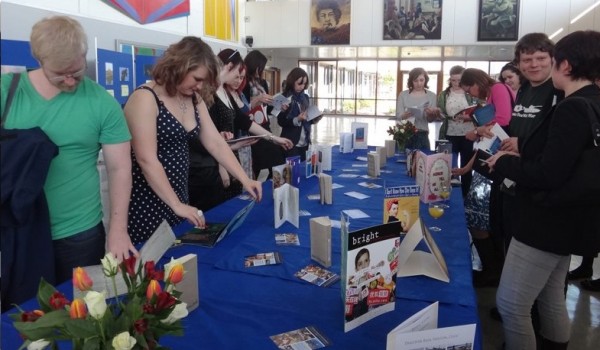
We’re celebrating their achievements on Monday 12 May by showcasing their work from the Publishing Project. There will also be invited guests from our Industry Advisory Board, and a selection of our PhD and MRes students speaking in a round table about publishing studies research.

You are welcome to join us to either or both parts of the afternoon – please let us know if you’d like to come so we have an idea of numbers.

3-4.15pm Round Table on Publishing Research (Chaired by Claire Squires, with Maxine Branagh, Paul Docherty, Carol Mango, Rachel Noorda, Anna Kiernan, Stevie Marsden and Louisa Preston). Pathfoot B2

4.30pm onwards Publishing Showcase and Drinks Reception. Pathfoot Crush Hall.

An Introduction to Oxford University Press

December 12th, 2013 by Min | Posted in Blog | Comments Off on An Introduction to Oxford University Press
Tags: , , , ,

Min Yu reports on Vivian Marr (OUP)’s Visiting Speaker session:

Oxford University Press is a worldwide academic publisher. We were so lucky to have Vivian Marr, Head of Language Acquisition from the Global Academic Business to give us a presentation about OUP. According to Vivian’s talk, we know so much  information about the press and learned useful knowledge.

First of all, Vivian introduced the important history timeline of the OUP, for example, in 1478, first book printed in Oxford, first publication of Oxford English Dictionary (in instalments) in 1884 and OED online launched in 2000. With the develoment of OUP, it has enabled excellent research, scholarship, and education by publishing worldwide. When Vivian introduce the range of publishing, we are surprised that OUP has 6500 employees in 60 countries and more than 4000 employees are outside the UK. It has more than 6000 new copyrights per year across 40 languages. We can see OUP is the largest and most successful University Press in the world.

Then, Vivian presented the structures of OUP and its governance. It is amazing that its publishing branches are in 13 countries, offices in another 50 countries and representation in more that 50 countries. OUP has 5 main business groups to maintain and extend the market: Global Academic Business,English Language Teaching, Oxford Education (Oxed), Asia Education and OUP Esp.

OUP also has rapid digital growth, with its digital sales doubling in the three years 2012. OUP now has more than 15,000 UK and US titles available as eBooks, and 250 mobile Apps for iPhone, iPad, and other mobile devices-developed using OUP content. Finally, Vivian told us about the development of dictionaries at OUP in the future. Dictionaries are also very important because they provide new business and revenue opportunities because digital licensing income of the dictionaries will replace the lost print salses revenue. In the future, OUP would like to lead the global brand in the world, so it has some global language solutions, for example, it will use a global content brand to work with global technology companies.

After Vivain’s presentation, I learn so many useful things.She also gave us some useful websies and twitter presence, so if you want to learn more about OUP, you can visit these :

www.oup.com: general information about OUP, also vacancies and internships
www.oxforddictionaries.com: free dictionary service with premium subscription service
www.oed.com: the full history of the English language, constantly updated
www.oxfordreference.com: access to hundreds of Oxford’s reference titles
www.oxfordlanguagedictionaries.com: French, Chinese, German, Russian, Italian, Spanish bilingual dictionaries

Twitter presence

•@oupacademic: info on OUP’s publishing, mainly from the Global Academic Business Division
•@oxfordwords: anything to do with words, new and old, grammar, writing, language and lots more
•@oed: the latest research from the Oxford English Dictionary

The Mood Board Project

December 11th, 2013 by Amalia Koulakioti | Posted in Blog | Comments Off on The Mood Board Project
Tags: , ,

Definitely one of the most enjoyable activities of the course was the creation of a mood board. Our mood board had to be related to our publishing project and contain interesting things that might act as an inspiration for us.

It was a perfect opportunity to show our creativity and to think about our upcoming publishing projects.

My mood board included images of Greek goddesses, covers of favorite fantasy and dystopian novels, a draft sketch of how I imagine my cover to be, and a sample of different typefaces that I might use in the actual project.

Of course creating the mood board was only the first part of the fun. Bringing them with us in class and observing what everybody else had created, was the second.

The class filled with colors, pictures, even fabrics. All of the students had tried their best to create beautiful and inspiring mood boards. Liam’s mood board was full of colorful landscapes, traditional dances and Scottish monuments.

Dana’s mood board was a playful look at one of the most iconic British heroes, Sherlock Holmes. Her whole mood board looked like a children’s novelty book.

Laura (Jones) presented her favorite ampersand in a purple font, with various different pictures and images inside it, while Aija’s mood board was in a black font, with dozens of letters embracing the protagonist of her story.

Clem’s chest looked like it had come out straight from the pages of a novel, with letters, cards, and books about the Great War inside of it.

Jana’s mood board was so deliciously medieval. Arthurian legends, wonderful castles, beautiful manuscripts found their way into her project (her husky was adorable as well!).

Alexis was purely…anatomical. A ribcage, a human heart, the muscles in an arm, the eye cornea and a skull, were all part of her mood board.

Keisha presented nostalgic pictures of her academic years, combined with popular cartoons like the Simpsons, Bugs Bunny and Tom & Jerry.

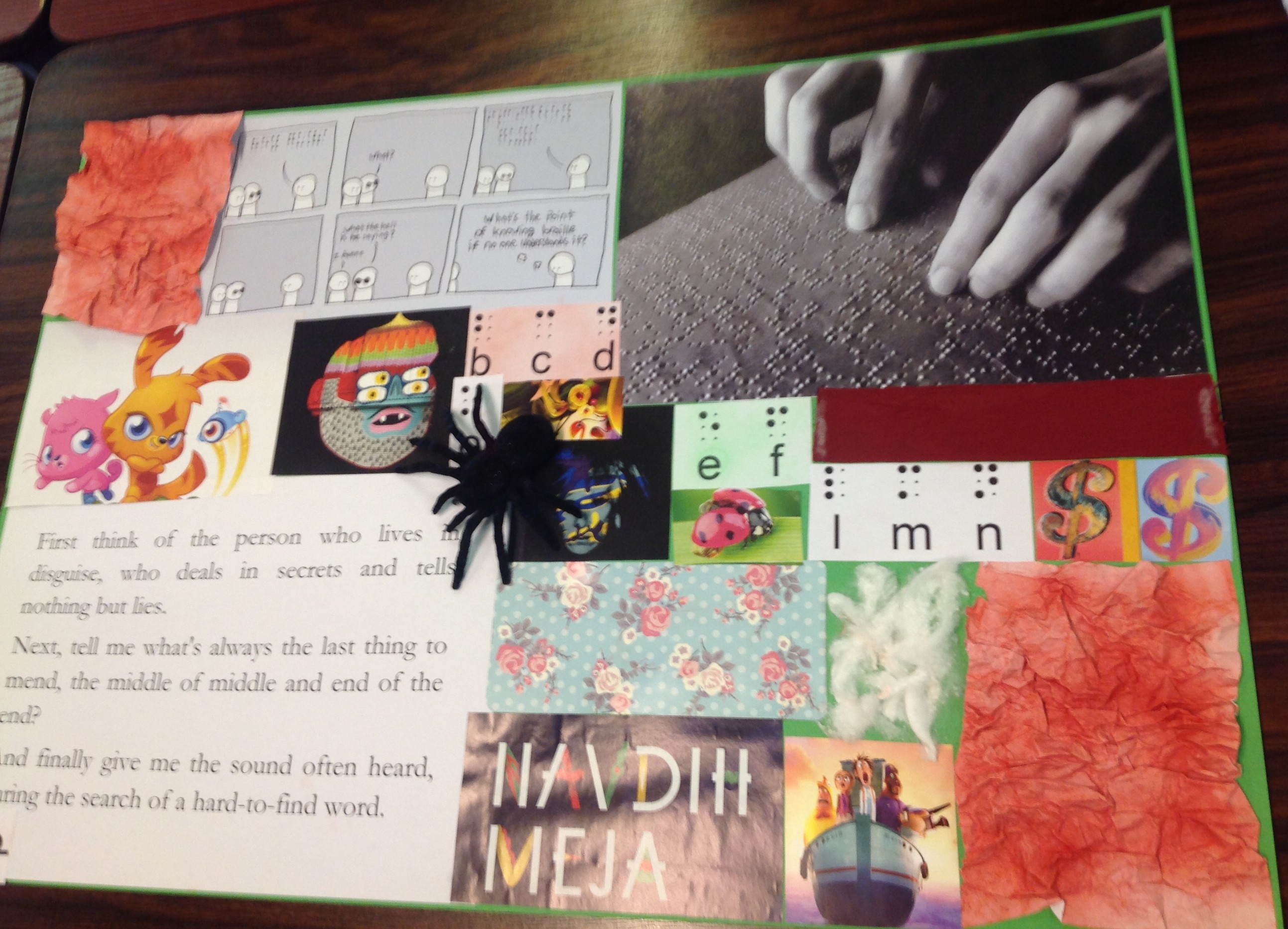
Ana combined pictures, textures, and words to create a beautiful demonstration of her upcoming Braille project.

Vidhya showed us the sights of her hometown, the customs and traditions of a typical Indian city.

Laura (Muir) collected pictures of some of the most fascinating tattoos and Rosie’s mood board was full of flowers, lovely drawings and…bees.

Fanny’s mood board was romantic; the box that she used was like an object you can find in a Jane Austen novel, as well as the letters inside.

Lastly, Monidipa collected images from dystopian landscapes and futuristic cities, along with her logo for her publishing project.

Amalia Koulakioti

Aija Oksman, MLitt Publishing Studies 2012-2014 (PT)

November 26th, 2013 by Aija | Posted in Student Profiles | Comments Off on Aija Oksman, MLitt Publishing Studies 2012-2014 (PT)
Tags: , , , , , , , , ,

My interest in publishing stems from being read to when I was a child, growing up in very literary oriented surrounding and having done my undergraduate in Literature and Linguistics at the University of Salzburg. My time in Edinburgh is split between the MLitt Studies, my two jobs and volunteering for Rock Trust. I enjoy being busy, I enjoy putting my gathered skills in actual use and I look forward to be part of publishing world.

I have lived as an expatriate (so far I have lived in Finland, Belgium, Ireland and Austria) for over thirteen years, I have developed a new appreciation for my own language as well as for translated literature. Therefore, my personal interests have been developing towards literary agency and marketing, as well as minority and international literatures – so the ultimate dream would be to be able to find my place in the world where I could combine most of that. That, or alternatively I could open my own little restaurant, with walls covered in bookshelves. Food for the tummy and mind.

Publishing Prizes 2012-13

November 8th, 2013 by cs48@stir.ac.uk | Posted in Blog | Comments Off on Publishing Prizes 2012-13
Tags: , , , , ,

The Stirling Centre for International Publishing and Communication at the University of Stirling is delighted to be making the following awards to students who will be graduating from the MLitt in Publishing Studies on 22 November 2013.

• The Freight Books Prize for Publishing Design – Lina Pettersson Langlee

• The Faber & Faber Prize for Digital Innovation – Claire Jeffery

• The Publishing Scotland Prize for the Best Dissertation – Lina Pettersson Langlee

• The Taylor & Francis Prize for the most Distinguished Student on the MLitt in Publishing Studies – Joanne Marjoribanks

All the prizes are sponsored by members of the Centre’s Industry Advisory Board, several of whom are offering prizes to students in the Centre for the first time.

Lina Pettersson Langlee is the recipient of both the Freight Books Prize for Publishing Design and the Publishing Scotland Prize for the Best Dissertation. For the former, she took on a challenging design project, producing a beautiful final product which demonstrated panache, clever choices, and strong understanding of the potential market for her book, Dear Father… For this, Lina wins £100 of cash and £100 of books of her choice from Glasgow-based publisher Freight Books.

Lina’s prize-winning dissertation, for which she will receive £100 of books of her choice from Publishing Scotland’s BooksFromScotland.com website, was titled ‘Is Text No Longer Enough? A Look at the Digital Turn of “New Literacies” and Going Beyond the Text’. The dissertation examines how publishers are attending to new digital literacies, and included case studies of The 39 Clues and Pottermore. Her conclusion to the question of whether text is no longer enough? Simultaneously yes and no. Lina is currently working on a freelance basis for a number of companies, including Freight Books.

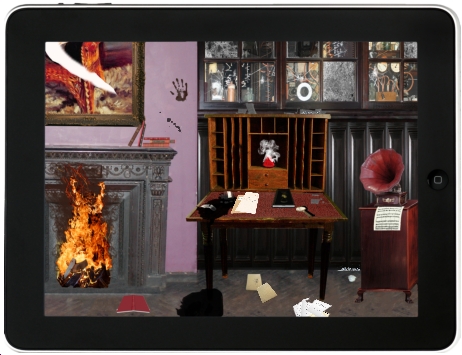
Claire Jeffery is the winner of the Faber & Faber Prize for Digital Innovation, for her work developing the concept of and designs for an app based on Robert Louis Stevenson’s Jekyll and Hyde. Claire’s work here demonstrated strong knowledge of the original text, including how to adapt and gamify it for a digital market. She embraced the digital medium’s capacity for extra material and interactivity. Her award will consist of a two-day placement with Faber & Faber in London, during which she will have the opportunity to meet with the heads of Faber Digital, Faber Factory, and the marketing team. Claire is now working as Production Assistant at Prepress Projects in Perth.

Joanne Marjoribanks is the winner for the Taylor & Francis Prize for the most Distinguished Student on the MLitt in Publishing Studies, thus winning £200 of books from T&F. Jo’s overall grade profile on the course was consistently high, and she produced extremely strong work including a dissertation which examined ‘The Soul of the Indie Bookseller’, and a publishing project in which she created a guidebook for families with teenagers whose siblings are autistic.

Professor Claire Squires, Director of the Stirling Centre for International Publishing and Communication, commented that ‘It’s a great validation of our MLitt in Publishing Studies to have these industry-sponsored prizes, which showcase the work of the Centre and its students. We congratulate the individual students on their creativity, knowledge, skills and understanding of the publishing industry, and are particularly delighted to be able to have prize-winning work which celebrate digital savvy and entrepreneurialism – key attributes for the publishers of the future.’

Dana Peters, MLitt in Publishing Studies, 2013-14

October 30th, 2013 by Dana Kendra Peters | Posted in Student Profiles | Comments Off on Dana Peters, MLitt in Publishing Studies, 2013-14
Tags: ,

Hello! My name is Dana Peters and I just started my journey with the MLitt in Publishing Studies program.

The road toward traveling from California, USA all the way to Stirling, Scotland was a long one. My BA in European History from the University of California, Santa Cruz could take me in a great number of directions, but what I really had a passion for was books. Reading any kind of book, even textbooks, was a joy. Books have always been a constant friend in my life.

Working in the publishing field feels like the right decision. The University of Stirling‘s MLitt in Publishing Studies sounded like a dream come true, especially for someone whose major editing experience extended as far as making story corrections for friends.

I’m looking forward to learning more about this rapidly changing industry and gaining the skills I need to thrive in the publishing industry. This is a big chapter in my own story and one I hope to make the most of.

If you’re interested in following my journey, I am now on Twitter.

Conny Lenz, Cengage Learning

October 23rd, 2013 by Xiaolin Ma | Posted in Blog | Comments Off on Conny Lenz, Cengage Learning
Tags: , , , , ,

Conny Lenz‘s visit to Stirling was impressive and meaningful for us. She is a Publishing Studies alumna and digital publishing assistant at Cengage Learning. Conny Lenz introduced her route into publishing and her current job at Cengage Learning.

First of all, she began by expressing her personal feelings about the Stirling publishing course. She thinks this course is very helpful, because it provides a sound overview of the publishing industry, teaches students how to finish marketing and sales tasks, trains students of all kinds of ability through dummy projects, and helps students accomplish their dissertation. Her words inspired us to move forward.

Conny then went on to talk about her route into publishing. She mentioned that internships are very important, and she advised us to contact as many publishing recruiters as possible. She also mentioned that we could use social networks like LinkedIn for our careers. She stressed the importance of competitor awareness in interviews.

Maybe because some of us are not familiar with library reference, Conny introduced the work that library reference does. It needs to source content from libraries and institutions, such as The National Archives, British Library and Royal Archives. It needs to assess, oversee and manage the digitisation of the content. It will determine design and layout of product and images. Providing marketing and sales teams with documentation and information on the product is also a part of its work.

Next, Conny presented how digital archives were created and how to use the search engine of the Daily Mail Historical Archive.

The next topic focused on her current work at Cengage Learning. Her first project was Nineteenth Century Collections Online. The second project was the management of the transfer of seven products from one platform to another. The third project was the State Papers Online, Eighteenth Century Part 1. The fourth project is Punch Historical Archive 1841-1992. She showed her projects by using a lot of images of raw materials and the process of designing these library references, and which fully showed her work at Cengage Learning.

This is an informative session about library reference, and I think the whole class will agree we learned a lot during this speaking. Thanks, Conny!

-Xiaolin Ma

Tweets from Conny’s Visiting Speaker session have been Storified here.


Min Yu, MLitt in Publishing Studies 2013-2014

October 22nd, 2013 by Min | Posted in Student Profiles | Comments Off on Min Yu, MLitt in Publishing Studies 2013-2014
Tags: , ,

Hello, everyone, my name is Min and I am  from the city of Shenzhen (near Hong Kong), Guangdong Province, China. I am 26 years old and I was born in Shandong Province which is in the north in China. Actually, I have been working in a media company as a media asset manager for 3 years after I graduated from my undergraduate university, Shenzhen University with a degree in Communication.Then I decided to improve myself to get a master degree, so I quit my job and became a student again.

The publishing industry is very technological and advanced in UK, so that’s why I choose to study publishing here. When I started studying, I find there are a lot of information and knowledge needing to be received and understand. It is not easy for me to study these , so I decided to spend more time reading books. I think it is really a challenge for me to study. On the other hand, I find I can learn a lot from this programme, especially I can learn various cultures in my class because this is a great international class. The classmates are nice and they have different personalities. I also can learn something from them because we have different educations and backgrounds.

The most important thing is that I hope my English language will be improved effectively and I can read many books. There are many fantastic books in UK and I really want to read as many as possible. In the future, I hope I can work in the library in my University in China because I love the environment of libraries and campus.

My hobbies are watching movies, travelling, so I will plan to travel to Europe at this studying aboard year. I hope this year will be unforgettable.


MLitt Publishing Studies students visit BookSource distributors in Glasgow

October 9th, 2013 by Clemence Moulaert | Posted in Blog | Comments Off on MLitt Publishing Studies students visit BookSource distributors in Glasgow
Tags: , , , ,


You walk into a bookshop (if you still do that sort of thing), you pick up a book that looks interesting; with a bounce in your step, you take it to the till, you buy it; you take it home and disappear into it for a few hours. A delightful experience — but do you ever wonder about the journey that book has taken to get to you?

Before it gets to the bookshop it goes through a distributor, a step most readers will not be familiar with. The postgraduate students on the current MLitt Publishing Studies programme recently visited BookSource in Glasgow to learn more about the distribution process, to visit the warehouse and find out how this book distributor is coping in our troubled industry.

BookSource, one of the UK’s foremost book distributors for independent publishers, has existed since 1995 and thrived since then — up until the digital revolution and Amazon, that is.  These last two factors mean that the distribution step is no longer as important as it used to be, and in the future might even be obsolete.

The staff at BookSource are well aware of the dangers facing their business. Managing information is key to their survival: they must be on top of the latest innovations at all times and re-imagine their business strategy in order to remain a fierce competitor on the market. Tapping into the digital book distribution market is a big part of their new business plan. Nevertheless, they are aware of the limitations: ‘I think it will be a sad, sad day when we start making children’s e-books,’ says Davinder Bedi, director, managing director at BookSource.


Davinder believes that Scottish Independence is another threat looming on the horizon. With borders possibly closing off a huge market for BookSource, their business may not survive at all. Publishers like being physically close their books—if Scotland becomes a country on its own, who is to say that British publishers will want to do business outside of their country? Davinder is pessimistic: he doesn’t think the Scottish market is big enough to survive on its own.

Where will BookSource stand in five years’ time — will it even stand at all? Will the warehouse close down or will it be unrecognisable, totally adapted to a wholly changed industry? One thing is for sure: BookSource is determined to try and re-invent themselves before throwing in the towel. The publishing industry must take example from BookSource: we must be perceptive, inventive, and most of all ruthless visionaries to thrive in the digital age.

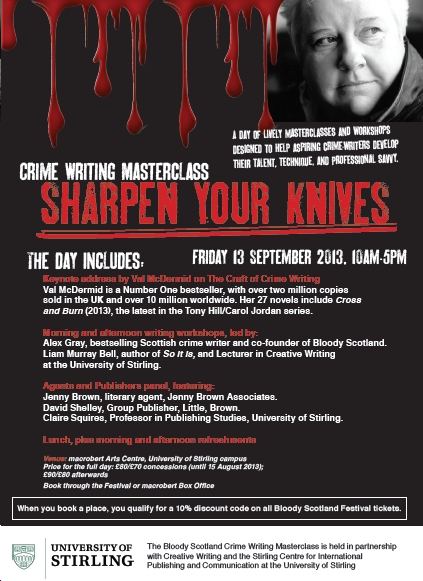
Bloody Scotland Masterclass – Agents’ and Publishers’ Panel

October 7th, 2013 by Aija | Posted in Blog | Comments Off on Bloody Scotland Masterclass – Agents’ and Publishers’ Panel
Tags: , , , , , , , , , , , ,

One of the perks of this year’s Bloody Scotland International Crime Writing Festival in Stirling was the opportunity to hear the best of the field offer advice to hopeful writers on the process of writing, publishing and whatever comes in between.

The Agents’ and Publishers’ panel was lead by Claire Squires, director of Stirling Centre for International Publishing and Communication on September 13th. The panel discussed what happens after the next hopeful front list bestseller has been written and when the author seeks to have the manuscript accepted either by an agent or a publisher.

Taking part in the panel were Jenny Brown, of Jenny Brown Associates, and David Shelley, of Little Brown. Jenny is equally inspiring and intimidating for an aspiring literary agent such as myself, having opened her agency in 2002 after years of formidable experience, not forgetting being the founder of the Edinburgh International Book Festival. If that’s not enough, she and her associates have become the biggest literary agent in Scotland and one of the leading agencies in UK, with international reputation.

David on the other hand represents the other hurdle in the writer’s way towards bestselling stardom – the publisher. David, who has worn many a different hat under the general title publisher has not settled for one particular job title – he also guests as an editor for a few selected authors within Little Brown, including Val McDermid and Mitch Albom (and yes, JK Rowling too, but let’s focus on other exciting aspects of David’s career, shall we?).

Jenny launched right into the session by emphasising how crime writing is still the fastest growing genre in the UK (and one of the leading internationally), with approximately 30% of the book market. David agreed – crime writing is definitely the most commercially growing genre that is remarkably consistent despite other market or trend fluctuations – fluctuations we know all too well that publishing is harshly dependent on. As the trend moves on, so will the publisher.

Both Jenny and David agreed that trends are nearly impossible to keep up with; what is “hot” right now could very well be over by the time you have the manuscript of a bestseller that nicely fits into that pigeonhole all finished and ready to be pitched. Trends move on faster than anyone can write, and rather than focusing on fitting into that niche, both Jenny and David emphasised, an aspiring writer would do well to focus on being passionate and finding your own voice, your niche, rather than doing lavish imitations of others’ work. Jenny also – to my great pleasure – emphasised how translated crime writing is breaking the barriers and entering the UK market. David remarked upon the cold realism of marketing; it is nearly impossible to bring out a title that is based on the same basic idea as one published before. There is no space in the market for two great Fife based detectives, but there might be space for one great detective from Fife, and the other from – why not – Stirling. How you present your setting is what makes you, as a writer, unique.

Classic crime is being brought back as well as being retranslated. Foreign authors are intriguing, whereas deceased writers are proving to be some of the toughest competition to the wave of new writers. One particularly interesting piece of advice that David provided for budding writers was to imagine further than one novel. He has found himself attracted to authors who can envision at least a couple volumes of a series, can explain character traits and subplots beyond that one particular event in the novel they are currently pitching. A good series of novels with an ever-evolving character can very well be the key to cracking your way into the crime-writing scene.

Claire led the discussion to the actual publishing process; what channels are there for new writers? How can one get their manuscript read, represented and subsequently published? As expected, both David and Jenny agreed on this point strongly; get an agent. It is nearly impossible to break into publishing without being professionally represented. Most publishing houses do not accept unsolicited manuscripts so agents act as a quality control filter for publishers. Jenny emphasised having manuscripts edited by a professional freelancer – never submit anything you are not absolutely sure is the best it can be. And this is doubly important for self-publishing authors.

Be confident, know your trade, know your next few steps and especially – know whom you are talking to when making a pitch. Let your story do the talking. It is even more advisable to target your agent and publisher. Do your homework – know whom you are pitching to and make sure they know why you have chosen them. Or perhaps if you’re desperate and unsure of your manuscript, a box of chocolates never hurts – doesn’t necessarily help either, but definitely never hurts.

Claire opened a topic that is much debated in publishing circles – self-publishing. Jenny explained how self-publishing allows more control and can lead to enticing a wide readership, which in turn encourages word-of-mouth and reviews before landing under the ears or eyes of an publisher. Self-publishing allows the writer to test the waters and to cater for the readership before attempting to break into the market. Although, writers would do well to note, that if you have already published something on the internet, the good bet is that a hopeful publisher would prefer to publish something completely new from you – or perhaps offer you a series deal. David did mention how even editors browse through self-publishing platforms – such as Authonomy – as you never know what you might find.

The panel concluded with questions from the master class participants; one particularly memorable was one lady from the master class, who has a number of novels (18 to be exact) published online but no one had yet approached her nor returned her numerous attempts to contact agents and publishers. Jenny’s initial reaction was to enquire what does she believe an agent could do for her that she cannot do herself? What indeed. To leave on a hopeful note, Claire asked both David and Jenny to give the master class some final words of inspiration. David encouraged the budding writers never to give up, as the first book published is rarely the first book written, and to especially venture into other avenues than traditional forms of publishing – digital, self-publishing and the like can prove to be a writer’s saviour, enabling an initial point of contact, enticing on its own merit. Jenny emphasised the necessity of wide reading, because all that we read will feed into what we write, how we write and how we present ourselves. There is hope for everyone.