MLitt Publishing Studies

Publishing Prizes 2013-14

April 12th, 2015 by cs48@stir.ac.uk | Posted in Blog | Comments Off on Publishing Prizes 2013-14
Tags: , , , , , , , , ,

The Stirling Centre for International Publishing and Communication at the University of Stirling is delighted to have made the following awards to students who graduated from the MLitt in Publishing Studies 2013-14.

  • The Freight Books Prize for Publishing Design – Laura Jones
  • The Faber & Faber Prize for Digital Innovation – Liam Crouse
  • The Publishing Scotland Prize for the Best Dissertation – Fanny Schmidt
  • The Routledge Prize for the most Distinguished Student on the MLitt in Publishing Studies – Laura Jones

All the prizes are sponsored by members of the Centre’s Industry Advisory Board.

Laura Jones's prize-winning Read. Write. Ink.

Laura Jones’s prize-winning Read. Write. Ink.

Laura Jones is the recipient of both the Freight Books Prize for Publishing Design. For this former, she produced the fascinating design project Read. Write. Ink., focusing on collectors of literary tattoos. It features writers close at home including Vicki Jarrett, but also examples she sourced via Twitter. For this, Laura wins £100 of cash and £100 of books of her choice from Glasgow-based publisher Freight Books. Fellow student Aija Oksman was Highly Commended in the Freight Books Prize for Publishing Design for her powerful project Pursuit: Empowering Post-Natal Depression.

Laura is also the winner of the Routledge Prize for the most Distinguished Student on the MLitt in Publishing Studies, thus winning £200 of books from Taylor & Francis. Laura’s overall grade profile on the course was consistently high, and alongside her Publishing Project she produced extremely strong work including the dissertation, ‘Amazon: Friend or Foe?’. Laura is now working at Glasgow publisher Saraband Books.

Fanny Schmidt’s prize-winning dissertation, for which she will receive £100 of books of her choice from Publishing Scotland’s BooksFromScotland.com, is titled ‘Copyright, Books and Social Media’. The dissertation, as tis abstract explains, ‘examines the interrelation between copyright and authorship on social media platforms, arguing that that it should be awarded with both a fair dealing exemption for the use of copyrighted material in those spaces and also a better protection of the copyright of original material produced for social media. It further examines whether or not social media content should be awarded authorship status in order to support the claim for copyright. However, the findings suggest that due to the high level of prosumption on social media, authorship in the traditional sense cannot be granted; calling into question the copyright legislation these websites should receive.’ A pdf of Fanny’s dissertation is available via this link. Fanny is now working at Bloomsbury Academic.

Liam Crouse is the winner of the Faber & Faber Prize for Digital Innovation, for his work developing the concept of and designs for a geospacial app mapping out the life of the celebrated Gaelic poet Duncan Bàn MacIntyre along the West Highland Way. Liam was the recipient of the inaugural Gaelic Books Council Scholarship at the Stirling Centre for International Publishing & Communication. His aware consists of a two-day placement with Faber & Faber in London, during which he will have the opportunity to meet with the heads of Faber Digital, Faber Factory, and the marketing team. A previous recipient of the award, Claire Jeffery, writes about her experience here.

Liam Crouse's prize-winning app The Duncan Ban Trail

Liam Crouse’s prize-winning app The Duncan Ban Trail

Professor Claire Squires, Director of the Stirling Centre for International Publishing and Communication, commented that ‘It’s a great validation of our MLitt in Publishing Studies to have these industry-sponsored prizes, which showcase the work of the Centre and its students. We congratulate the individual students on their creativity, knowledge, skills and understanding of the publishing industry, and are particularly delighted to be able to have prize-winning work which celebrate digital savvy and entrepreneurialism – key attributes for the publishers of the future.’
My Internship with Glasgow Women’s Library

April 8th, 2015 by Kena Nicole Longabaugh | Posted in Blog | Comments Off on My Internship with Glasgow Women’s Library
Tags: , , , , ,


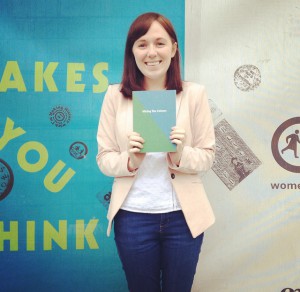
photo 3In November of last year, I began a publishing internship with Glasgow Women’s Library. Located in Glasgow’s East End, GWL acts as a lending library, historical archive and provider of services and programmes for women across Scotland. The mission of the library is ‘to celebrate the lives and achievements of women, champion their historical, cultural and political contributions and act as a catalyst to eradicate the gender gap that contributes to widespread inequalities in Scotland’. Unique as the only women’s library in Scotland, GWL aims to provide a welcoming and productive space for women from all walks of life; a warm smile and offer of tea is almost guaranteed when you walk through the doors.
My role at the library was to provide publishing related support for a book titled Mixing The Colours: women speaking about sectarianism, an anthology of short stories and poems about women’s experiences with sectarianism in Scotland. More than sixteen writers contributed to the book, including commissioned authors Eleanor Thom, Denise Mina and Magi Gibson. The short stories and poems contained within the publication were collected through a series of creative writing workshops and discussions where women were encouraged to draw on experiences of sectarianism in their lives. The result is a moving narrative that is truly unique: Mixing The Colours: women speaking about sectarianism is the first ever published work written by and about women on the issue of sectarianism. The book was launched with a conference on 20th March that included performances by the contributing writers, discussions and a screening of the accompanying film of the same name. The entire project was spearheaded by the wonderful Rachel Thain-Gray, my internship mentor and the Project Development Worker for Mixing The Colours.

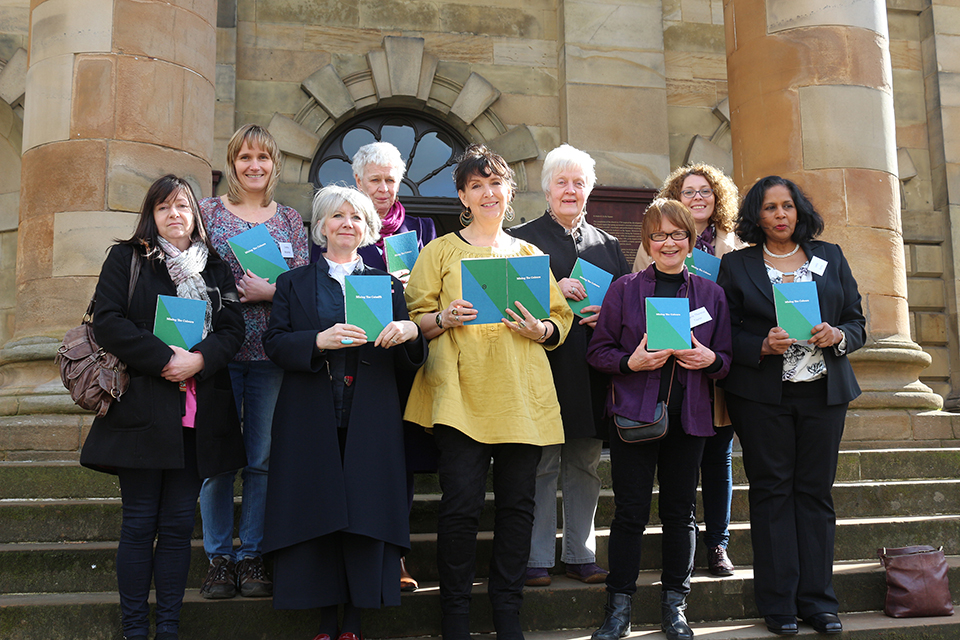
The authors of Mixing The Colours: women speaking about sectarianism

Several of the authors of Mixing The Colours: women speaking about sectarianism posing with the book.

During my time at the library, I worked on various editorial and marketing tasks for the Mixing The Colours publication. These included proofreading the manuscript, contacting book festivals, researching, designing an Advance Information sheet and copyright page, writing a press release and sending it to media outlets, blogging and planning for the conference.

The Mixing The Colours conference at St. Andrew’s in the Square in Glasgow.

I’m grateful to have been trusted with so much responsibility throughout my time at the library and for all the support I was given by Rachel, Rebecca and the rest of the Glasgow Women’s Library staff. The internship served as a broad introduction to the tasks involved in the overall production of a book and it was a privilege to work with an organisation with such strong values while developing my own skills as a publishing student. 

Gaelic Books Council Scholarship report – Liam Crouse

February 9th, 2015 by cs48@stir.ac.uk | Posted in Blog | Comments Off on Gaelic Books Council Scholarship report – Liam Crouse
Tags: , , , , , , , , , , ,
Liam Crouse, the first recipient of the Gaelic Books Council Scholarship, reports on his award:

Profile-Publishing1My initial interest in Scottish Gaelic literature was fostered during my undergraduate degree in Celtic and Archaeology at the University of Edinburgh. Two forms of prose, the short story and the novel, were instrumental by both fostering my linguistic ability and cementing my interest in Gaelic-language literature. Following graduation, during my return home, my once fluent conversational skills began to ebb. However, by engaging with the modern literature, I was able to keep some semblance of fluency. It was during this period that I recognised the importance of literature to minority languages – not only in terms of cultural value, but also to foster usage and regeneration.

Unlike the English-language publishing industry, in the Gaelic world we need more – more books, more authors, more publishers, more support. That was one of the reasons for creating the Gaelic Books Council scholarship. Initiatives within the past decade have focused on populating the literary corpus with quality works of prose. All the while continuing with those initiatives, new efforts are being exerted towards developing publishing capacity.

Through the course at the University of Stirling, I have gained an industry-oriented knowledge-base of the publishing industry, both in Britain and abroad. Courses in marketing strategies, business acumen, digital skills and publishing dynamics complemented each other in insightful and appealing ways. These skills were brought together in my publishing project – a geospacial app mapping out the life of the celebrated Gaelic poet Duncan Bàn MacIntyre along the West Highland Way, for which I was awarded the Faber & Faber prize for digital innovation. Towards the conclusion of the course, my thesis concerning the market for Gaelic books allowed me to investigate the multifaceted industry in a way which combined my zeal for the language with my interest in business and marketing practice.

Throughout the course, I gained first-hand experience working with publishers both big and small. The Gaelic Books Council arranged two internships at Gaelic-language publishers, one in Stornoway (Acair)and the other in Highland Perthshire (Grace Note Publications). While working with Grace Note, I helped in the translating of a children’s book which just recently was published in late November. I also secured an internship at the multinational publisher, HarperCollins, working on bilingual dictionaries. The contrast between large and small, multinational and local, and English and Gaelic made for interesting comparison.

I further became involved in Gaelic publishing in a more entrepreneurial spirit in December 2013, when news broke about the termination of Gaeldom’s sole magazine. A small group of enthusiasts and I rose to the challenge and established the first e-zine in the language called Dàna. The past year has been immensely enjoyable and enlightening, allowing me to directly apply many points from the degree. The e-zine is a tangible project with which I feel like I am helping to progress the language’s literature and we intend to continue developing the site’s outreach and influence in the coming years. It will certainly keep me busy!

The scholarship and degree have been both interesting and engaging. To those prospective publishing students: not only will it provide the keen librophile with a good balance of business sense, it will also equip you with the knowledge and connections that will allow you to thrive within the industry.

Note: Liam will shortly be taking up a post as Gaelic Development Office at Ceòlas Uibhist Ltd.

Fanrong He, MLitt in Publishing Studies 2014-15

January 12th, 2015 by Fanrong He | Posted in Student Profiles | Comments Off on Fanrong He, MLitt in Publishing Studies 2014-15
Tags: , , ,


84040b69jw1eh7o7bl7nuj20l00vkgruHello, everyone, My name is Fanrong He and my English name is Amanda, I’m from China.  My undergraduate major was Publishing, and I choose to go on to study this major at the University of Stirling is because I’m really interested in the publishing industry. As we all know, publishing industry in many countries is facing a huge change, from traditional publishing to digital publishing. How to participate in this industry well is a question for many people, and this is the question which I’m interested in.

I like reading books and doing exercise when I’m alone. I prefer reading e-books than paper books. Thanks to an amazing development of technology,  e-books can suit modern life much better. I’m looking forward to gain knowledge about digital publishing and copyright. In my opinion, digital books will be the main stream in the feature while the physical books will still exist.

I have a strong emotions that force myself to do my best, I like the feeling that do very hard working on a certain issue, this makes me feel like I’m fulfilled by positive energy all the time.


Beautiful Gift Books

January 12th, 2015 by Leia Forster | Posted in Blog | Comments Off on Beautiful Gift Books
Tags: , , , , , , , , , , , , , , , , , ,

Something that has always caught my attention in book shops is books with wonderful production value; thick paper, glossy images and gold embossing. If a book has gold embossing, I need it in my life. While run-of-the-mill paperbacks can be great purchases if you’re an avid reader, when it comes to giving books as gifts I feel there’s a need to choose something a little more special. If like me you are at a loss for what to buy someone this Christmas, read ahead and behold the beautiful gift books of my choosing.

The Barnes and Nobles Leatherbound Series

illu

leatherbound

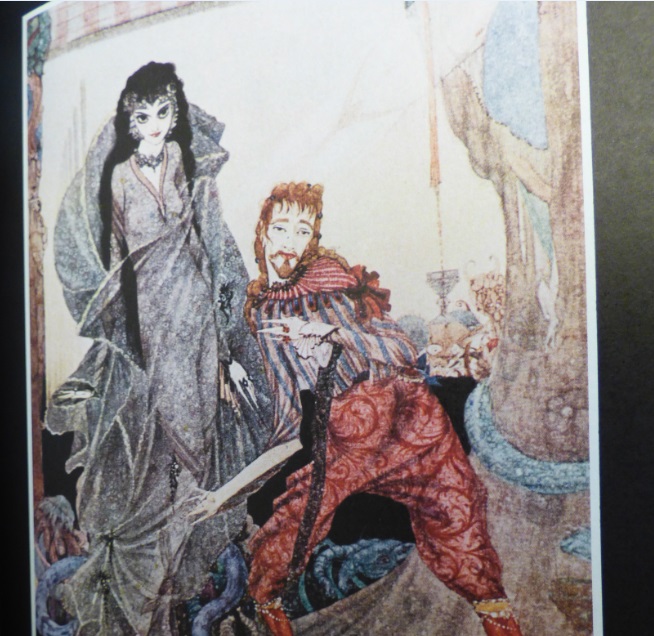
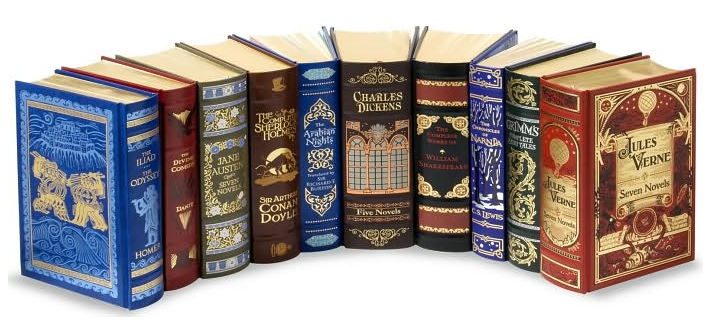
An affordable and wonderfully produced collection of books. Ranging from the classics to science fiction and non-fiction, you can tell a lot of thought has gone into the cover designs for each individual book. With an extremely reasonable RRP price of £25 a book, there’s no reason not to have several of these on your shelf. Many of the editions have several books within their pages, and the quality of production almost makes you feel bad for paying so little. The image to the right is just one example of the illustrations that can be found in these books. This particular one is from Edgar Allan Poe’s Tales of Mystery and Imagination.


Mister Finch, Living in a Fairytale World

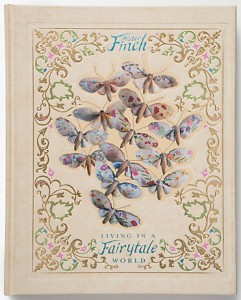
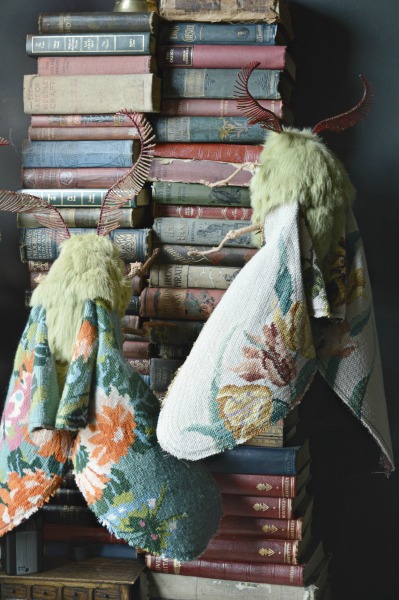
 mr finch 5For anyone interested in quirky art, this is the book for you. Mister Finch is a textile artist from Leeds who creates fabric fairytale creatures ranging from huge bees to dead canaries. Have you ever wondered what it might be like to have cat sized moths in the world? Mister Finch has.

This book showcases the best of his work with wonderfully photographed, glossy full colour images, and the cover could be considered art itself with the intricate metallic embossing.

mr finch 3mr finch 2


 Folio Society & Gollancz H.G.Wells Classics

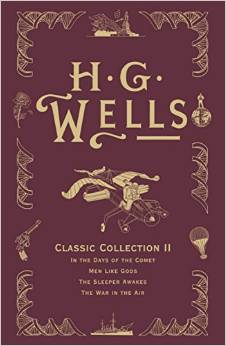
H. G. Wells Set [3 Vols] Classics of Science Fiction The Time Machine, The Invisible Man, The War of the Worlds - Folio SocietyThe Folio Society prides themselves on their extremely high standards of book design and production. Amongst my favourites is this collection of H.G.Wells Classics complete with illustrations. This lovely edition is however out of print, but can be still be found through online retailers with a price tag of around £65.

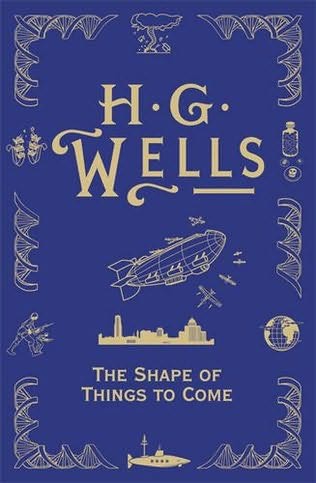
If that’s a little over budget, Gollancz published a series of cheaper but equally as charming H.G.Wells books. This edition of The Shape of Things to Come was recently featured in the hit TV show, The Walking Dead.

 classic collection hgwells

These are just a few of the many particularly special books in circulation that could make fantastic gifts. If these aren’t quite what you were looking for, I hope this post gives you the inspiration to find something suitable for that book-loving friend or family member.

Visiting Speaker: Dr Sam Rayner

January 7th, 2015 by Callum Mitchell Walker | Posted in Blog | Comments Off on Visiting Speaker: Dr Sam Rayner
Tags: , , , , , , , , , , , , , , ,

staffphotosam

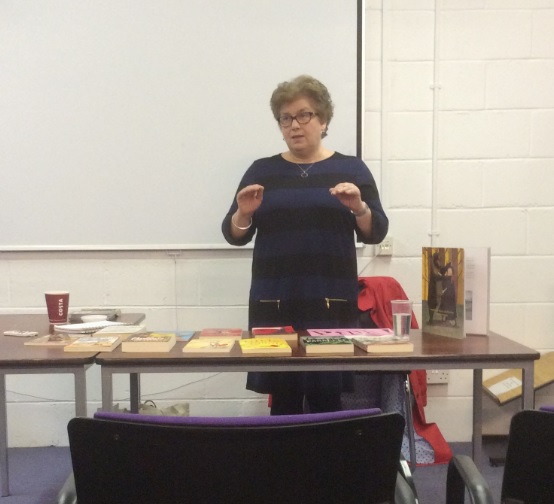
On Thursday the 4th December we enjoyed the last visiting speaker of the semester, Dr Sam Rayner, the Director of the Centre for Publishing at the University College of London (UCL). Dr Rayner’s talk focused on her paper ‘Star Texts: The Next Generation’ in which she explores the dynamic modern world of publishing and its impact and potential impact on teaching and learning in society. Dr Rayner analyses the way in which publishers edit and package content for new readers and new markets, the shaping of the literary canon, and the emergence and significance of several types of ‘Star Texts’. Before beginning her talk, Dr Rayner pre-warned us of her use of Star Trek puns (which she admitted she had toned down), however the class was eager to hear about her research on ‘Star Texts’.

But what does Dr Rayner mean by Star Texts?

Dr Rayner began by expressing that throughout her academic and professional life (whether it be teaching, research, working in libraries or bookselling), texts and their status and consumption have been fundamental. This made her interested in observing how we read, keep, study and rate books. As a literary and publishing researcher, Dr Rayner recognised that certain terms related to texts with cultural standing—‘The Canon’ and ‘The Classic’, have “become elusive and complicated by two other means of quality control”—‘The Prize Winners’ and ‘The Book Club Recommendations’. Dr Rayner collectively calls these four groups ‘Star Texts’, and argued, “these texts create clusters in the impossible constellation of the research environment that they belong to”. This term, ‘impossible constellation’ comes from Prof. Ruth Mateus-Berr from the University of Applied Art Vienna, during a conference on artistic research, and she used the term to attempt to describe the “several contradictory methods, understandings and histories” that could be applied to artistic research. Dr Rayner believes that this ‘constellation’ was a particularly useful way of understanding how texts exist in the 21st Century. Her research therefore focuses on the tension between a literary work, and the responses to the literary work in question. Dr Rayner suggested that whilst the text remains unchanged, there is a constant transformative process of the work, born out of the interaction and response from each specific reader.

‘The Classic’

Dr Rayner went on to discuss importance of the transformative star text group of ‘The Classic’. These texts, Dr Rayner argued, are those that most commonly stand the test of time. But what makes a text a ‘Classic’? Dr Rayner pointed out that scholars have very varied views on this question. The ‘Classic’, academics argue, should arguably be “timelessly appealing” and “elevate its author to the status of a god”. Dr Rayner also added that ‘Classics’ can be very subjective, and one individual’s list of ‘Classic’ texts won’t necessarily be the same as that of another individual. However, we do find a curated ‘Classics’ section in a bookshop, and publishers for centuries have created ‘Classic’ lists. This type of text is chosen, designed and marketed by publishers rather than academics (not suggesting they are purely commercial products, however). Dr Rayner asserted that the ‘Classic’ should appeal to every type of reader. She also pointed out that publishers such as Penguin attempt to modernise by means of packaging, engaging with digital, and marketing these timeless texts.

‘The Canon’ 

Dr Rayner next went on to explain another type of ‘Star Text’ known as ‘The Canon’. The establishment sets this group for primarily educational purposes and to define identities within culture. This type of text exists to represent the view of the individual and the preservation of tradition. Dr Rayner went on to discuss how texts have become ‘canonised’ in education through curriculum and have moved away from chronological presentation, towards a clear genre focused syllabi of texts. ‘The Canon’, Dr Rayner believes is undergoing a time of extreme change, and the impact of celebrity culture and national feeling are determining the way texts are canonised in education. Dr Rayner also addressed the issue of whether or not students should be given a prescribed reading list, as arguably this is a means of industrially restraining the individual’s imagination. Perhaps a more effective system would rather encourage young people to love reading and get into a habit of it, Dr Rayner shared to the argument.

‘Prize Winning Fiction’ 

The next type of ‘Star Text’ Dr Rayner explained was the ‘Prize Winning Fiction’ category. Dr Rayner argued that in the modern world of publishing, being nominated for literary prizes quite often means being read or not being read by the reading public. Dr Rayner also discussed how effective creative writing courses are in the emergence of this type of text and the development of a synergy between academics, creative writing and publishing bestsellers. The question was also raised over what should constitute as a ‘prize winner’. Should it be by measured by unit sales or by its literary quality? Furthermore, who should decide on these status elevated texts? Academics, publishers or readers?

‘The Book Club Recommendations’

Following on from Dr Rayner’s previous group of ‘Star Texts’ was the final group of ‘Book Club Recommendations’. This group can also be a prizewinner, but experiences the treatment of being associated with a well-known figure or celebrity. In these cases, the power of an individual’s brand is worth thousands in sales of a title if they have been selected as part of their ‘book club’. This phenomenon arguably gave the book back its ‘social history’ and within these book clubs, the well-known figure(s) (such as Oprah or Richard and Judy) play an active role in choosing, recommending and associating themselves with a title. Dr Rayner described how in a sense these individuals act as mediators between the author’s text and the audience. Book clubs show more than any other type of ‘Star Text’ the tension between the cultural and the commercial that exists in the book trade.

Merely ‘Solar Flares’ or Eternal ‘Burning Stars’?

Dr Rayner developed her argument by observing the conflict between cultural and academic responses of texts and the importance of reader interaction and marketing campaigns on the success of these titles. In the vast ‘constellation’ of texts in the current market, Dr Rayner believes that grouping these ‘Star Texts’ helps us to identify what drives us when we choose what we are reading. The development of technology also makes the text organic, with digital transforming the way in which we read, store and share text. Dr Rayner’s paper raised several interesting debates on the textual environment and what defines a text as a ‘Star’ and indeed what cultural, academic and commercial forces play a part. By the end of Dr Rayner’s talk, we were ready to “boldly go where no researchers have gone before” and explore the future of ‘Star Texts’ and textual constellations!


Callum Walker, MLitt in Publishing Studies 2014-2015

November 30th, 2014 by Callum Mitchell Walker | Posted in Student Profiles | Comments Off on Callum Walker, MLitt in Publishing Studies 2014-2015
Tags: , , , ,

972331_566137346760754_1796775402_n

Hello! I’m Callum. I’d like to say that I’m from a far away place like several of my classmates… But I’m from Falkirk! I studied my undergraduate degree in English Studies and History here at Stirling University and the MLitt in Publishing Studies course made it impossible to resist one more year. As graduate life grew closer I began to realise that I wanted to enjoy a career in which I could combine my passion for literature and my interest in the business and communication between a product and people. The ever-changing world of publishing and the course at Stirling seemed like a perfect fit for me.

I had some experience in the publishing industry before the course when I interned at Gay Times Magazine in London last summer. This experience helped me to realise that I have a great desire to be a part of the process of creating a product that can affect, inspire and ultimately change people’s lives. Alongside my studies, I’ll also be interning at Edinburgh-based children’s and non-fiction independent publisher Floris Books next semester.

It is clear from our first few classes that we will be learning about the many different processes, job roles and sectors of the publishing business which I think will benefit me as I am not entirely sure where I want to end up yet in my future career. Whether I end up working in editorial, marketing or production… I can’t wait to find out!

Follow me on LinkedIn and Twitter.

Guest Speaker: Lindsey Fraser

November 19th, 2014 by Leia Forster | Posted in Blog | Comments Off on Guest Speaker: Lindsey Fraser
Tags: , , , , , , , , , , , ,

fraser

fraser ross

On the 13th of November, Lindsey Fraser of Fraser Ross Associates visited us here at Stirling to give a talk on the role of the literary agent.

Lindsey began by reminiscing of a time when book publishing was simpler. Books had one price; that which was displayed on the book jacket, and books were limited to paperback and hardback formats.

As the publishing industry adapted to reflect changes in the digital landscape, it became apparent that authors needed representatives who had their best interests at heart and would help them to manoeuvre the unfamiliar realm of publishing.

Having spent ten years working for the Scottish Book Trust, Lindsey and colleague Kathryn Ross had established that there was a need amongst Scottish authors for agent representation, and so they left the Scottish Book Trust in order to create Fraser Ross Associates. They are now part of the small literary agent community which forms The Association of Scottish Literary Agents.

When speaking specifically about the role of the agent, Lindsey said that she considers literary agents to be responsible for finding the best possible homes for books. She also expressed that a major part of the role is giving your writers confidence, and that it is important to remember that agents are sometimes the only contact that writers have with the world of publishing. Trust is essential in this relationship.

Lindsey went on to highlight that the agent is on the side of the author, and ultimately it is their aim to help the author make money from their writing. The agent also encourages the writer to respect publisher deadlines and teaches them how to deal with promotional events as well as showing them how to make the most of opportunities that are presented to them.

Talking more about the encouragement that should be offered to authors, Lindsey noted that they are particularly vulnerable after having their first book published and are beginning to consider the next. It is important to help them through this period of insecurity. She commented that authors have a tendency to look at what was not right with their book and need to be reminded of what was good. She also said that sometimes after having a book published, authors would like to have a period of rest, but there is an important issue here regarding the children’s book industry. Children grow up quickly, and their interest in certain books changes. If you are publishing a children’s series, you need to ensure that the books are published before your readership outgrows them. Sometimes it is necessary for an author to produce a number of books in quick succession, especially if their books are doing well.                                                                                                                              scottish bt

Nearing the end of the talk, we were informed of The Scottish Book Trust’s live literature scheme which provides funding for author visiting sessions at schools in Scotland. They pay half of the author’s fee as well as traveling expenses which allows more schools to benefit from visiting sessions while authors also get to promote their books and interact with their readers on a more personal level.

Lindsey’s talk offered wonderful insight into the role of an agent in the publishing industry. She shared with us her refreshingly honest thoughts and opinions regarding some issues within the industry, and I particularly liked her comparison of the Bologna Children’s Book Fair to speed dating which highlighted once more the importance of networking in this industry.

Saltire Society Literary Awards 2014

November 19th, 2014 by Callum Mitchell Walker | Posted in Blog | Comments Off on Saltire Society Literary Awards 2014
Tags: , , , , , ,


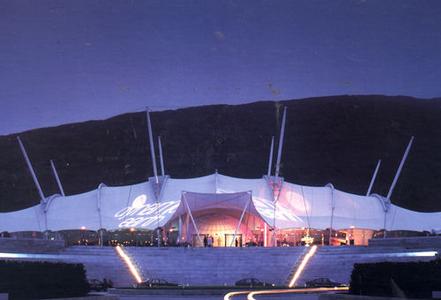
SCOTLAND ALBA LOGOOn Tuesday 11th November several of our MLitt & PhD students enjoyed an evening of literature, music and canapés at the Saltire Literary Awards hosted at Dynamic Earth in Edinburgh. The Saltire Society, a non-political independent charity founded in 1936, hosts the annual ceremony to celebrate the finest Scottish literature produced in the past year.

The most prestigious award of the night, the Saltire Society Book of the Year, was won by an academic work detailing Scottish urbanisation in the 18th century, The Scottish Town in the Age of Enlightenment 1740-1820. Co-authored by professors Bob Harris and the late Charles McKean, the book was produced after a three-year long period of research and also won this year’s Saltire Society Research Book of the Year award. Exploring the transitional development of 18th century burghs and the importance of understanding these changes in society, the book was described as a “pioneering study” by judges. Professor Harris received a cash prize of £10,000 at the ceremony and told guests that he was honoured to win the award in a country “with such a rich tradition of writing”.

Winners in the categories of poetry, history, literature and first book, were awarded £2,000, including Alexander Hutchison for his collection Bones and Breath, which claimed the Saltire Society Poetry Book of the Year award. Described as a “masterly new collection” from the poet, the book mixes satire with affection. The History Book of the Year award was won by social historian Steve Bruce for his exploration of cultural and religious change in Scotland in Scottish Gods: Religion in Modern Scotland 1900-2012. Ali Smith took the Saltire Society Literary Book of the Year award home for her novel, How to be Both, described by judges as “an exhilarating read” in which two narratives are linked despite being set centuries apart. Celebrating the emerging talent of first-time authors who have not previously been published, the First Book of the Year award was won by Niall Campbell for his “remarkably powerful first collection” Moontide, which was praised as “one of the most distinctive lyric voices to emerge from Scotland in recent years”.


1113921311400The Saltire Society Publisher of the Year award was introduced in 2013 and is supported by Creative Scotland. Celebrating the vitality and innovation of Scottish-based publishers, this year the award was won by Dingwall-based small enterprise Sandstone Press. The publisher was awarded £4,000 to assist further developments in the company’s business and was recognised for their “enthusiastic pragmatism” and the quality of their editorial work. Sandstone faced strong competition from a shortlist including Backpage Press, Freight, Birlinn, Bright Red and Floris. Executive Director of the Saltire Society Jim Tough praised the shortlisted publishers for showing “[the] creativity and adaptability needed to succeed in today’s competitive marketplace”.

Other awards of the night included the Saltire Society Literary Travel Bursary, supported by the British Council. The award went to St. Andrews University student Lenore Bell, who won a cash prize of £1,500. This prize will fund her research for a novel set in Edwardian Brooklyn in the USA.

Supporting the next generation of academics, the Ross Roy Medal is awarded to the best PhD thesis on a subject relating to Scottish literature. This year’s winner was Stirling University’s very own Barbara Leonardi for her thesis, “An Exploration of Gender Stereotypes in the Work of James Hogg”. Dr Scott Lyall, Chair of the judging panel, commented that “Leonardi’s writing is beautiful, and she shows real conceptual and socio-historical nous in opening up Hogg’s writing to a feminist and postmodern analysis”.

Congratulations to all the winners of the night and thank you to the Saltire Society for celebrating the Scottish imagination, and giving us a fantastic evening!


Visiting Speaker: Dr Simon Frost, Bournemouth University

November 14th, 2014 by Sarah Boyd | Posted in Blog | Comments Off on Visiting Speaker: Dr Simon Frost, Bournemouth University
Tags: , , , , , , , , , , ,
Simon FrostAs an extra addition to the Visiting Speaker series, Dr Simon Frost, Senior Lecturer in English at Bournemouth University, came to talk to us about his current research project. Entitled ‘Private Gains and Retailed Literature: Pathways to a Sustainable-Economic Account of Reading‘ (though Frost pointed out that his subtitle keeps changing!), this ambitious project is being undertaken in association with John Smith’s, the higher-education bookseller familiar to most students for their on-campus shops.
It’s probably worth mentioning at this point that Dr Frost’s project is quite a complex and, in some ways, esoteric one and that it is very much ongoing and developing, so at times it became a little difficult to take on all of the information he was conveying. The seven-and-a-half pages of notes I took during his presentation are testament to this! However, I’ll do my best to cover what he had to say.
First, Dr Frost outlined the aim of his project, to produce a defence of literature (the project is focused on fiction) in economic terms, rather than the cultural terms in which arguments for literature’s value are usually expressed. This was one of the trickier ideas to get our heads around but Frost put it in layman’s terms, saying that he’s trying to find out why a customer would choose to buy books, rather than booze! Essentially, his belief is that pointing to literature’s cultural importance does not mount a strong enough defence for the funding and resources allocated to it and that we require a discussion that engages with the economics of literature in sustainable terms or, in other words, attempts to discover what readers gain from the books they buy in more practical terms.
We then looked at the structure of Frost’s project, which is organised into three ‘threads’:
  • ‘theorisation’ – produce a model of how readers gain from books, bridging the literary and economic by investigating the idea that books meet intangible needs for readers.
  • ‘tuition’ – a number of students will be involved in the research for this project, particularly in compiling the results of an extensive survey, aiming for 750 completed surveys.
  • ‘professional practice’ – working in conjunction with John Smith’s, examine the shift from ‘bookseller’ to ‘book-based supplier of solutions’, in particular the move to provide new services based on outcomes/gains.

John Smith's BooksIn order to explain how he became involved with John Smith’s, Dr Frost gave us a potted pre-history of the current bookselling situation in Britain. John Smith’s has been around since 1751, so it has survived and responded to the major changes that have happened in the bookselling industry over the last several centuries, from the 1899 establishment of the Net Book Agreement (NBA) and its encouragement of dedicated bookstores, to the collapse of the Agreement in the 1990s which led to the downfall of almost all chain booksellers on the British High Street. More recently, the rise of online bookstores (themselves largely a result of the NBA’s collapse) has forced John Smith’s to rethink its business, as Amazon and its ilk have disrupted the traditional tutor-student-campus bookstore relationship. Their response has been to stop thinking of themselves as ‘booksellers’ at all and instead re-brand as a provider of solutions for students and Higher Education (HE) institutions. Indeed, their website is tagged as ‘John Smith’s Student Store’, with no reference to bookshops at all.
In effect, this has resulted in John Smith’s working with HE institutions to provide students with all the resources they need to successfully enter, negotiate and exit higher education. Their Stirling store, for instance, lists 15 departments, providing products from art supplies to bikes, mobile phones to university-branded clothing. They are no longer thinking about how they can sell the most books to students but about how they can meet all the needs that students might have, how they can become the main provider of solutions to students’ demands and problems (as well as aiding HE institutions to meet their outcomes). In this way, their rethinking of their business model fits neatly with Dr Frost’s project, as it relocates books as one part of a service that anticipates and provides everything that students will gain from appropriating. So, a copy of ‘Mrs Dalloway’ is no longer just a tool for education and cultural influence but also a product that can be analysed and quantified in economic terms.

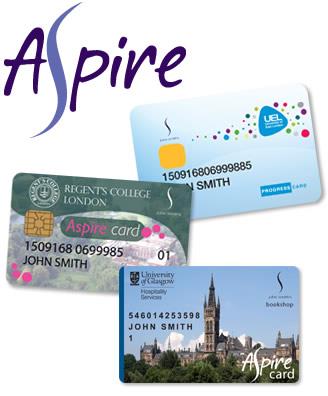
aspireFor the final part of his presentation, Dr Frost went into more detail about how the relationship between students, their HE institutions and this new incarnation of John Smith’s works. An essential part of this is the distribution of bursaries to students in England (introduced as a mitigating response to the raising of tuition fees). Universities receive a sum of money from the government and parcel this out to selected students in bursaries, often around £300, which are intended to widen opportunities for students from low-income backgrounds (and, ideally, to be spent on university-related goods and services, rather than down the pub, though we did have a discussion of whether or not the social environment provided by pubs – and cafes, equally expensive though perhaps less stigmatised – is a valuable part of the university experience!). John Smith’s have become involved in this process via their ‘Aspire‘ smartcard, which can be pre-loaded with the bursary money and limits what it can be spent on. This allows for a number of interesting features, from each card being tailored to its recipient’s needs, to facilitating data gathering and feedback to the institution. Of course, as several members of the class pointed out, this has some moral and legal implications, particularly with regards to privacy (the idea of tutors being able to keep tabs on whether you’ve purchased their reading list or not is more than a little Big Brother!) and this is an area that Dr Frost will be looking into as his study develops. At the moment, though, his main questions in this area are:

  1. Is the diversity of purchasing agency (i.e. those involved in the process of purchasing) now so great that it produces a break from the linear rational-choice model of purchasing?
  2. Do the limits imposed by the ‘Aspire’ model constitute an interruption of free will or free exchange? They limit the convertibility of one resource to another (the bursary can be turned into books or bikes but not beers) but do they also limit free choice? Such limits are common in the public world but how do they function in the semi-commercial and commercial spheres?
It was fascinating to hear about a project still in progress, with Dr Frost acknowledging that he is still in the process of gathering information and developing the theories and concepts that will form his ultimate conclusions. His observation that his ‘inner critic’ was working even as he spoke was one that I – and I’m sure most of us – identified with, but it’s reassuring to know that the pros suffer too. It was also great to feel that he was genuinely interested in our responses and in engaging in conversation with his audience – it’s always encouraging to feel that we’re being taken seriously by people already working! I’ll be interested to see the results of his project and how it shifts and develops as it progresses.