publishing

Min Yu, MLitt in Publishing Studies 2013-2014

October 22nd, 2013 by Min | Posted in Student Profiles | Comments Off on Min Yu, MLitt in Publishing Studies 2013-2014
Tags: , ,

Hello, everyone, my name is Min and I am  from the city of Shenzhen (near Hong Kong), Guangdong Province, China. I am 26 years old and I was born in Shandong Province which is in the north in China. Actually, I have been working in a media company as a media asset manager for 3 years after I graduated from my undergraduate university, Shenzhen University with a degree in Communication.Then I decided to improve myself to get a master degree, so I quit my job and became a student again.

The publishing industry is very technological and advanced in UK, so that’s why I choose to study publishing here. When I started studying, I find there are a lot of information and knowledge needing to be received and understand. It is not easy for me to study these , so I decided to spend more time reading books. I think it is really a challenge for me to study. On the other hand, I find I can learn a lot from this programme, especially I can learn various cultures in my class because this is a great international class. The classmates are nice and they have different personalities. I also can learn something from them because we have different educations and backgrounds.

The most important thing is that I hope my English language will be improved effectively and I can read many books. There are many fantastic books in UK and I really want to read as many as possible. In the future, I hope I can work in the library in my University in China because I love the environment of libraries and campus.

My hobbies are watching movies, travelling, so I will plan to travel to Europe at this studying aboard year. I hope this year will be unforgettable.


Bloody Scotland Masterclass – Agents’ and Publishers’ Panel

October 7th, 2013 by Aija | Posted in Blog | Comments Off on Bloody Scotland Masterclass – Agents’ and Publishers’ Panel
Tags: , , , , , , , , , , , ,

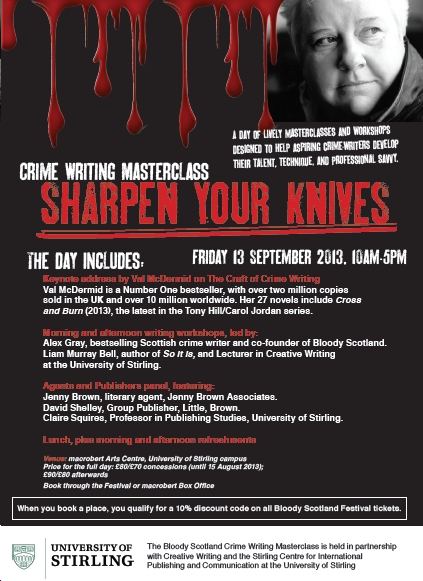
One of the perks of this year’s Bloody Scotland International Crime Writing Festival in Stirling was the opportunity to hear the best of the field offer advice to hopeful writers on the process of writing, publishing and whatever comes in between.

The Agents’ and Publishers’ panel was lead by Claire Squires, director of Stirling Centre for International Publishing and Communication on September 13th. The panel discussed what happens after the next hopeful front list bestseller has been written and when the author seeks to have the manuscript accepted either by an agent or a publisher.

Taking part in the panel were Jenny Brown, of Jenny Brown Associates, and David Shelley, of Little Brown. Jenny is equally inspiring and intimidating for an aspiring literary agent such as myself, having opened her agency in 2002 after years of formidable experience, not forgetting being the founder of the Edinburgh International Book Festival. If that’s not enough, she and her associates have become the biggest literary agent in Scotland and one of the leading agencies in UK, with international reputation.

David on the other hand represents the other hurdle in the writer’s way towards bestselling stardom – the publisher. David, who has worn many a different hat under the general title publisher has not settled for one particular job title – he also guests as an editor for a few selected authors within Little Brown, including Val McDermid and Mitch Albom (and yes, JK Rowling too, but let’s focus on other exciting aspects of David’s career, shall we?).

Jenny launched right into the session by emphasising how crime writing is still the fastest growing genre in the UK (and one of the leading internationally), with approximately 30% of the book market. David agreed – crime writing is definitely the most commercially growing genre that is remarkably consistent despite other market or trend fluctuations – fluctuations we know all too well that publishing is harshly dependent on. As the trend moves on, so will the publisher.

Both Jenny and David agreed that trends are nearly impossible to keep up with; what is “hot” right now could very well be over by the time you have the manuscript of a bestseller that nicely fits into that pigeonhole all finished and ready to be pitched. Trends move on faster than anyone can write, and rather than focusing on fitting into that niche, both Jenny and David emphasised, an aspiring writer would do well to focus on being passionate and finding your own voice, your niche, rather than doing lavish imitations of others’ work. Jenny also – to my great pleasure – emphasised how translated crime writing is breaking the barriers and entering the UK market. David remarked upon the cold realism of marketing; it is nearly impossible to bring out a title that is based on the same basic idea as one published before. There is no space in the market for two great Fife based detectives, but there might be space for one great detective from Fife, and the other from – why not – Stirling. How you present your setting is what makes you, as a writer, unique.

Classic crime is being brought back as well as being retranslated. Foreign authors are intriguing, whereas deceased writers are proving to be some of the toughest competition to the wave of new writers. One particularly interesting piece of advice that David provided for budding writers was to imagine further than one novel. He has found himself attracted to authors who can envision at least a couple volumes of a series, can explain character traits and subplots beyond that one particular event in the novel they are currently pitching. A good series of novels with an ever-evolving character can very well be the key to cracking your way into the crime-writing scene.

Claire led the discussion to the actual publishing process; what channels are there for new writers? How can one get their manuscript read, represented and subsequently published? As expected, both David and Jenny agreed on this point strongly; get an agent. It is nearly impossible to break into publishing without being professionally represented. Most publishing houses do not accept unsolicited manuscripts so agents act as a quality control filter for publishers. Jenny emphasised having manuscripts edited by a professional freelancer – never submit anything you are not absolutely sure is the best it can be. And this is doubly important for self-publishing authors.

Be confident, know your trade, know your next few steps and especially – know whom you are talking to when making a pitch. Let your story do the talking. It is even more advisable to target your agent and publisher. Do your homework – know whom you are pitching to and make sure they know why you have chosen them. Or perhaps if you’re desperate and unsure of your manuscript, a box of chocolates never hurts – doesn’t necessarily help either, but definitely never hurts.

Claire opened a topic that is much debated in publishing circles – self-publishing. Jenny explained how self-publishing allows more control and can lead to enticing a wide readership, which in turn encourages word-of-mouth and reviews before landing under the ears or eyes of an publisher. Self-publishing allows the writer to test the waters and to cater for the readership before attempting to break into the market. Although, writers would do well to note, that if you have already published something on the internet, the good bet is that a hopeful publisher would prefer to publish something completely new from you – or perhaps offer you a series deal. David did mention how even editors browse through self-publishing platforms – such as Authonomy – as you never know what you might find.

The panel concluded with questions from the master class participants; one particularly memorable was one lady from the master class, who has a number of novels (18 to be exact) published online but no one had yet approached her nor returned her numerous attempts to contact agents and publishers. Jenny’s initial reaction was to enquire what does she believe an agent could do for her that she cannot do herself? What indeed. To leave on a hopeful note, Claire asked both David and Jenny to give the master class some final words of inspiration. David encouraged the budding writers never to give up, as the first book published is rarely the first book written, and to especially venture into other avenues than traditional forms of publishing – digital, self-publishing and the like can prove to be a writer’s saviour, enabling an initial point of contact, enticing on its own merit. Jenny emphasised the necessity of wide reading, because all that we read will feed into what we write, how we write and how we present ourselves. There is hope for everyone.

Visiting Speaker – Alastair Horne

May 2nd, 2013 by Laura Jones | Posted in Blog | Comments Off on Visiting Speaker – Alastair Horne
Tags: , , , ,

Alastair Horne‘s visit to Stirling on March 28th was much anticipated on Twitter, with talks the night before of red carpets and royal carriages on the 8:30am Edinburgh to Stirling train which students and tutors alike frequent to make the 10am start. Those of us lucky enough to take the Digital Process & Product module had a double dose of Alastair as he taught a class on digital start-up business models before taking up his position as visiting speaker at 2pm.

So as to avoid spilling the beans of our innovative, game changing business models (well, we hope) I will focus on Alastair’s visiting talk on the wonders of social media. Alastair himself has 10 years of experience in publishing, is the social media and communities manager at Cambridge University Press ELT with a personal Twitter account of 3.6k+ followers, a professional global Twitter account, a Facebook page for CUP ELT with 33k likes, fortnightly webinars… I could go on. Let’s just say Alastair knows what he’s talking about when it comes to social media.

His emphasis rested on building relationships with readers. Publishers need to let readers in, let them peek behind the curtain and feel part of the process. As the talk inevitably turned to Amazon, Alastair highlighted that their relationship with publishers is no longer mutually beneficial considering Amazon refuses to share stats and data. For this reason, publishers need to battle Amazon for reader loyalty. Nurturing a genuine relationship with readers is the best chance publishers have at reducing Amazon’s suffocating monopoly.

So, how does one go about shaping these vital relationships? Alastair offers two options.

1. Go to where the readers and conversations already reside and partake.
2. Create a new platform to start conversations and entice readers in. This option means not having to rely on a third party, particularly important if the conversation is, say, on Goodreads which is suddenly obtained by Amazon.* The rewards are greater for this harder option as Alastair pointed out that it took one year for CUP ELT to blossom from idea to actuality.

For publishers specifically, they need to learn to use social media effectively and to their advantage, for these 5 reasons.

1. Search visibility – Facebook Group graphs can offer great data about who is finding your page and how. Google+ brings together the social and the search by providing personalised search results through network lists.
2. Marketing – publishers must be stealthy with marketing and not post too many hard sales.
3. Customer support – Twitter can offer immediate customer support, turn a negative into a positive should someone be able to fix a problem quickly and efficiently.
4. Market research – where Goodreads was recommended as a valuable site for research.
5. Building relationships – the most important element. Trust must be built over time so publishers become part of readers’ lives. This kind of investment is long term and many publishers are too impatient to invest, especially as it’s time consuming and impossible to measure the direct effect.

And because Alastair loves a good list (who doesn’t?!) he also provided 12 suggestions for social media success.

1. Find home – you don’t need to be on every social media platform, find a platform that works best for your needs and make yourself at home.
2. Be regular – post daily on Facebook, 5x or more on Twitter, not too much, not too little. Spread out those posts.
3. Be prompt and responsive – you’re not a broadcasting station, engage with your readers, know when someone has mentioned you and don’t rely on scheduled tweets, you run the risk of looking mechanic and less human. Keep track of what your audience is discussing.
4. Involve the whole team – not just marketing, get everyone on board who is active and enthusiastic on social media, also get authors involved.
5. Share enthusiasm – let your audience know you’re excited about books. Let them see behind the scenes, the production, it can generate some very real excitement.
6. Involve the audience – get to know who shares and reads your content, make them feel valuable.
7. Encourage sharing – make it easy for your readers to share your content, create content that people will want to share.
8. Curation – you’re not the only source of good content, share other people’s content and involve the network you’re using. Add value by offering your voice to a retweet, don’t just mechanically RT something you find interesting, comment on it.
9. You’re a person – no one wants to talk to a corporation, introduce the team and open yourself up to your readers.
10. Re-purpose content – alter content for different platforms, make it applicable over the networks you’re using.
11. Take the conversation elsewhere – as above, don’t rely on those third parties.
12. Work out what’s working – all about analytics and tracking people. If it’s broke, fix it!

And so ends a crash course in social media. I was greatly encouraged by Alastair’s enthusiasm towards social media and the opportunities it can create for publishers, should they learn to use it to their advantage. I fully agree that publishers can’t create meaningful relationships with their readers fast enough. The sooner the better. Alastair was a fantastic guest and continues to be a fantastic presence on Twitter as he tweets valuable content from afar keeping true to his own advice.

*The day ended on a sour note as Amazon acquired Goodreads only hours after Alastair completed his talk, part of it recommending Goodreads as a valuable area of reader data and relationships for publishers. The irony was not lost.

Laura Jones (cross posted to publishthings.com)

Paula Morris Lecture – How the Novelist Sees the World…

January 23rd, 2013 by tsarchdeacon | Posted in Blog | Comments Off on Paula Morris Lecture – How the Novelist Sees the World…
Tags: , , , , , ,

… With great big sweeping Venn diagrams to connect the myriad of people and organisations that contribute to the life-cycle of a novel. With detailed characterisations and in-depth analyses of the interplay between each Venn bubble, with a structured flow and a bit of conflict to keep it all moving nicely along. Novelists see the world (of publishing) as a fascinating place that might be much akin to the worlds of their books.

There are four kinds of people in the world, none of whom a novelist is particularly enamoured with:

  • Gatekeepers. Agents, publishers, booksellers, the media, festivals, and prizes.
  • Rivals. Other writers. (Note: ‘rivals’ and ‘friends’ are by no means mutually exclusive. Or so they would have us believe.)
  • Necessary Evils. The public, online reviewers, book clubs, festival audiences, etc.
  • Enemies. Yourself. Money. The world at large.

And yet novelists have far more to worry about than these frustrating gnats that surround them. Worries such as publicity, for one, which is an increasingly important aspect of the novelist’s life. It is no longer an isolated art; writers need to be actively engaged with the world through social media and self-promotion. They’re constantly bombarded with people asking questions or favours. They get e-mails by the giga-load.

Then there’s the insecurity. Writers are a ‘whirlwind of insecurity’. Will their next book be their last? Will it be a failure? It’s a life of unstable income and of second jobs – fixing, ghost writing, journalism, anything to keep writing.

It takes a hell of a lot more than talent to get published. It takes persistence and discipline, luck, ego (a.k.a. ‘drive’) and often a very thick skin. It takes a healthy aversion to reading too many reviews and the ability to ignore the call of the market (or risk becoming a hack). A good pen and a few nice turns isn’t enough anymore.

So all this begs the question… why? Why would anyone choose to take on such a career?

‘It’s not a career, it’s a vocation’, Morris said, ‘you should be doing it because you would be miserable doing anything else’.

See more from Paula Morris at her website.

-Talis S Archdeacon

Mariclaire White, MLitt in Publishing Studies 2012-2013

January 23rd, 2013 by Mariclaire White | Posted in Student Profiles | Comments Off on Mariclaire White, MLitt in Publishing Studies 2012-2013
Tags: , , , ,

I began considering a career in Publishing while studying MA English Literature and Film Studies at the University of Dundee. During summer break between 3rd and 4th year, I became a marketing intern for a comedy company during the Edinburgh Fringe Festival. The job was frantic, consuming and required a lot of walking around rainy Edinburgh promoting a show alongside hundreds of competitors. While this may sound like hell to a lot of people, the reward of seeing a member of public you had encouraged at the show, was completely worth it. Once University began again, I sought a way to combine a lifelong interest in literature with my newfound passion for marketing, leading me to the logical choice of working within the publishing industry.

Whilst researching postgraduate degrees, I was immediately attracted to the MLitt in Publishing Studies at Stirling due to its reputation as a Centre for International Publishing and Communication as well as its excellent links to the publishing industry. In order to finally make up my mind about applying, I spoke to a former student who could not recommend the course enough and I have not been disappointed. I am so excited to progress with my studies and put the skills I learn into practice in the real world! You can find out how my studies are going on twitter!

Visiting Speaker – Ann Steiner

January 21st, 2013 by Nicola Marr | Posted in Blog | Comments Off on Visiting Speaker – Ann Steiner
Tags: , , ,

The visiting speaker series continued with an insightful talk from Ann Steiner, researcher and lecturer in Literature and Publishing Studies at Lund University, Sweden, who gave an academic’s perspective on recent developments in international publishing.

Ann began by explaining that the publishing industry as a whole is very culturally specific, with different countries experiencing vastly varying market structures and stability. Using Sweden as a case study, we learned about ways to promote literature within the limits of population and language. Sweden, a fairly large country with a relatively low population, has around 300 major publishing houses all operating on an international level, yet only 5 of them producing work specifically for the Swedish market.

Ann then went on to talk about different integration models of publishing in Sweden, using the example of The Bonnier Conglomerate – a large family run media corporation who dominate the market and control all aspects of the publishing chain from printing to retail stores. This monopolization leaves very little room for competition, with smaller publishers struggling for visibility in the mainstream market. This can be seen as detrimental to the Swedish publishing industry as a whole, and Ann was part of a commission who raised concerns about this exploitation to the Swedish government.

An interesting point raised by Ann was the difference in reading habits between Swedish readers and UK readers – most notably the fact that many Swedish people are not familiar with electronic reading devices. The e-book industry in the UK is an ever-expanding market, a trend many of us would expect to see continuing worldwide. However as Ann pointed out, although e-books are available in Sweden the market hasn’t reacted as favourably as in other parts of the world, which is surprising considering the high internet saturation in Sweden. Ann suggests one reason for this unusual cultural difference is a problem which is recognized at national level – that if the e-book market flourishes it may cause a decline in the number of Swedish-language books being read, as it is expected the majority of e-books accessed will be English titles. Ann predicts that the market in this area will eventually mature and if one retailer chooses to promote a particular device, Sweden may see an increase in e-book sales.

The next topic of discussion focused on the way Swedish consumers buys books – or don’t, as the case may be. Current figures show 35% of all books are currently bought in bookstores, with 22% of books being purchased online. However, Ann discussed a worrying trend in the demise of bookstores in small communities. This has been caused in part by the de-regulation of book pricing in Sweden in the 1970’s, which has since seen the price of books plummet, meaning bookstores struggle to make a profit. This low pricing structure has altered the consumer perception on the value of books in Sweden, meaning people now expect to buy books at very low prices. The closure of bookstores throughout the country is expected to have a knock-on effect on the industry as a whole, with recent figures already showing a worrying decline in the reading ability of young boys in Sweden.

Next, Ann spoke about Swedish literature within the context of the rest of the world. Historically, Sweden was an import country with over half of all fiction and non-fiction literature coming from other countries. Although mainly translated, Sweden also has a fairly thriving foreign language market. Over recent years, the success of Swedish crime fiction has seen a massive upturn in the export market, particularly after the international success of Stieg Larsson’s The Girl with the Dragon Tattoo.

Ann also touched briefly on the ways in which Swedish literature is perceived in other countries, pointing out that particularly in the German market, Swedish books are often portrayed as stereotypically cold and harsh, with covers that would not sell in the Swedish market.  Ann finished the talk by pointing out the importance of country specific publishing,  stating that books are very much intertwined with culture and can be deeply important for a national sense of being.

During a brief Question and Answer session afterwards, students got the chance to learn more about the publishing course run by Ann at the University of Lund and the similarities in the teaching content. Ann also spoke briefly about her predictions for the Swedish market in the future – most notably that the Swedish crime fiction genre will eventually die out and hopefully make way for new trends in Swedish literature.

An interesting, enlightening and at times surprising insight into the Swedish market and how it differs from the UK market, I think the whole class will agree we learned a lot during this session. Thanks, Ann!

-Nicola Marr

Aija Oksman, MLitt in Publishing Studies 2012-14

January 19th, 2013 by Aija | Posted in Student Profiles | Comments Off on Aija Oksman, MLitt in Publishing Studies 2012-14
Tags: , , , ,

As I completed my Bachelor’s degree in English Literature at the Paris Lodron University of Salzburg, I was left with a conundrum of what to do next. Having been a expatriate since twelve years, I planned to keep at it, and hence I arrived in Edinburgh. I set up my humble home in Edinburgh city and began my studies at Stirling. I had lived in Ireland before, and had truly enjoyed the general jovial atmosphere I experienced there – and after some queries, I was informed Scotland is much, much better – and in all aspects nonetheless. Shocking, eh?

As I have a strong passion for literature and theatre, and anything to do with the written and spoken word in any form – be it poetry, songs, fiction, ghost writing or anything else – and having learned foreign langauges since I was very young, I have always appreciated the fine nuances of languages that make them unique. My goal is one day to be able to work with minority and translation literatures as I believe that is where my strength lies. But on the road there, I wish to expand my abilities and knowledge as much and have it as varied as humanly possible. And enjoy my life whilst doing it.

Talis S. Archdeacon, MLitt in Publishing Studies 2012-2013

January 16th, 2013 by tsarchdeacon | Posted in Student Profiles | Comments Off on Talis S. Archdeacon, MLitt in Publishing Studies 2012-2013
Tags: , , , , , , ,

Most people reading these student profiles already know what a dynamic and fascinating industry publishing is, with never-before-imagined possibilities and innovative new technologies at every turn. There’s no need to tell you how a profound love of stories in all forms – fiction and non-fiction, long and short, in books and magazines – irresistibly draws us all into the world of publishing.

I started my career as a journalist about six years ago in Riga, Latvia. I moved up quickly and within a few years found myself editor-in-chief of the largest English-language newspaper in the Baltic States. After that I ran a local second-hand bookshop and attempted to launch a new publication – an entertainment listing service in three languages. Though that idea soon failed (I didn’t really know at that point how to deal with the many challenges of a start-up publication), my interest in publishing had been piqued and I was eager to get myself into the industry proper.

But how? I tried applying for a few jobs in a few different countries, but my disparate and tangential experience made it difficult. My academic degrees were unrelated to the field. I needed something to tie it all together.

The publishing programme at Stirling is the ideal way to do just that. I joined the master’s degree programme to help transfer my related skills in journalism and bookselling to publishing and to learn about the rapidly evolving market.

This is one of the most exciting times in history to be in publishing. We, the publishing students of today, are at the very forefront of these changing times and are nearly ready to take our places as the industry leaders of tomorrow.

Nieske Zuidema, MLitt in Publishing Studies 2012-2013

January 12th, 2013 by Nieske Zuidema | Posted in Student Profiles | Comments Off on Nieske Zuidema, MLitt in Publishing Studies 2012-2013
Tags: ,

My name is Nieske Zuidema and I’m a student on the MLitt in Publishing Studies course. I come from the Netherlands, where I’ve worked at two book stores. While it was fascinating to see what happens to a book after it has been published, I became more and more interested in what happens beforehand: the publishing process. I therefore always had a career in publishing in the back of my mind while doing my undergraduate degree in Communication Studies.

When looking for a master’s program, it soon became clear to me that a publishing course in the UK would suit me best, since I love reading English books and since the publishing industry here has a major influence on the rest of the world. The program in Stirling especially interested me, as it focuses on all aspects of publishing (editing, production, marketing, etc.) and combines theory and practice. After only week into the course, I definitely felt like it will give me a good preparation for a job in the industry, and I’m very glad that I’ve decided to come here!

Visiting speaker: Peggy Hughes, City of Literature

November 17th, 2012 by Aija | Posted in Blog | Comments Off on Visiting speaker: Peggy Hughes, City of Literature
Tags: , , , , , , ,

The delightful Peggy Hughes amused the Publishing studies 2012/2013 class  with her lively presentation on the UNESCO badge of City of Literature  – a designation, which was bestowed upon Edinburgh back in 2004. The City of Literature Trust  is head by Peggy herself and her boss Alison Bowden.

Why Edinburgh should be designated as a City of Literature by UNESCO, you might ask. Well, when a group of prominent figures in the literary scene having a post-prandial discussion they came to the surprising conclusion that as Edinburgh was “brilliant at books,” something should be done to make sure this would become general knowledge. Simply because Edinburgh has a huge literary heritage, and has a vibrant contemporary scene – already hosting some of the world’s most well-known and largest poetry and literature festivals and events.

Organisations from grassroots up to government level Edinburgh worked together to create The Bid, an audit of all Scottish literary accomplishments in two volumes – talking about putting things in a nutshell – We Cultivate Literature on a Little Oatmeal. It took a bundle of Scottish treats (whiskey, haggis, bagpiper among others) to convince the UNESCO headquarters in Paris.

Among her lively and very fast paced presentation, the class was entertained with best bits of past events that had aimed to hold Edinburgh to its badge of honour as well as a selected few spoilers over the upcoming events. Working together with other Edinburgh literary events and organisations, the City of Literature has proven to be worth every bit of the designation, more than holding its own among the others with its goals of establishing partnerships, promoting participation, learning as well as advocating awareness towards Edinburgh and keeping the focus on creativity, bringing people together in literature.

Thank you to Peggy for the grand insight into the Scottish literature scene and its uniqueness, and I’m sure the class cannot wait to see the ‘Stache-mob or join the Literary Salon.