Blog

Visiting Speaker – Ann Steiner

January 21st, 2013 by Nicola Marr | Posted in Blog | Comments Off on Visiting Speaker – Ann Steiner
Tags: , , ,

The visiting speaker series continued with an insightful talk from Ann Steiner, researcher and lecturer in Literature and Publishing Studies at Lund University, Sweden, who gave an academic’s perspective on recent developments in international publishing.

Ann began by explaining that the publishing industry as a whole is very culturally specific, with different countries experiencing vastly varying market structures and stability. Using Sweden as a case study, we learned about ways to promote literature within the limits of population and language. Sweden, a fairly large country with a relatively low population, has around 300 major publishing houses all operating on an international level, yet only 5 of them producing work specifically for the Swedish market.

Ann then went on to talk about different integration models of publishing in Sweden, using the example of The Bonnier Conglomerate – a large family run media corporation who dominate the market and control all aspects of the publishing chain from printing to retail stores. This monopolization leaves very little room for competition, with smaller publishers struggling for visibility in the mainstream market. This can be seen as detrimental to the Swedish publishing industry as a whole, and Ann was part of a commission who raised concerns about this exploitation to the Swedish government.

An interesting point raised by Ann was the difference in reading habits between Swedish readers and UK readers – most notably the fact that many Swedish people are not familiar with electronic reading devices. The e-book industry in the UK is an ever-expanding market, a trend many of us would expect to see continuing worldwide. However as Ann pointed out, although e-books are available in Sweden the market hasn’t reacted as favourably as in other parts of the world, which is surprising considering the high internet saturation in Sweden. Ann suggests one reason for this unusual cultural difference is a problem which is recognized at national level – that if the e-book market flourishes it may cause a decline in the number of Swedish-language books being read, as it is expected the majority of e-books accessed will be English titles. Ann predicts that the market in this area will eventually mature and if one retailer chooses to promote a particular device, Sweden may see an increase in e-book sales.

The next topic of discussion focused on the way Swedish consumers buys books – or don’t, as the case may be. Current figures show 35% of all books are currently bought in bookstores, with 22% of books being purchased online. However, Ann discussed a worrying trend in the demise of bookstores in small communities. This has been caused in part by the de-regulation of book pricing in Sweden in the 1970’s, which has since seen the price of books plummet, meaning bookstores struggle to make a profit. This low pricing structure has altered the consumer perception on the value of books in Sweden, meaning people now expect to buy books at very low prices. The closure of bookstores throughout the country is expected to have a knock-on effect on the industry as a whole, with recent figures already showing a worrying decline in the reading ability of young boys in Sweden.

Next, Ann spoke about Swedish literature within the context of the rest of the world. Historically, Sweden was an import country with over half of all fiction and non-fiction literature coming from other countries. Although mainly translated, Sweden also has a fairly thriving foreign language market. Over recent years, the success of Swedish crime fiction has seen a massive upturn in the export market, particularly after the international success of Stieg Larsson’s The Girl with the Dragon Tattoo.

Ann also touched briefly on the ways in which Swedish literature is perceived in other countries, pointing out that particularly in the German market, Swedish books are often portrayed as stereotypically cold and harsh, with covers that would not sell in the Swedish market.  Ann finished the talk by pointing out the importance of country specific publishing,  stating that books are very much intertwined with culture and can be deeply important for a national sense of being.

During a brief Question and Answer session afterwards, students got the chance to learn more about the publishing course run by Ann at the University of Lund and the similarities in the teaching content. Ann also spoke briefly about her predictions for the Swedish market in the future – most notably that the Swedish crime fiction genre will eventually die out and hopefully make way for new trends in Swedish literature.

An interesting, enlightening and at times surprising insight into the Swedish market and how it differs from the UK market, I think the whole class will agree we learned a lot during this session. Thanks, Ann!

-Nicola Marr

“It is still about the Physical Book” – Meeting Scott Coning

January 16th, 2013 by Miriam Knafla | Posted in Blog | Comments Off on “It is still about the Physical Book” – Meeting Scott Coning
Tags: , , , , ,

As the semester 1 came to an end, Scott Coning, Managing Director of Better World Books, visited us on the 29th of November as the last speaker of the year to talk about the disrupted book market, the importance of discoverability and the positive prospect that the physical book is not going to die.

“If I leave you with more questions than answers, I’ll have done my job.”

Because that is exactly the state the publishing industry is in right now. Market disruption challenges everyone and nobody knows where we are going. The merger of Penguin Random House shows plainly that even the big players feel challenged and look for ways to survive. Scott proposes that publishers need to reorganise and get flexible; they have to reassure authors that they are worth while, put a lot of effort into meta-data management and guarantee the broadest possible reach for their products. At that, what has to be acknowledged is that every market is different, not just language-wise.

He also advises publishers to combine strengths with their competitors; share content and platforms in order to reach more customers. Furthermore, publishers should try to print as close to the customer as possible and reduce the many handlings of a book in its manufacturing process to the end-customer. Of course, due to such cost-saving measures warehouses have to cut down as not as many books go through. Bookstores, as well, need to reassess what consumers want, at what time and to what price. What is a book worth nowadays? Should content be free?

What he criticises about the online-buying trend is the loss of discoverability. How should customers discover books “when all they have is a search box?” Bookshops are all about the atmosphere, people usually go there in the hope to find a good read. The publishing dilemma is that with fewer bookstores there are fewer show rooms, less face to face enthusiasm and, hence, fewer channels to bring books to the consumer.

The blatant reality is that 72 bookshops closed last year; a trend that is about to deprive entire communities of one of their major and crucial ways to access books.

Scott suggested the idea that e-books are a welcome device to promote more reading. “It is still about the physical book,” though. The challenging question, however, is how to get it to the customer? It is the opportunity for bright minds and innovative thought to give the disrupted industry a new structure.

-Miriam Knafla

“Better World Books collects and sells books online, matching purchases with donations book for book, and contributing a portion of all revenues to literacy initiatives. It recently surpassed $10 million (£6 million) raised for literacy … [Scott] Coning [came] to Better World Books from leading UK book retailer Waterstone’s, where he worked for over 12 years overseeing operations as wide-ranging as customer service, branch management, and business strategy.” (source: Better World Books)

“If it comes down to it, then eat the baby food” – Society of Young Publisher’s Internship Panel

January 14th, 2013 by Aija | Posted in Blog | Comments Off on “If it comes down to it, then eat the baby food” – Society of Young Publisher’s Internship Panel
Tags: , , , , , ,

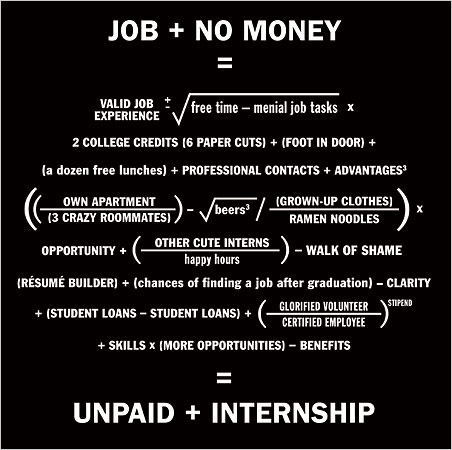
At the annual intern event of the Society of Young Publishers  junior staff members from various Scottish publishing houses gave, in a rare opportunity for us fledgling publishing students, insight and information on how to get one’s foot in in the publishing business. Sobering realities were spoken, albeit in warm tones.

The panel of eight, chaired by Dr. Padmini Ray Murray of Stirling University’s publishing studies, shared their labour intensive attempts of cracking into publishing – starting from advice on how to write a thorough research dissertation that can be used to one’s benefit when applying for a job, to some of the bittersweet intern experiences (such as having to promote a baby food cook book and actually having demonstrate the excellence of the cook book by eating some of the gourmet choices, and thus securing a rave recommendation) and with the comforting notion that a lot of luck is in question, and it might take months (or as in one case) about a year before a young publisher would land on their first job within an actual publishing house.

The key is to do as many internships as possible, to be social, hardworking and foremost, to be proactive. Nothing will be gained from sitting on one’s bum, waiting for that pot of gold at the end of the rainbow to just drop in your lap in the form of a job advert or offered internship through the (hopefully) varied connections. The general consensus between the panel was to be bold enough to contact publishers and publishing houses, big and small, and tell them you are available to work for a week or two weeks and to emphasize on top your already existing skills the fact that you are out to learn. Naturally this should go with a thorough knowledge of the publisher’s goals and previous titles, just so you can dazzle them with a proper explanation as to why you think they would be the best to provide you with invaluable experience.

Interestingly enough, many in the panel mentioned how applying for smaller companies is in many ways a better opportunity, as big publishing houses have enough to deal with as it is and often do not need interns in the way smaller companies are able and willing to take a youngling in with open arms — especially if they are willing to work, FOR FREE.

Armed with new motivation and more hands-on information (it is always good to know others have struggled as well) on how to secure an internship and further on, a career in publishing the students filed out to the Edinburgh dusk, ready to try out their own publishing wings as soon as possible – secured with the conviction of actually being ready to eat that baby food, if it comes down to it.

AHRC Studentship Grant – Perspectives of a Current Holder

January 13th, 2013 by Joanne Marjoribanks | Posted in Blog | Comments Off on AHRC Studentship Grant – Perspectives of a Current Holder
Tags: , , ,

If you’re planning on studying in the Stirling Centre for International Publishing and COmmunication in 2013-14 and are a Home or EU student, you may be eligible for an AHRC studentship. Joanne Marjoribanks, a current studentship holder, writes about her award:

The award of the AHRC studentship grant has been of enormous benefit to me as I have progressed with the MLitt Publishing Studies course.

I have often thought of scholarships as being very competitive with complex and demanding application requirements, therefore I was initially reluctant to apply. However, after further consideration I decided to pursue it. Thankfully, the application process was not as complicated as I thought it would be, and both my course director Claire Squires and Sheilah Greig in the Graduate Office were very helpful. I was absolutely delighted when I found out that I had been selected to receive grant funding. Considering that I almost didn’t apply and that I wasn’t at all confident in my chances, I was even more grateful that I had been chosen. It just goes to show that you should try for things even if you don’t think you’ll be successful.

I was very pleasantly surprised at the level of funding which has been allocated to me. It has paid my tuition fees in full, which, without the grant I would have had to drain my personal savings account to pay for. Being able to retain my savings is obviously a great advantage for my future, especially in this economic climate. Payment of my tuition fees alone would have been a huge help; however, the addition of a quarterly stipend is proving to be an even greater benefit to my studies.

Throughout my academic career, I have found that I work best when I have peace and quiet in my own space. The grant money is enabling me to rent a very comfortable flat by myself in Bridge of Allan, which has provided me with a productive environment for my studies. Furthermore, the grant funding has meant that it is not necessary for me to have a part-time job to pay for my living costs. This has obviously been very beneficial, as I have more time to focus on my studies. The extra time also allows me to get involved in other activities related to publishing, such as attending events run by the Society of Young Publishers, which serve to enhance my experience of the publishing industry while at university.

The grant continues to be a great help to me in pursuing the completion of my degree, and I’m sure it will be a great asset to my CV as well. I would strongly encourage anyone who is eligible to apply for it. You never know, you might have a better chance than you think

Student article in Publishing Research Quarterly

January 12th, 2013 by cs48@stir.ac.uk | Posted in Blog | Comments Off on Student article in Publishing Research Quarterly
Tags: , ,

Rachel Noorda (nee Chase) has recently published an article in leading international journal Publishing Research Quarterly.

Her article, ‘International Success: Selling Niche Titles Beyond the Prime Home Market’, is based on her MLitt in Publishing Studies dissertation, which she completed last year. Within a specifically Scottish context, but with relevance to small and niche publishers around the world, Rachel’s article assesses how niche titles can find global success. She uses examples drawn from her research with Scottish publishers including Edinburgh University Press, Floris, and Freight Books.

Rachel’s article is available from Publishing Research Quarterly (2012) 28: 359–36.

AHRC studentships available for Studying Publishing 2013-14

January 11th, 2013 by cs48@stir.ac.uk | Posted in Blog | Comments Off on AHRC studentships available for Studying Publishing 2013-14
Tags: , , ,

If you’re thinking of studying on our industry-leading MLitt in Publishing Studies with us in 2013-14, as a Home or EU student you may be eligible for a prestigious AHRC Professional Preparation Masters studentship.

Details of the scheme are available via the Universities of Stirling and Strathclyde AHRC Block Grant Partnership website.

The deadline for receipt of applications is Friday 22 March 2013, by which time you must also have made a full application for a place on the programme.

Read the perspective of a current AHRC studentship holder here.

Comics and the Publishing Industry

January 11th, 2013 by Claire Jeffery | Posted in Blog | Comments Off on Comics and the Publishing Industry
Tags: , , , , , , ,


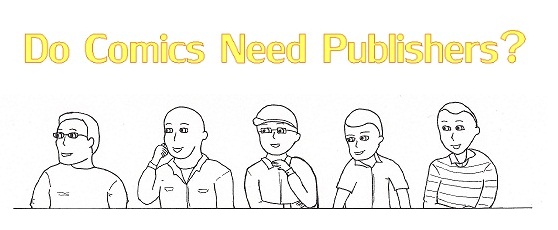
Artwork by Cheridan Smith


It’s a good question; and one that inverts the typical view of the artist dependant entirely on the promotion of the publisher. The panel on the night were well-equipped for this discussion.

From the right, John McShane was the host for the evening from Graphic Scotland, an organisation promoting comics locally. He was joined by Martin Conaghan, writer of the comic Burke and Hare, Gordon Roberts of Geekchocolate.co.uk and Arsecancer.co.uk fame; Gary Erskine, creator of the Roller Grrrls series; and Ernesto Priego, who is involved both in academic study in the field and is a cofounder of Comicsgrid.com. A late but welcome addition to the panel was the appearance of Gill Hatcher, who was pulled from the audience and offered a great insight into the discussion with her self-published Team Girl Comic.

There were quite a few themes present in the discussion. The role of distribution and how methods of reaching an audience have dramatically changed in the past few years – to the advantage of the comic writer and the disadvantage of the publisher. The financial realities of going it alone. The difficulties in having a sustainable career in an area where the expectation is of a free product.  The pride and passion that every project big or small is published with.

The key has always been getting the right product to the right customer; something that the current system struggles to achieve. Bigger publishers appeal to broad markets, and therefore by selling in large bookshops and having promotions on a national scale they can get results. But this is impossible for comics targeted at smaller or even niche markets. For example, one based on a particular city would benefit from being sold mainly in that city, but not in every bookshop in the country.  Reaching the customer has taken on a completely different meaning with the advent of the internet. Crowdfunding sites like Kickstarter allow companies to complete projects that would never have seen the light of day. Communities online allow people with similar interests to come together no matter what their geographical location. Social media allows small and self-publishers to market themselves and reach new customers. This targeted selling means that money previously wasted on generic advertising is instead used to reach those directly interested in the comic.

The difficulty lies in pricing products created and sold online. Consumers have a natural expectation of low prices for digital work because they don’t have a physical product to hold. Publishers have an opposing expectation for higher prices given the longevity of electronic products. But these can be debated. In the closing stages of the discussion, Gary Erksine brought up the loss of his artwork from his computer.  It wasn’t due to a file being misplaced, the computer being hacked or even the artwork being stolen: the technology and files from only seven years ago were obsolete. The digital revolution is gaining momentum by the day, and is dictated by trends and fashions as companies selling technology survive by continually moving to a new product.  But as this happens we move on from previous electronic forms and in many cases lose access to the files that came before them. A consumer-driven society means that, where an old book can be found years later on a shelf, digital technology and software is rapidly replaced. The illusion of digital products lasting eternally hides the reality that data can be lost in a simple click of a button.  The future of publishing depends on finding a balance between printed and electronic materials.

The overall answer to the question of do comics need publishers is yes – even coming from a panel largely working as independent or self-publishers on individual projects. The big publishers are needed by the industry for large scale ventures, for developing a brand and even giving  individuals enough notoriety through their work that personal projects can be pursued. But the smaller and self-publishers are also essential as a force for the life blood of the industry, driven by passion and enthusiasm. Comics are a medium which cannot be produced without this drive.  With the role of the publisher changing and communities with no boundaries, there are increasing gaps that can be filled by those who have a message to say and a desire to say it.


– Claire Jeffery

“Kids Need the Best Books!” – Meeting Keith Gray

December 21st, 2012 by Miriam Knafla | Posted in Blog | Comments Off on “Kids Need the Best Books!” – Meeting Keith Gray
Tags: , , , , , ,

Keith Gray, advocate for the physical book and supporter of school libraries, visited us to give a passionate talk about the boom and development in children’s and young adult’s publishing, the beauty of books, and, well, his admiration for John Green.

From when Keith first started writing to today, a lot has changed in the children’s and young adult’s literature market. Back in 1996, a category for young adult’s fiction did not even exist. Barriers had to be brought down; teen fiction had to be established as its own category. Junk by Melvin Burgess, which, according to Keith, can today be seen as the first YA’s novel, and the big selling Harry Potter series by J.K. Rowling introduced novels to the market that were neither written for children nor adults but for teenagers. Ever since, the young adult’s book market grew; competition got fierce. The positive side of this is that there is a lot of good material out there today which is brilliant as Keith states: “kids need the best books!” A matter that seemed to be close to Keith’s heart in this context is the closure of school libraries. To him as an author for whom school libraries are the biggest bridge to reach his audience and who wants to see children having access to good literature in general, this is an alarming trend. He has joined in on the protest and I think everyone should. Of what worth are the best books if you take away one major platform that enables children to access them?

Another topic that Keith couldn’t avoid talking about is the controversy around the digital book. If we talk about the best books, about which format are we talking? Does the format even matter?

“A book is a solid block of virtual reality – why put buttons on it?”

Read digitally, read enhanced or stick to the traditional pleasure of skipping pages, smelling paper, feeling the texture of a book cover? Which format has more to offer? Which format is more suitable for children? Books become more and more what can be called media packages. “Everything is turned into an app.” Book characters have their own fictional blogs and websites; entire communities are created around them. And even though Keith sees the potential of such promotional activity, he also considers it to be a worrying trend. What will become of simple books? What will become of authors who are reluctant to give away what happens to their characters once the book has finished. Can they keep up with the competition? Will younger and future generations still acknowledge the beauty of the physical book? Keith’s tip is to make a book into an object that you want to own, something you want to show-off on your bookshelf, something you like to identify with. Make every effort to turn a manuscript into a “lovely, brilliant book experience.”

Finally, after a lot of swooning over the physical book, and don’t get me wrong here, his enthusiasm was delightful and entertaining, he started to rave about a certain author. As I am a fan of that author myself, I was quite delighted when he mentioned him and his promotional strategies on today’s competitive and fast evolving YA’s market. The author he was talking about, and this shouldn’t be a surprise as I mentioned him in the introductory lines, is John Green. Green can be seen as a prime example when it comes to reaching his audience. He and his brother Hank built up an online community par excellence over the past years. The two brothers share their everyday life experiences in a weekly Vlog-format and talk about interesting matters that come to their minds, all on YouTube. Their channel VlogBrothers currently has over 807.000 subscribers and more than 261 million views. Their Nerdfighter community not only watches their videos and reads John’s books but they also attend conventions and events that the two participate in. ‘Terrifying’[1] gatekeepers such as parents, grandparents, librarians and teachers are simply bypassed and the target audience directly addressed. This guarantees Green a sturdy fan base and a solid clientele. On a personal note, it is exactly this social media strategy that got me hooked to start reading his books. And after Keith’s talk, I realised that a friendly character can indeed make sales and it wouldn’t surprise me if the next book my classmates bought, would have the name Keith Gray on it. I, at least, already have a copy of one of his books on my bookshelf.

Keith Gray is an author of children’s and young adult’s fiction and has recently worked as an anthologist and collaborated with other authors to write about intriguing topics such as losing one’s virginity (Losing It) and what would/could/should happen in an afterlife (Next). His publications reach from Creepers published in 1996 by Mammoth, about gangs of kids who do garden creeping respectively hedge hopping or, how the police would call it, trespassing, to his latest book Ostrich Boys which won the Angus Book Award and the silver medal in the Smarties Prize and which was also adapted into a play. Keith usually targets his books towards boys (he does have a female readership as well, though) dealing with the overall theme of what it is like to be a young boy.


[1] Yes, they can be terrifying; they can be your alley or your worst enemy. Try to market a novel so that both the adult, (who might be of an overprotective kind) who usually provides the book, and the kid, who is supposed to read it, like it. Your book can be held up at so many stages before it actually reaches the child it was dedicated to.

Forward Thinking – Bookseller article by Centre Staff

December 19th, 2012 by cs48@stir.ac.uk | Posted in Blog | Comments Off on Forward Thinking – Bookseller article by Centre Staff
Tags: , , ,

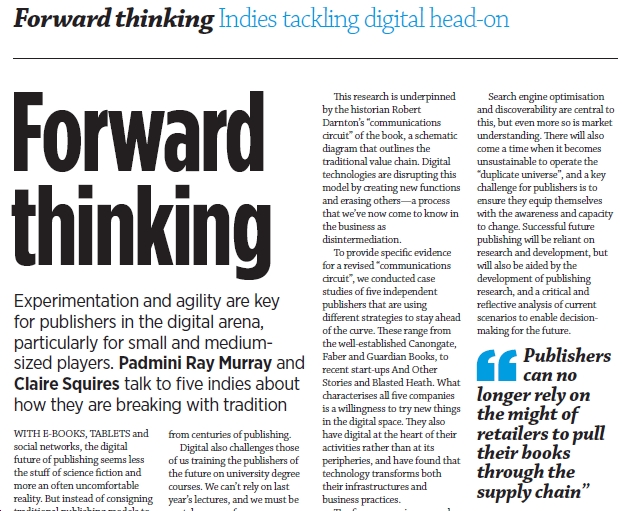
As part of the AHRC Digital Transformations Research and Development project The Book Unbound: Disruption and Disintermediation in the Digital Age, Stirling Centre for International Publishing and Communication staff Professor Claire Squires and Dr Padmini Ray Murray have published this week December 2012, pp.22-25) in the UK publishing trade journal The Bookseller an article based on their research findings, examining how independents are staying ahead in digital publishing. As Squires and Ray Murray begin:

‘With E-Books, tablets and social networks, the digital future of publishing seems less the stuff of science fiction and more an uncomfortable reality. But instead of consigning traditional publishing models to a black hole, Will Atkinson, Faber & Faber’s sales and marketing director, ag many publishers are trying to operate in a “duplicate universe”, retaining traditional print-driven models of publishing alongside newer ones. In the turn to digital, traditional job roles are “creaking”, says Atkinson, and the linear production process is being undermined – but most publishers are yet to arrive at a 360 approach towards commissioning, production, marketing, sales and distribution.’

Focusing on case studies of five independents, the article discusses the quick thinking and agility of publishers in the digital arena. The publishers taking part in the study are And Other Stories, Blasted Heath, Canongate, Faber and Guardian Books.

More on the Book Unbound project is available via the project website.

Saltire Society Book Awards 2012

November 21st, 2012 by cs48@stir.ac.uk | Posted in Blog | Comments Off on Saltire Society Book Awards 2012
Tags: , , ,

Every year, the Saltire Society Book Awards shortlists and winners bring attention to the best of Scottish writing. Novels, short stories, poetry, biography and autobiography, history and other works of non-fiction are all celebrated in the literary prizes, which were first awarded in the 1930s, and on a regular basis since 1982.

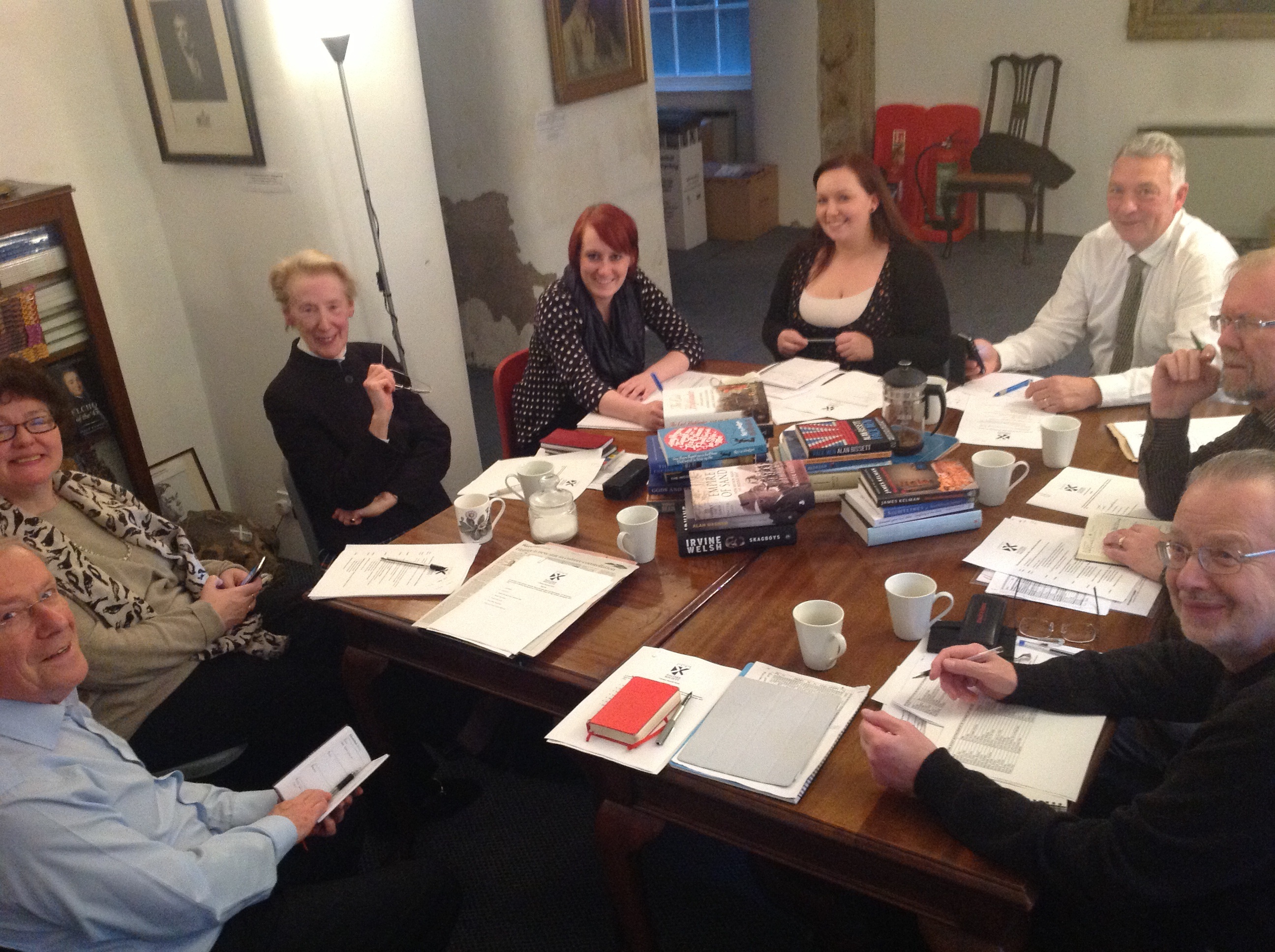
This year’s awards have a particularly strong Stirling connection. Our Director, Professor Claire Squires, has been since 2011 one of the six judges involved in the process of judging the submitted books. This year, she is joined at the Saltire Society by Stevie Marsden, an AHRC Collaborative Doctoral Award PhD student, who will be writing her thesis on the book awards, is involved in the administration of the awards at the Society, and also sits in on judging meetings.

This year also sees the shortlisting on the Saltire Book of the Year Awards of our colleague Kathleen Jamie, Professor of Creative Writing. Her book Sightlines joins books by Carol Ann Duffy, James Kelman, Ewan Morrison, Aonghas MacNeacail, Alan Warner and Irvine Welsh on the shortlist.

We’re also really pleased that two of the six books on the shortlist for the Saltire First Book of the Year are published by new Glasgow-based publishing imprint Freight Books. Freight’s publisher Adrian Searle is on our Industry Advisory Board, and regularly comes to Stirling as a Visiting Speaker on the MLitt in Publishing Studies. Other Scottish publishers with books on the shortlist include Cargo Publishing, Fledgling Press and Polygon. Publishing and writing in Scotland is alive and kicking!

The winners of the Saltire Society Book Awards will be announced in a ceremony at the National Library of Scotland on Friday 30 November, as part of Book Week Scotland.