Blog

James Daunt: Defender of the Bookshop

October 27th, 2011 by Katherine_Marshall | Posted in Blog | Comments Off on James Daunt: Defender of the Bookshop
Tags: , , , , ,

On the 6th October 2011, book retailer Waterstone’s ended its famous 3-for-2 offer, thereby signalling a new direction for the company under Managing Director, James Daunt.  The offer, described by some as “iconic”, will be replaced by a series of price discounts and promotions, designed to increase the flexibility of book buying in its stores.  Daunt has championed the new pricing strategy, proclaiming that it will provide customers with the opportunity to buy the book that they want, rather than focusing on the price.  He wants his shops to be “community hubs”, where people can browse for books in a pleasant environment without being bombarded by blunt and “irritating” offers.

Waterstone’s struggles have been well documented of late, but it remains to be seen whether this latest shift in strategy will herald a change in fortunes for the company.  However, it is not the only thing to change as Daunt steams ahead with his plans to revive the retailer.   The MD, who took up the post in June, is on a mission to transform the bookseller into a company capable of rivalling online giants such as the mighty Amazon.  In addition to ending the 3-for-2 offer, Daunt has indicated the possibility of introducing differential pricing in his stores (a controversial and slightly baffling concept) and Waterstone’s is also due to launch its very own e-reader in 2012.

Daunt’s vision of what a bookshop should be is, in many ways, commendable.  Unfortunately, the reality of the bookselling market today means that the MD’s traditional ideals risk falling on deaf ears as consumers increasingly value price over place of purchase.

Watch this space…

Book Cultures, Book Events Conference

October 23rd, 2011 by cs48@stir.ac.uk | Posted in Blog | Comments Off on Book Cultures, Book Events Conference
Tags: , , ,

Proposals for papers now being accepted. Deadline 6 January 2012.

The Stirling Centre for International Publishing and Communication, in collaboration with Queen Margaret University (Edinburgh), the University of Dundee, and Bookfestival Scotland announces the conference ‘Book Cultures, Book Events’, to be held at the University of Stirling from Friday 23 to Sunday 25 March 2012.

Plenary  speakers include: Dr Danielle Fuller of the University of Birmingham

Call for Papers:

A significant development in the environment of literature and the book at the turn of the 20th and 21st centuries has been the growth of literary festivals and book towns. As part of the literary marketing mix, book festivals and towns offer publishers the opportunity to promote their authors and sell their products. Such locations also provide physical and sociological spaces in which readers encounter writers and literature, and become book consumers. Book festivals and towns have clear links to regional economies, and are heavily used in the promotion of tourist destinations, as testified by the strategic partnerships and sponsorship arrangements with a variety of agencies. As part of this process, concepts of cultural identity are forged and commodified, conjoining literature to cultural heritage, the creative industries and political ideology. In the era of new media and digital delivery, the opportunity to meet authors and fellow readers face-to-face, to buy books and other merchandise, and to align a liking for literature with travel and tourism, is being taken up by hundreds of thousands of readers every year. Literary festivals and towns, while heavily promoted by digital marketing activities, afford physical meeting spaces for authors, books, readers and ideas.

To explore these events and environments, the Book Cultures, Book Events conference will bring together academic and student researchers from different disciplines with practitioners and stakeholders, to their contemporary perspectives and historical precedents. Suggested topics include, but are not limited to:

  • literature as live event
  • analyses of contemporary or historical book events, festivals, conferences and environments (including bookshop spaces)
  • the role of live events in the digital age
  • author/reader interactions at live events
  • literary travel, tourism and heritage
  • literary commerce and merchandising
  • book events and other media/cultural forms
  • partnerships and sponsorship
  • constructions of cultural identity via literature events
  • literature in the context of cultural heritage, the creative industries, and political ideology

Proposals for papers of 20 minutes are invited. Please send as an email attachment abstracts of 300-400 words, plus a biography of 100-150 words, by 6 January 2012, to: book.cultures@stir.ac.uk .

The conference is supported by the Royal Society of Edinburgh, and as such registration costs for the conference will be minimal.

The conference is part of the Royal Society of Edinburgh Research Workshop Book Events: The Transnational Culture, Commerce and Social Impact of Literary Festivals, organised in association with the Stirling Centre for International Publishing and Communication at the University of Stirling, Queen Margaret University, the University of Dundee and Bookfestival Scotland.

For any enquiries, please contact: book.cultures@stir.ac.uk

Adrian Searle and Freight Books

October 23rd, 2011 by Paola_Gonella | Posted in Blog | Comments Off on Adrian Searle and Freight Books
Tags: , , ,

Our visiting speaker on Thursday 13th October was Adrian Searle, director of Freight Design, an award-winning Scottish creative design and brand development agency based in Glasgow city centre. Founded ten years ago, the company quickly established itself as one of Scotland’s leading design and marketing consultancies.

Adrian gave a very interesting talk about the joys and difficulties of setting up his own publishing company. He explained how he got involved in the business through his design company. In 2001, they decided they would do a self-commissioned project every year and their first undertaking, The Hope that Kills Us, combined two of Adrian’s favourite things, Scottish literature and football. The book, sponsored by Arts&Business Scotland and picked by The Guardian as one of the top 10 best football fictions, brings together eight specially commissioned stories from some of Scotland’s best contemporary writers, with each story examining the participants, experience and emotion that feed the nation’s obsession with football.

Following the critical acclaim received for The Hope that Kills Us, the company decided to embark on another self-commissioned project entitled The Knuckle-End, which featured two pocket-sized hardbacks joined by a fabric hinge, the first one dedicated to a selection of short stories and poems by recent graduates from the Creative Writing Master at University of Glasgow as well as award-winning writers, and the second one dedicated to images and photographs on themes inspired by the title.

A couple of other projects of which Adrian seemed particularly proud are Dougie’s War, a graphic novel by acclaimed novelist and biographer Rodge Glass and artist Dave Turbitt about the legacy of the war in the Middle East and the effects of PTSD on returning veterans, and Gutter, an award-winning, high quality, printed journal for fiction and poetry from writers born or living in Scotland. As Adrian told us, the magazine also proved to be a good way for Freight to make friends with a lot of good writers, which then helped them setting up their own publishing company, Freight Books.

Adrian described the company as small, independent and with a specific interest in both middlebrow commercial and literary fiction. They usually publish 4 or 5 books a year, which range from stunning debuts of writers that may have been published already in Gutter to forgotten classics like All the Little Animals, Walker Hamilton’s un-classifiable first novel that will be republished in June 2012. Their first book, published last September, is Killing the Messenger, the second novel from Christopher Wallace, who won the 1988 Saltire First Book of the Year Award for The Pied Piper’s Poison.

Adrian also announced that The Hope that Kills Us, Dougie’s War and Gutter will be available soon in digital form, thanks to a collaboration with Faber Factory, an initiative that Adrian described as ‘absolutely brilliant’, especially for independent publishers that cannot invest in additional resources for text digitisation.

Cocktails with the SYP Scotland

October 16th, 2011 by Victoria_Sugden | Posted in Blog | Comments Off on Cocktails with the SYP Scotland
Tags: , , ,

The Society of Young Publishers is a UK community that is aimed towards those of us with less than ten years of experience. Established in 1949 by a body of volunteers, either already in publishing or an associated trade, SYP endeavours to support and encourage us in our publishing pursuits. The prime opportunity to network, mingle and make yourself known, SYP events are treasured occasions for all young publishers-to-be.

Recently, described as an event for “bookish types” on Facebook, SYP Scotland gathered at the Dragonfly Cocktail Bar in Edinburgh last Thursday (6th October) for a mélange of cocktails and networking. The evening was a great opportunity for young and budding publishers to network with those who have established themselves in a publishing career. I was particularly inspired by Fiona MacLeod‘s infectious passion and enthusiasm  for the trade.

The notion of networking in a relaxed and informal atmosphere with a cocktail in hand certainly, for me, reinforced the retrospective term of “Gentlemanly” publishing, on the drinking and socialising side of things! Ironically, the industry that was once so male orientated is now flooded with women, which was immediately obvious as you stepped into the function room of Dragonfly- the ratio of men to women was undoubtedly disproportionate! Nonetheless, it was a lovely evening had by all, with a very eclectic mix of mouth-watering cocktails and fine spirits catering towards all bon vivants!

Keep an eye on the SYP website for more great up and coming events.

Stories for a Better Nation

October 13th, 2011 by cs48@stir.ac.uk | Posted in Blog | Comments Off on Stories for a Better Nation
Tags: , , ,

The Rt Hon Douglas Alexander MP delivered the Williamson Memorial Lecture at the University of Stirling tonight, speaking to the title ‘A Better Nation? A Personal Reflection on Scotland’s Future’. A central element of his argument was the need for political discourse surrounding Scottish nationhood, and the forthcoming independence debate, to attain a ‘different quality of imagination’.

His words were reminiscent of those spoken by Andrew O’Hagan a couple of weeks earlier, and reported on by MLitt in Publishing Studies student Nuria Ruiz. Books, O’Hagan, argued, make the world more real for us. O’Hagan’s idea, paraphrases Nuria, was ‘that Scottish civic memory actually finds its most forceful expression in the arts – Scottish plays, music, art and books are becoming powerful, punching above their weight in the cultural stakes. In particular, books are playing a bigger role in making the world “more real” for us as Scots.’

Alexander’s speech provided an interesting counterpoint to the O’Hagan’s argument. In a talk peppered with references to Shakespeare, Plato, Burns, William McIlvanney and Alasdair Gray, he made an argument for a politics informed by a pluralistic imagination and underpinned by the principles of common humanity. Democratic politics, he says, have taught him many things, including:

‘that in policy, statistics matter, but in politics, stories matter too. Because stories help shape what is hidden in plain sight all around us – what we judge has meaning, and what we judge doesn’t. And it is through stories that we provoke the feelings of hope that are at the heart of participating in a progressive society – the care, concern, and compassion that has always underpinned the will to act.’

The place of writing – and publishing – in this vision is worth considering further. Nuria ended her blog on Andrew O’Hagan by arguing that Scottish publishing can and should be central, that ‘if Scottish book culture is on the ascendant, then Scottish publishing can become as commanding as the stories it makes and preserves.’ Alexander ended his speech with an appeal to the future: ‘the history of Scotland, written by this generation, can and will be remembered not by the “The End of an Auld Sang” but positively and vibrantly by “The beginning of a New Story”.

The role of writers, artists, musicians, poets – and indeed publishers – should take its place at the heart of this narrative: asking difficult questions, creating new stories, communicating them effectively to a variety of audiences.

The conversation continues…

The full text of Douglas Alexander’s speech is available here.

Liber 2011, International Spanish Book Fair

October 11th, 2011 by Almudena_Santalices | Posted in Blog | Comments Off on Liber 2011, International Spanish Book Fair
Tags: , , , , ,

Last week, Liber, the 29th International Spanish Book Fair took place in Madrid. Three days of exhibition, 443 businesses stands from 21 countries and 12,000 visitors from all over the world validated its status as “the main book business industry platform dedicated to the Spanish language and one of the most important international book gathering”.

An improvement of this year was the introduction of a new section: Liber Digital. Twenty-five specialized firms have participated. Arantxa Mellado, space coordinator, says, “It has been extremely well received by professionals. It has not only met the expectations of the participants, there are, also those who even have confirmed that only on the first day have achieved a return.” Also, David Sanchez, the creator of 24symbols, affirms, “in addition to meeting the expectations, we found that the sector is launching and customers are willing to change”.

A study by the Federation of Spanish Publishers’ Guilds, suggests 75% of Spanish publishers are either selling digital works already, digitising existing content or creating exclusively digital material. It found that by 2012, a quarter of Spain’s 900-plus publishers expect to sell digital versions of more than half their backlist and a third will distribute a higher number of new titles as e-books, principally for tablets and mobile telephones rather than e-readers.

Amazon Spain, launched last month, is one of the first attempts of the shift that is taking place in the publishing industry. The webpage offers books in Spanish, Catalan, Galician and Basque languages. Moreover, we should not forget about Libranda, “a company whose mission is to provide logistic, technical, commercial and, administrative services to publishers, bookshops, enabling them to efficiently manage the digital environment in which they are immersed”.

Even though the digital revolution is starting, it is really slow in the high street. Robert Strokes considers that “sales of e-readers are concentrated mainly in larger stores. In general, the smaller the store the less likely it was to sell either”.

Andres Has thinks that “no matter how many startups there have been and how much potential there is in the market, there is much to be done: not only are there a limited e-books available, those that wish to read them still have very few options for devices on which they can be read”. What Has believes is true,but the Spanish publishing industry is aware of the importance of the change and is on track to become a massive phenomenon.

By Almu Santalices

Image: actualidadeditorial.com

References: Ifema, Publishing Perspectives, The Independent, The Bookseller (2).

The Road to Becoming An Agent, and Where It Is Heading

October 8th, 2011 by Kate_McNamara | Posted in Blog | Comments Off on The Road to Becoming An Agent, and Where It Is Heading
Tags: , ,

Literary Agent and consultant Maggie McKernan of The McKernan Agency ended up in her position in an interesting fashion. After studying Philosophy and Logic, she got on a train and ended up in Paris. She took it into her head to become a writer, and spent three very hungry weeks with no fixed accommodation before she stumbled into the Shakespeare and Company bookshop, where the owner offered her a bed on in the library above the shop in exchange for work. McKernan took him up on this offer, and spent her days working at the till, reading, and serving a few customers. At night she slept upstairs among rats with writers who boarded there. McKernan watched them come and go, and  slowly began to realize that she did not actually want to write, but work with writers.

The turning point came when a young Sebastian Barry wandered into the store. Speaking to him, she discovered that what she really wanted to do was publish people like him. Determined now to work in publishing, she wrote to sixty publishing houses in London and got a job, which she partly puts down to her looking up the name of a managing director and addressing her letter to him personally. She began working in design and production, as this was the only way in. She never believed that she could work in editing like she wanted, but her views on editors were soon to change.

“None of them were quite as clever as they first seemed, and you could become an editor,” she told us. She worked for a while, then moved houses, set up a literary fiction imprint, and worked more and more with writers, which she loved. Her particular approach was to keep the writers’ interests to the forefront of what she did. “My strength as an editor…”, McKernan said, “was what they call in publishing Author Management.” This entailed working closely with the authors, managing their expectations and helping them to achieve what they wanted to achieve.

Four years ago, she changed tack and became a literary agent as she wanted to be her own boss, as commuting to London was no longer an option for her. This was a good move for her personally, and everything was going quite well. And then along came the recession.

McKernan was undeterred. She began to take on a client list, and now has between twenty and twenty-five writers, which she hopes in time will become fifty.

McKernan doesn’t seem overly spooked by the technological advances in publishing and what these will mean for the literary agent: ““As long as writers are still enabled to write I will be happy, and I may have to do something else, I may have to make my living some other way.”Her attitude to e-books is refreshing: “All that really matters is that people keep writing books and that we keep being able to find books.”  Naturally, McKernan clearly sees the need for the literary agent – they are a way of filtering out unpublishable material so that publishers do not have to employ a whole division solely to read new manuscripts. Surprisingly for a literary agent, she is fully supportive of the idea of self-publishing: ““If you do it yourself, you get all the money…the writer sees the possibility of getting all the money, and why should they not?” However, she does mention that self-publishing authors may want to consider hiring someone to do P.R for them. Unlike some agents, she gives no indication of wanting to be both publisher and agent to her authors, but she does insist that ebooks are an area she would love to work with if she was just starting out.

In spite of this attitude, McKernan realises the publishing industry is changing drastically for everyone:“Challenges and opportunities are almost the same thing…technology has frightened everyone, and agents in particular….Will people still print books? Will they still buy books?” All those in the industry must watch and wait as technology and e-publishing develop further before these questions may be answered with any certainty. Whatever happens, it seems McKernan will take it in her stride and continue to put the author first.

By Kate McNamara

The 2011 Guardian and Observer Books Power 100

October 6th, 2011 by Helen_Lewis-Mcphee | Posted in Blog | Comments Off on The 2011 Guardian and Observer Books Power 100
Tags: , , , ,

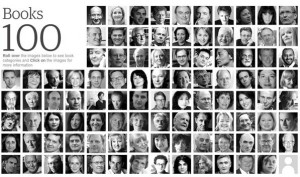
Guardian and Observer Books Power 100 2011

When the Guardian and Observer first drew up their list of the publishing Top 50 in 2006, Richard and Judy Book Club creator Amanda Ross hit the top slot. The R&J format, based on Oprah Winfrey’s book club in the US, revolutionised the publishing industry, with their impact well documented across the publishing world. At the time, a title’s success often hung on the recommendation of these two TV celebrities, who spawned such stars as The Lovely Bones, My Sister’s Keeper, and The Cloud Atlas.

All change for the 2011 Power 100 list. Over the last five years, the digital revolution has totally changed the publishing landscape. Jeff Bezos, founder and CEO of Amazon, has the dubious honour of being named number one, with Larry Page (Google CEO) and Tim Cook (Apple) also occupying prestigious ranks (3 and 10). JK Rowling is straight in at number two, with the launch of her new Pottermore website due for early 2012. More than a fansite, Pottermore aims to deliver interactive reader experiences, and has, indeed, been shaped and re-designed based on the feedback of Beta users. What really strikes me about this is the way that Rowling has capitalised on the seemingly insatiable appetite of Potter fans worldwide for MORE. More content, more experience, and more involvement in the Potter world.

Which leads me to Number 100. A new entry. One of the most powerful players in the publishing industry to emerge in the last few years. You. No longer is the power monopolised by commissioning editors or even TV personalities. Through Facebook, Twitter, blogs, and online forums, it’s the readers who are deciding what’s worth reading, and, even more alarmingly, sharing their opinions with their friends, fans, and followers in a way that’s impossible to control or even predict. Book reviews are no longer confined to the opinions of so-called (and questionably-incentivised) experts, tucked away in specialist columns or publications. We trust the judgement of our peers, not what some retailer tells us we want, and can choose from a seemingly infinite  selection of titles: frontlisters, backlisters, big hitters and hidden gems. We’re no longer satisfied with the one-size-fits-the-target-market method of publishing: we want an individual, tailor-made reading experience. And we want to talk about it. We’ll blog, tweet, rant on forums and tell the world through status updates. We’ll always have something to say.

And we’re not just talking about books. At time of writing the List has 144 associated tweets, 212 Facebook recommendations, and a comment stream that reads like an angry battle-of-the-bibliophiles. It doesn’t matter how much time, research, and discussion went into its compilation, every reader has an opinion, and an avenue through which to voice it. We won’t be told what to read/buy/think, and we’re not afraid to show it.

We’re the children of the digital revolution. And you won’t fool us.

The Changing Face of UK Printing

October 5th, 2011 by cs48@stir.ac.uk | Posted in Blog | Comments Off on The Changing Face of UK Printing
Tags: , ,

Getting ready to fold...

Martin the Printers is a family run business whose history starts in 1892 and has been dedicated to book publishing since the 1950’s.  They deal with many publishers both large and small, and deal on a global basis.  David Martin gave an enthusiastic talk about the changing nature of UK printing, ranging from the economics of the Euro to environmental awareness.

Since January, the staff at Martins’ have been collectively working for 24 hours a day, 6 days a week.  The demise of the euro has made it cheaper for publishers to use UK based printers.  Costs in the Far East have risen by 50% over the last 18 months, particularly in China and India where a lot of publishers placed their work. Another advantage the UK printing market has over foreign competition is time.  It can take 12 weeks for a book to be printed and shipped back to the UK from overseas.  At Martin the Printers they are now able to complete a print run in 5 days, quite handy when a book is flying off the shelves and more are needed quickly.  This turnaround was really impressive especially when they used to be given 7-8 weeks to print a book.  This means that the UK can now be more competitive and a lot more work is being placed here.

At Martins they have an impressive approach to their Environmental Policy.  By weight they recycle 98% of their waste and reuse products where they can.  They are FSC accredited (Forestry Stewardship Council) and all paper used is approved by them.

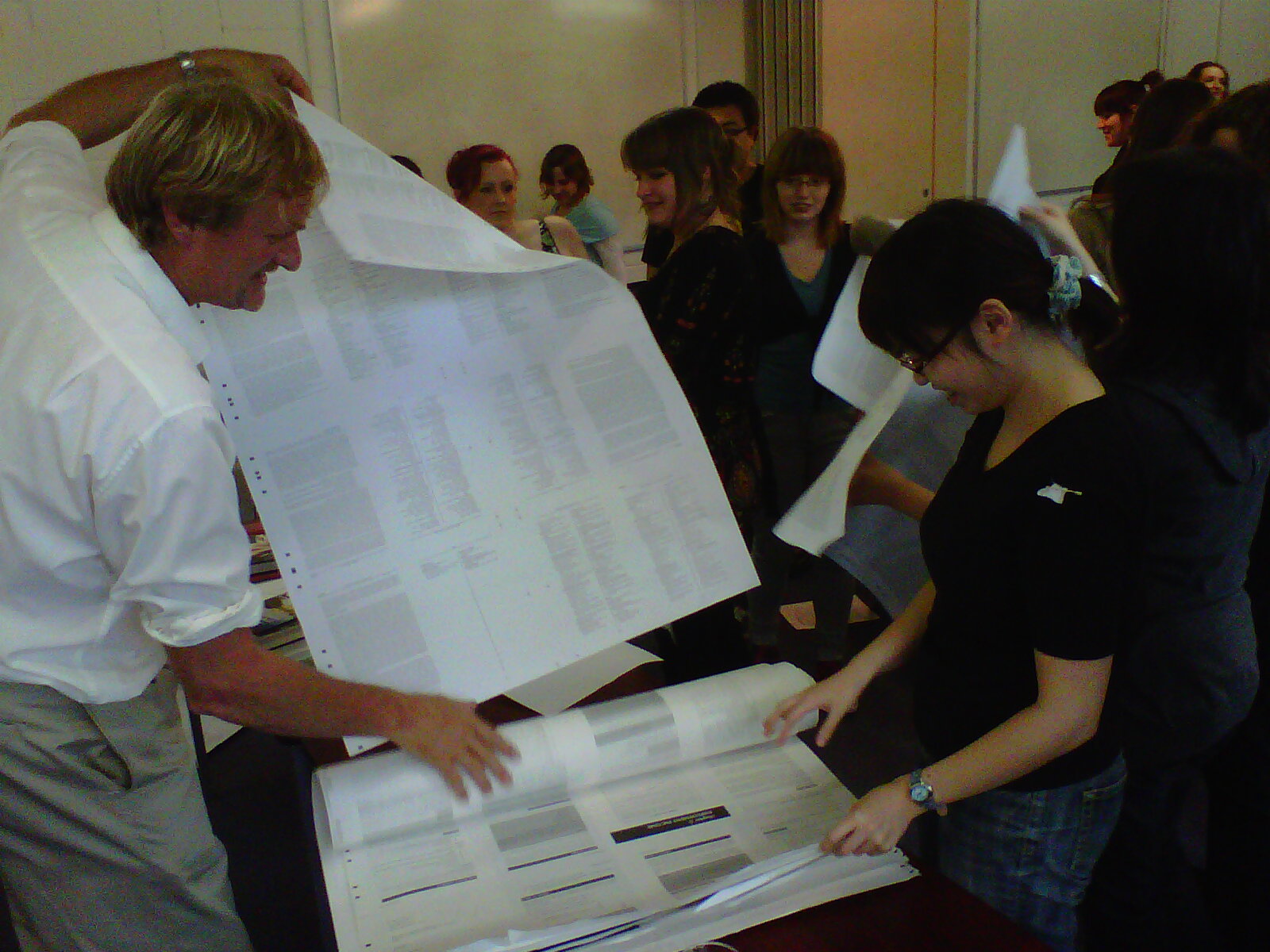
Near the end of the talk we were set into groups and given a huge sheet of paper with pages from a book printed on it.  This when folded, becomes one section of a book.  Our task was to fold this paper so the pages were in a consecutive order.  After many false attempts David took pity on us and instructed us how to do it.  Once all sections of a book are together, then the book can be bound.  The spine is glued and then sent to a trimmer to be shingled into neat edges.  At Martins they do four styles of book binding.

I don’t think any of us were quite expecting how interesting paper could be.  This is in no doubt due to David’s own infectious enthusiasm for the topic.  For example when a paperback turns yellow in the sun, it’s because of the poor quality of pulp in the paper.

David left us with a great bit of advice, “Enjoy What You Do,” which he clearly does.

By Aileen-Elizabeth Taylor

Not Just Surviving but Thriving

October 5th, 2011 by lp28@stir.ac.uk | Posted in Blog | Comments Off on Not Just Surviving but Thriving

Martins the Printers, historical image.

It’s good to know that the remaining printing companies in the UK are not just surviving but thriving in the current landscape of the publishing industry. Our visiting speaker on Thursday 29th October was David Martin of Martins the Printers, who kindly enlightened the MLitt Publishing Studies students, on the print and production aspect of book publishing in the UK and within Martins the Printers company.

Martins the Printers has been doing business since 1892[1]. The business has undergone plenty of change in this time and finds itself operating in a shifting and developing industry with the current advancement in technologies around the e-book, and the new developments of digital printing machinery.

The principles of printing seem to remain unchanged. Martins the Printers operates Litho printing machinery and digital printing. The choice depends on the size of the print run, the size and format of the book, any special binding requirements and paper stock. These factors are weighed up and agreed upon at the end of the day against the bottom line of how much is it going to cost. The result is a constant battle between the design ideal and production costs. Importantly too for the environment the company is fully accredited with the International Environmental Management Standard, and fully recycles 98% of its waste. [2]

David Martin explains how the current global economic circumstances have had an unexpected effect on business for Martins the Printers. As the doom and gloom spreads around the globe of the crashing financial markets, bad news for most of us, Martins the Printers is busier than ever working 24 hours a day 6 days a week. This is due in part to the current struggles of the euro. A UK publisher who would normally have their print run order placed in Italy or Spain are now finding it cheaper to order with a printer like Martins the Printers in the UK. As for competing with printers in Asia and Europe, Martins the Printers competes on the basis of time, rather than cost, where they can turn a job around in roughly five days from receiving the file or disc.  When you compare this to one to two weeks print turnaround plus delivery time for Europe and twelve weeks turn around time for the Far East, it’s not hard to see why Martins the Printers is doing so well. Most of the orders Martins the Printers receive are for newly published books, where the aim of the game is to get the finished printed copies out on the shelves as soon as possible. David Martin has found that for reprints in general, where there is time available, the publisher will go to a company in the Far East.  However in some cases for example, where there is a dramatic underestimate in the original print run, and the publisher needs a reprint made quickly the publisher will turn to a UK company like Martins the Printers.

There is understandably a hint of anxiousness detectable about the impact of the e-book on the printing business. However there is plenty of optimism coming from David Martin about the current state of their business and the outlook for the future. As the class attempts to get to grips with folding large sheets of printed pages in the correct order to form a traditional book section, I can’t help but think how important the presence and object-hood of the book can be to the reader of any age, and that there must, hopefully, always be printed books.

Louisa Preston.

Image credits:

Historical image: http://www.martins-the-printers.co.uk/Images/Martins_old.jpg

Page folding, David Martin and students: Louisa Preston.


[1] http://www.martins-the-printers.co.uk/

[2] http://www.martins-the-printers.co.uk/